Fuse Protected Charging Cable – 2-Pin Magnetic ODM
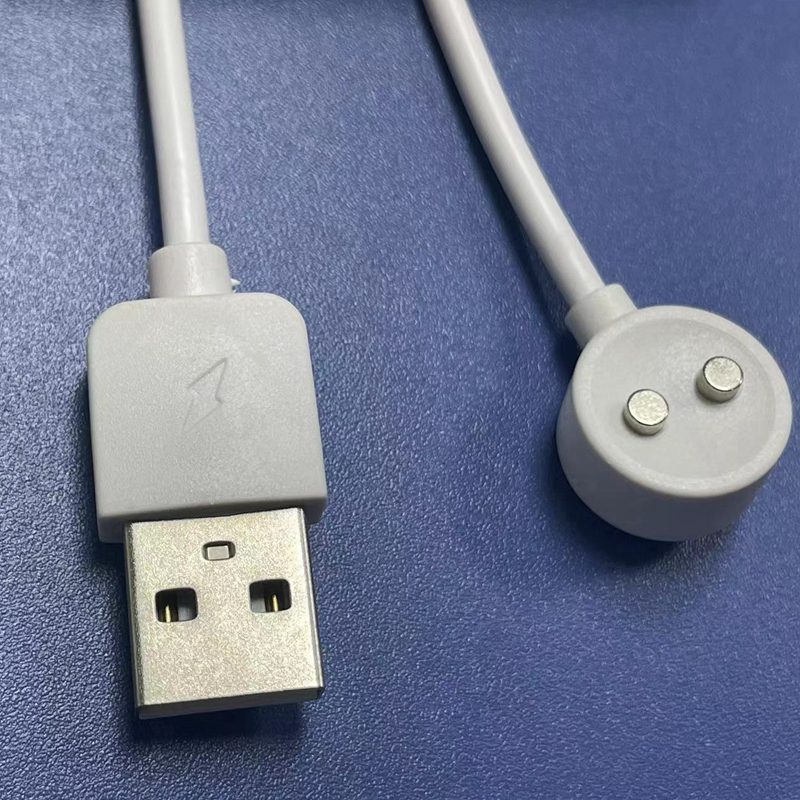
A fuse protected charging cable for volume ODM programs: 2-pin magnetic pogo head, 1 m lead, and overcurrent protection embedded inside the USB-A male plug housing. Indicative pricing from about US$0.40 per unit at 10,000 pieces, FOB, confirm per RFQ.
Overview
A fuse protected charging cable is a low-voltage charging lead with overcurrent protection built into the assembly itself rather than left entirely to the device. Our version is a 1 m USB-A to two-pin magnetic pogo lead for volume ODM programs, with the fuse embedded inside the overmolded USB-A male plug. It is designed for rechargeable handheld devices that are charged every day, held against the body and cleaned between uses, where a sealed housing leaves no room for an open charging port. As an indicative figure, a 1 m fuse protected charging cable in a 10,000 piece run is quoted at about US$0.40 per unit FOB, confirm per RFQ. This page explains where the protection sits, what it does, what we need from you to specify it, and how the unit cost is built.
What a Fuse Protected Charging Cable Does
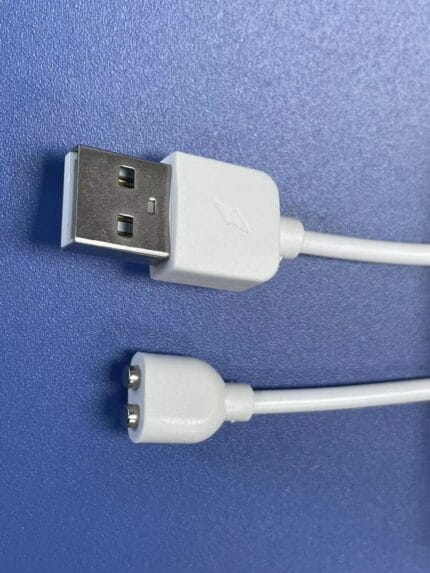
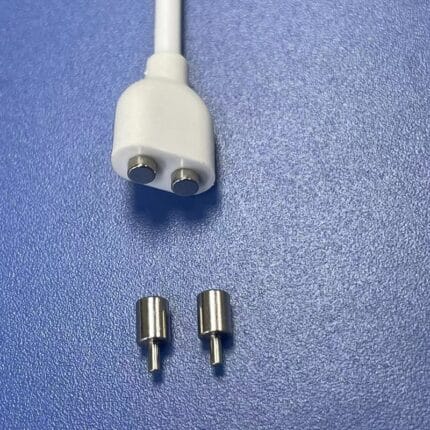
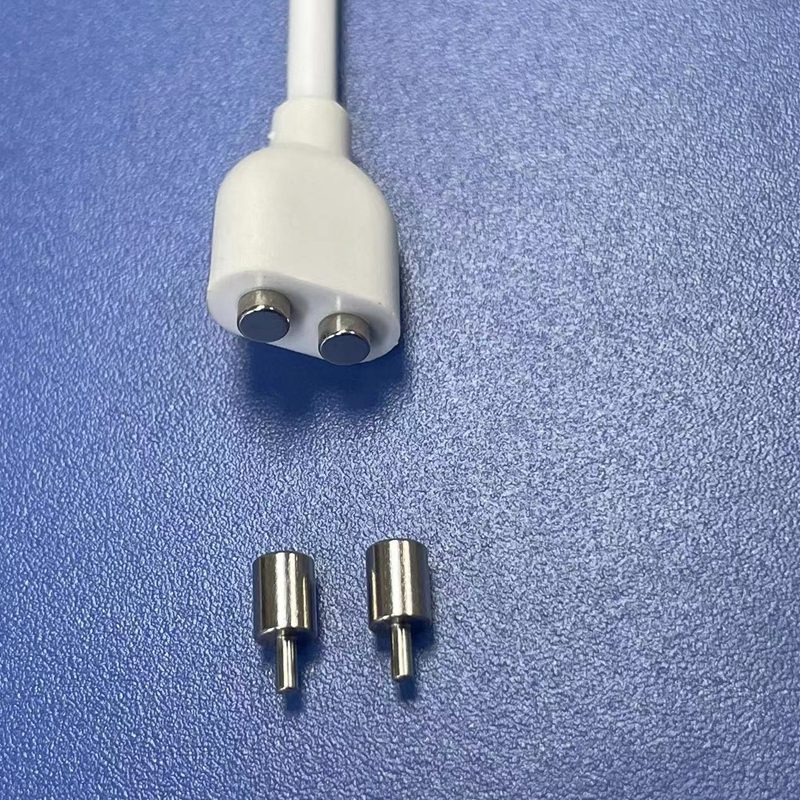
Two small permanent magnets in the head pull it onto matching steel pads on the device, while two spring-loaded pogo pins between them carry the charging current. Because the connection is magnetic rather than mechanical, a tug on the cable pulls the head away instead of levering against a sealed housing. That is the main reason designers choose this interface for compact water-resistant products. The USB end follows the connector and cable specifications published by the USB Implementers Forum. What distinguishes a fuse protected charging cable from a plain magnetic lead is the extra protection in the power path: if a fault pushes current above the agreed limit, the fuse opens the circuit before the cable, the connector or the device is damaged. The protection sits in the plug, not in the device, so it travels with the charger the customer actually uses.
Where the Fuse Is Embedded
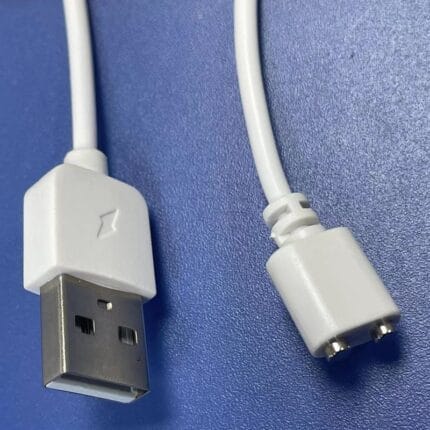
The fuse is built into the overmolded USB-A male plug housing. From the outside the plug looks like a standard USB-A connector: there is no inline fuse holder, no cylindrical bulge on the cable and no separate box to clip onto the lead. This is deliberate. An external fuse holder adds length, creates a snag point, complicates the strain relief and gives moisture another joint to enter. Putting the protection inside the plug keeps the cable profile clean, keeps the magnetic head small enough for a compact device, and keeps the whole assembly to two molded ends. Because the component is hidden, it cannot be verified by looking at a photograph — it is specified on the drawing, checked electrically on the production line and recorded in the lot documentation. The fuse is a built-in part of this series. Its rating, breaking characteristics and any related approvals are set per project on the approved drawing and are confirm per build; we do not publish a generic rating that would be wrong for half the programs we quote.
Why Overcurrent Protection Matters for Rechargeable Personal Devices
Chargers for rechargeable personal care and wellness devices live a harder life than a cable that stays plugged into a wall. They are pulled off a bedside table, coiled into a drawer, wiped down, carried in a bag and occasionally dropped onto a metal surface while live. A magnetic head that lands on keys, a coin or a metal table edge can bridge its two contacts. A worn strain relief or a crushed section of jacket can do the same internally. Devices in this category are usually sealed, so the user cannot see a damaged port, and they are often charged unattended overnight. A fuse in the supply lead is a final, independent safeguard: it does not replace the battery management inside the device, but it does limit the energy a fault in the cable can deliver. It is a small component with a large effect on the field failure rate, which is why we treat it as standard on this series rather than as an optional extra.
Fuse Protected Charging Cable Specifications
The table below is the reference configuration behind the indicative price. Every electrical value that is not fixed here is set on the approved drawing, because a charger for one device is not automatically right for another. A different head geometry, length or jacket is quoted rather than treated as out of scope.
| Item | Indicative figure |
|---|---|
| Connector | 2 pin magnetic pogo head, built to sample |
| Overcurrent protection | Fuse embedded in the USB-A male plug housing (standard on this series) |
| Fuse rating | Set per project on the drawing — confirm per build |
| USB end | USB-A male; USB-C quoted separately |
| Cable length | 1 m reference; 0.2–5 m available |
| Conductor | Stranded copper, gauge set from charge current and length |
| Magnetic retention | 200–400 g reference, measured on sample — confirm per build |
| Jacket | PVC or TPE, color matched; low-smoke or halogen-free on request |
| Compliance | CA Prop 65, RoHS or REACH documentation per project — confirm per build |
| Packaging | Bulk PE bag; retail box on request |
| Indicative price | about US$0.40 / unit at 10,000 pcs, FOB, confirm per RFQ |
Two-Pin Magnetic Head and Interface Options
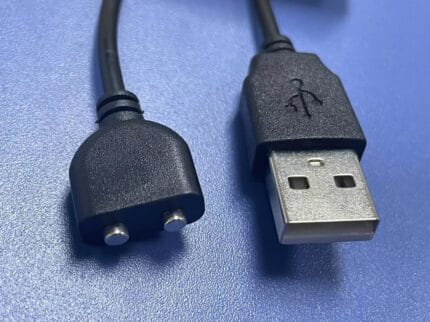
The head is the part that has to match the device. Two-pin versions carry power only, with the pin assignment fixed in writing so reverse polarity cannot damage the product. We build the head from the device contact drawing, a physical sample of the existing charger, or a caliper measurement of the current part. From any of those we measure pitch, pin diameter, magnet polarity and the housing outline, then produce a mating head that seats without wobble. Head shapes we have tooled for this series include round puck, teardrop, triangular fan, heart or kidney profile, and a puck that sits in a holder base. Magnetic retention on the reference series is 200 to 400 g, measured on the sample and confirm per build. Sending the sample is always the fastest route: two heads can share a pin pitch and still fail to seat because the magnet positions differ.
Materials and California Proposition 65 Compliance
Devices in this category are held against the skin and cleaned with wipes or water, so jacket and overmold compounds matter as much as the electrical design. Standard builds use stranded copper conductors in a PVC or TPE jacket with a smooth molded strain relief at each end; low-smoke, halogen-free and softer-touch compounds are quoted as alternatives. Material compliance documentation for this series, including California Proposition 65 testing for lead and phthalates, is available on request. We do not claim that a certificate covers a build that has not been tested: coverage, test limits and any market-specific marking are assembled per project and confirmed in writing before production. Ask for the documentation early in the RFQ so it can be matched to the exact compound, color and head geometry of your order.
Indicative Volume Pricing
For the reference 1 m build above, the indicative unit price at 10,000 pieces is about US$0.40 FOB. That is a planning figure, not a standing offer. The fuse is included in the reference build; a different fuse rating, a resettable type or an additional protection IC is quoted as a separate line because each changes the bill of materials and the plug overmold. Tooling that already exists is reused where the head geometry matches, while a new head geometry carries a quoted tooling charge stated up front. Smaller quantities sit on a different tier because setup, not material, dominates the cost. We publish the reference point so a buyer can decide early whether a program is worth quoting. All prices on this page are indicative, quoted FOB, and must be confirmed per RFQ. Unit price varies with connector, length, jacket, packaging, tooling and the compliance documentation required for the destination market. Fuse ratings and test limits are specified on the drawing and confirmed in writing before production.
Market Price Context
To make the reference point useful, here is the context we observed in a survey of publicly listed prices in October 2026. Retail listings for single magnetic charging cables ran roughly US$2.20 to US$5.00 each. Business-to-business supplier listings sat much lower, roughly US$0.45 to US$3.00 per cable at minimum order quantities between 1,000 and 5,000 pieces, with the lowest tier around US$0.45 at 5,000 pieces. Our indicative US$0.40 at 10,000 pieces sits below those published tiers, which is the point of a committed volume program rather than a catalog purchase. These are observed public listings at a point in time, not offers, and they move with specification, packaging and market conditions; treat them as context only. None of them are price-matched to a fused build, so the comparison is directional rather than exact.
Construction and Electrical Build
A typical assembly uses stranded copper conductors sized from the agreed charge current and cable length, a PVC or TPE jacket, a molded strain relief at both ends and an overmolded head holding two magnets and the pogo-pin array. The USB-A plug overmold also carries the fuse, so the plug is slightly denser than a plain connector but keeps the same external dimensions. Jacket color is matched to the device or the retail box, and the head can be keyed so it only seats in one orientation. We do not publish a generic current rating for the reference build, because the conductor gauge, fuse rating and pin plating are all set together on the drawing from the device requirement. What we do publish is the test plan: continuity, correct polarity, fuse path integrity and short-circuit behavior on every unit.
Customization, MOQ and Lead Time
Volume work starts with the device sample or contact drawing. From there we can vary cable length from 0.2 m to 5 m, jacket color and compound, USB plug style, head geometry, magnet strength, pin plating, printed logos and packaging artwork. Our mold-making capability covers new head geometries when existing tooling does not fit, with 3,000+ tooling sets built since 2012 and 100+ active molds. Prototype runs of 1 to 50 pieces let the sample be approved before the volume order; production runs then follow the approved first article. Volume pricing typically starts at 10,000 pieces, though the threshold moves with the connector and tooling. Lead time depends on whether tooling exists and on the compliance documentation needed for the destination market, so it is stated in the RFQ response rather than published as a fixed number. All prices on this page are indicative, quoted FOB, and must be confirmed per RFQ. Unit price varies with connector, length, jacket, packaging, tooling and the compliance documentation required for the destination market. Fuse ratings and test limits are specified on the drawing and confirmed in writing before production.
Quality Control and Testing
Every assembly is checked for continuity, correct pin assignment and an intact fuse path before packing, and the magnetic head is mated against a reference fixture to verify seating and pin travel. Lot records can include insulation resistance, hi-pot results, strain-relief pull-test data and a first-article inspection report when specified. For a fused build we recommend a dedicated check that the fuse is present and conducting, since a missing fuse can pass an ordinary two-wire continuity test on the charge pair. Test methods, fuse rating verification and acceptance limits are agreed in writing before production, so the report matches the drawing rather than a generic checklist. The fuse is a safety component and is treated as a controlled item in the bill of materials, not as a field-replaceable part.
Frequently Asked Questions
Is the fuse visible on the cable? No. It is embedded inside the overmolded USB-A male plug housing, so the connector looks like a standard USB-A plug. There is no inline holder or bulge on the cable.
What is the fuse rating? It is set per project on the approved drawing and confirm per build. We do not publish a generic rating, because it depends on the device charge current and the conductor gauge.
Is the US$0.40 price fixed? No. It is an indicative FOB figure for a 1 m reference build at 10,000 pieces, and every price is confirm per RFQ. Connector, length, packaging, fuse specification and tooling change the final number.
Can you match an existing charger? Yes. Send the charger or the device and we measure pitch, pin count, magnet polarity and head outline before quoting a matched head.
Do you supply compliance documents? Material compliance documentation, including California Proposition 65 testing for lead and phthalates, is available on request; coverage is confirmed per build in writing before production.
Related Cable Ranges
This product sits in our Low-Cost Cable Assemblies line for volume ODM programs. For engineering-led power leads see DC Plug Power Cables; for multi-branch builds to a drawing see Custom Wire Harnesses. Also compare the personal device charging cable and the custom magnetic charging cable programs. Specifications are easier to quote from a drawing, so the RFQ preparation guide is a useful starting point. Send your sample through the RFQ form for a written quote.
| Connector | 2 pin magnetic pogo head, Built to device sample |
|---|---|
| Overcurrent Protection | Fuse embedded in USB-A male plug housing |
| Fuse Rating | Set per project on drawing – confirm per build |
| USB End | USB-A male, USB-C quoted separately |
| Cable Length | 1 m reference, 0.2-5 m available |
| Magnetic Retention | 200-400 g reference – confirm per build |
| Jacket | PVC, TPE, Low-smoke or halogen-free on request |
| Compliance | CA Prop 65, RoHS, REACH – confirm per build |
| Packaging | Bulk PE bag, Retail box on request |
| Indicative Price | about US$0.40 / unit at 10,000 pcs, FOB, confirm per RFQ |