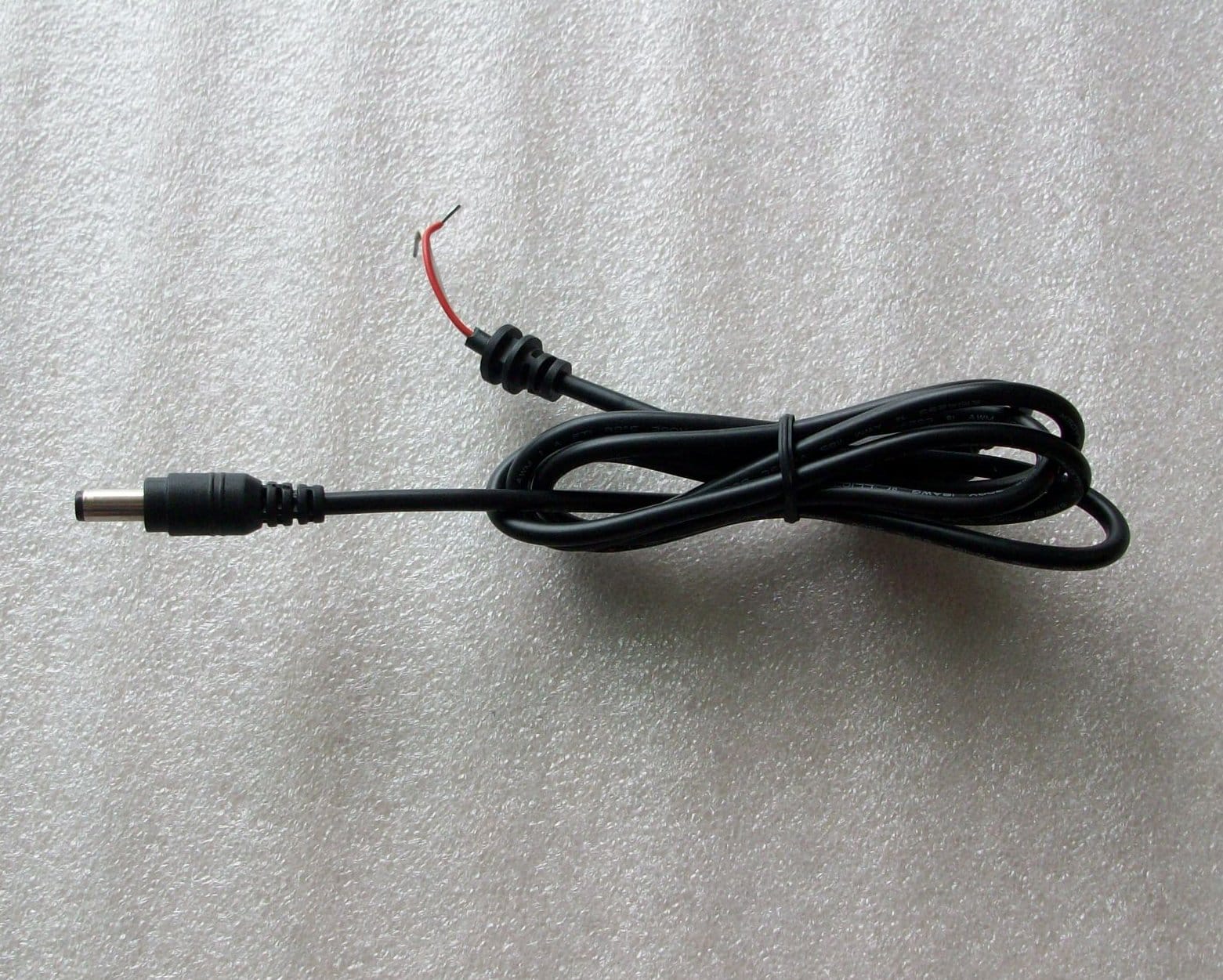
DC 5525 Male to Bare Wire Power Cable
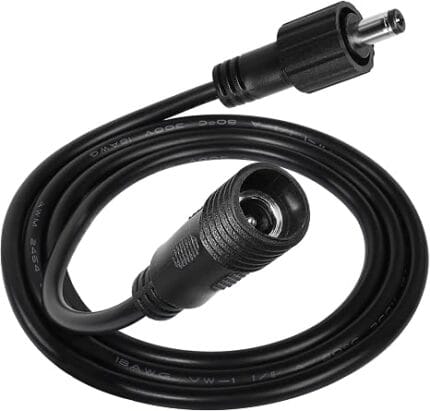
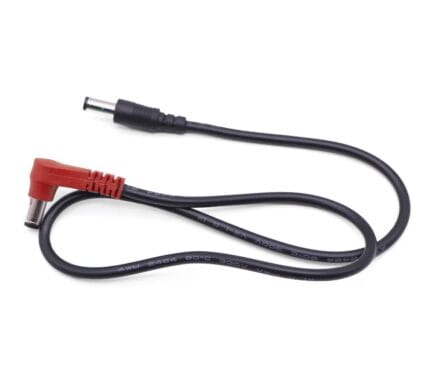
This 5525 bare wire cable puts a molded DC 5.5 x 2.5 mm male plug on one end and an exposed red-and-black tinned pigtail on the other, for custom DC wiring.
Solder or crimp the leads onto a terminal block or PCB.
Overview
A 5525 bare wire cable has a molded DC 5.5 x 2.5 mm male plug on one end and an exposed red-and-black tinned pigtail on the other. It is the part you reach for when the far end has to land on something that is not a barrel – a terminal block, a screw connector, a PCB or a crimp – and when you would rather not cut the plug off a finished supply lead to get there.
Key Specifications
| Connector A | DC 5.5 x 2.5 mm male plug |
|---|---|
| Connector B | Bare wire pigtail (red +, black -) |
| Polarity | Center positive (standard) |
| Jacket | Black PVC |
| Conductor | Stranded copper; gage stated per your drawing |
| Strip length | Stated per your drawing |
| Tin length | Stated per your drawing |
| Cable length | Custom |
| Application | Custom DC wiring, OEM integration, prototyping |
Specify the pigtail end properly
The plug end is standard. The open end is where builds go wrong, because three small dimensions decide whether it assembles cleanly at your end of the line.
| Dimension | Why it matters | How to state it |
|---|---|---|
| Strip length | Too short and the insulation enters the terminal; too long and bare copper is exposed outside it | Millimeters of jacket removed |
| Tin length | A tinned section will not seat in a spring-cage terminal | Millimeters tinned, or ‘no tin’ |
| Conductor gage | Sets both the current capacity and whether the wire fits the terminal | AWG or mm2 |
| End preparation | Ferrule, boot or twisted-and-tinned each suit a different terminal | Name the terminal type |
| Polarity marking | Red and black are a convention, not a guarantee | State which conductor is center positive |
If the pigtail is landing in a spring-cage connector, say so: those terminals grip bare strands and a tinned end will creep out of them over time. If it is landing under a screw, tinned is better because the strands do not splay.
Polarity: read the symbol, not the plug
This build is center positive, which is the convention on the great majority of DC gear. The device tells you what it wants with a small symbol near the jack – a circle with a dot in the middle and plus and minus signs arranged around it. If the plus sits at the center, center positive; if the plus sits at the ring, center negative.
- Read the symbol on the device before you wire anything.
- Where there is no symbol, check with a meter before connecting – not after.
- Reverse polarity is available on request. Say so on the order, and we will also confirm which conductor color carries positive.
- Red for positive and black for return is our default. If your harness uses a different convention, tell us and we will match it.
The current budget, and where the heat goes
A pigtail has no rating of its own; the assembly is limited by the smallest of three things – the plug contact, the conductor, and whatever you terminate into. Work it through before you pick a gage:
- Read the load current at the device, including startup peaks.
- Size the conductor for the length of the run, remembering the return path is in the same cable.
- Check the terminal or connector you are landing on – it is often the real limit.
- Confirm the joint is not enclosed, or derate it, because a soldered or crimped joint inside a sealed box runs hotter than one in open air.
Where the existing documentation does not state a current figure, the value is stated per your drawing. We do not assign ratings to a build we have not seen the load for.
Soldered, crimped or screwed
Each termination has a failure mode, and the right one depends on where the assembly lives. Soldered joints are compact and low resistance but are stiff, and the wick point where the solder stops is where flexing breaks the strands. Crimped terminations survive vibration better and are more repeatable in production, but need the right die for the terminal. Screw terminals need no tooling and are easy to rework, but they loosen under thermal cycling and should be re-torqued. Tell us which you are using and we will prepare the end for it.
Typical applications for this 5525 bare wire cable
- OEM equipment integration, where the supply lands on an internal terminal block
- Prototype benches and test fixtures
- Custom LED drivers and lighting control cabinets
- Replacing a cut supply lead with a properly molded plug
- Anywhere a fixed DC lead has to land on a screw terminal or PCB instead of a socket
How to specify your build
- Barrel size – 5.5 x 2.5 mm here; confirm against the device.
- Polarity – center positive unless stated otherwise.
- Conductor gage and cable length.
- Strip length and tin length, and whether you need a ferrule.
- Terminal type at your end, so the end is prepared for it.
- Jacket color and any print.
- Quantity.
Workmanship and testing
For DC 5525 Male builds the line runs to IPC/WHMA-A-620 Class 3 under ISO 9001, terminating 32 to 12 AWG. continuity and pinout are tested on each DC unit before it is packed, and seal checking is quoted whenever an ingress rating is on the drawing.
RoHS and REACH declarations are provided per project together with the agreed test reports; the documentation scope is listed under certifications and compliance. If your drawing specifies a UL style, we build to that drawing and supply the UL reference with the shipment instead of substituting an equivalent. The molded body is shot on our own presses; material choice and bond behavior follow the process described under how we run the overmold press. The wider context is covered under what outdoor duty does to a jacket. Any tooling we cut for this part stays yours, maintained in our own tool room under your part reference.
Custom builds and ordering
DC 5525 Male prototype lots start from 1 to 50 pcs and ship in 3 working days; production requires 500 pcs and runs 14 working days after sample approval. Your part number and labeling go on OEM and ODM DC shipments, and material certificates plus first-article reports are available. We hold 100 sets of mold tooling in house, so a standard body needs no tooling time and a new one adds about 10 working days.
Related DC pigtails and adapters
- 14 AWG DC Barrel Pigtail Cable to Bare Wire
- Threaded Locking DC Pigtail 5.5×2.1mm
- Reverse Polarity DC 5521 Power Cable
- DC Barrel Adapter Kit, 5521 / 5525 / 4017 / 3513
- DC Plug Adapter Set, 5521 / 5525 / 4017 / 3513
- Fused 12V Distribution Harness, Anderson Powerpole
- DC Plug XT60 Cable 5.5×2.1mm with Anderson SB50
Related capability: custom wire harnesses built to your drawing.
Frequently Asked Questions
Which wire is positive?
Red is center positive and black is the return, on the standard build. If your harness uses a different convention, tell us and we will match it.
Can I get it center negative?
Yes. Reverse polarity is a build note, not a different part – say it on the order.
What strip length do you use?
Whatever you specify. Give us the strip length and tin length, or name the terminal you are landing on and we will propose them.
Is the end tinned?
Tinned is the default, because it stops the strands splaying under a screw. For a spring-cage terminal, ask for untinned or for a ferrule instead.
| Connector A | DC 5.5 x 2.5 mm male plug |
|---|---|
| Connector B | Bare wire pigtail (red +, black -) |
| Cable Length | Custom |
| Jacket | Black PVC |
| Polarity | Center positive (standard) |
| Application | Custom DC wiring, OEM integration, prototyping |
| Strip Length | Stated per your drawing |
| Conductor | Stranded copper, gage stated per your drawing |
Related products
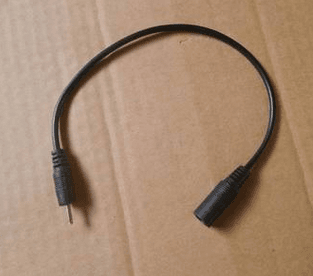
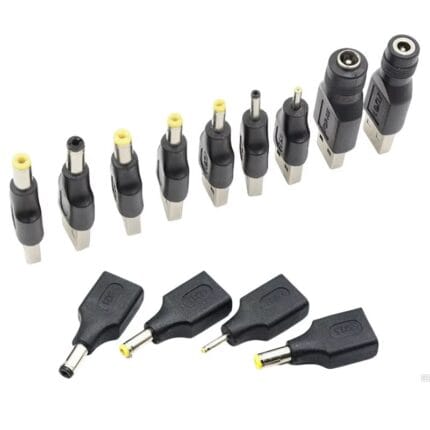
DC Barrel Adapter Kit – 5521 / 5525 / 4017 / 3513 / 1.35mm / 2.5mm, 6-Piece
A dc barrel adapter kit covering 5.5x2.1, 5.5x2.5, 4.0x1.7, 3.5x1.35 and 2.5 mm in six molded female-to-male adapters, so one supply covers a mixed estate. Center positive throughout, with nickel-plated brass contacts. Measure the socket pin with a caliper before ordering: the outer shell is identical across three of these five sizes. Bagged with a size card, or boxed with a printed insert.