7/8″ 5-Pin T-Splitter, 1 Male to 2 Female, IP67
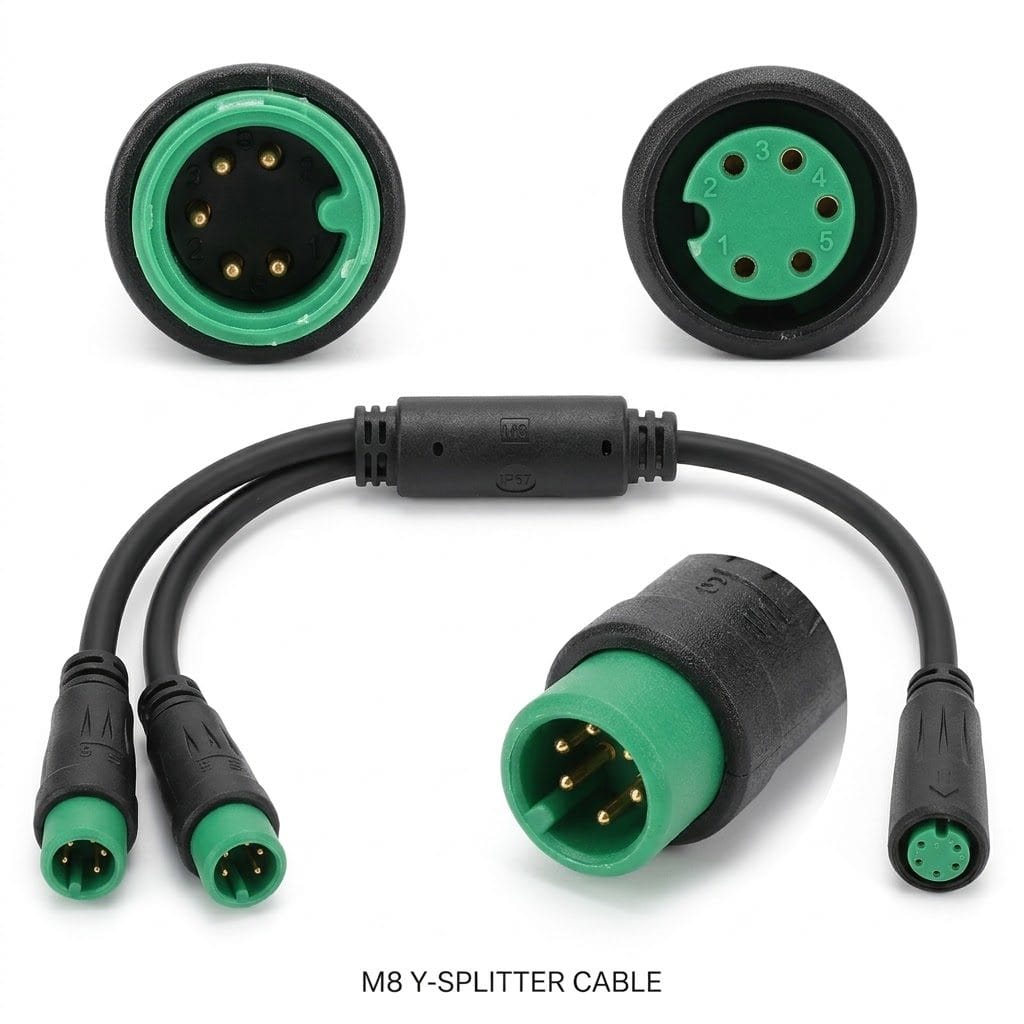
This 7/8 splitter turns one trunk connection into two branch feeds: a 5-pin male enters the T-body and two 5-pin female legs exit, each overmolded and sealed so a DeviceNet or CANopen drop can power two nodes without a junction box.
Overview
This 7/8 splitter turns one trunk connection into two branch feeds: a 5-pin male enters the T-body and two 5-pin female legs exit, each overmolded and sealed so a DeviceNet or CANopen drop can power two nodes without a junction box.
Splitters are what keep a fieldbus power topology tidy: instead of running a separate home-run cable to every node, one trunk connection is divided at the point of use. The T-body keeps both branch legs exits short and symmetrical, which shortens the drops to paired devices such as dual sensors, valve manifolds or twin drive cabinets.
Key Specifications
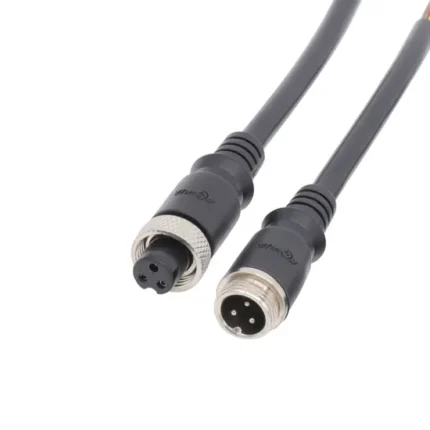
The table below lists the configuration shown in the product photo.
Construction and Materials
All three connectors are overmolded onto the splitter body in one molding cycle, so there is no open terminal cavity anywhere in the assembly. The legs are flexible circular cable sized for the 5-wire layout, and every coupling nut is knurled metal that seats positively against its mating panel or cordset.
Molding all three legs in one cycle removes the terminal cavity a field-assembled tee would leave, so there is no joint to loosen under vibration. Branch conductors are the same gauge as the trunk, and each nut seats against a metal shoulder rather than against the molding.
Typical Applications
Use it wherever two 7/8-inch powered devices sit close together: paired proximity clusters on a machine frame, twin nodes on a DeviceNet trunk, NMEA 2000 backbone branches in a helm console, or two actuator packs fed from a single CANopen drop.
It is also used for twin proximity clusters, paired valve manifolds on one drop, and NMEA 2000 backbone branches inside a helm console.
Compatibility and Fitment
The 7/8-16 UN thread and 5-pin arrangement match standard 7/8-inch power connectors used across DeviceNet and CANopen hardware. Verify the pin function map on your trunk and branch devices; all five conductors pass straight through from the male to both female legs.
Custom Builds and Ordering
Branch length, leg orientation and other contact counts can be produced to order. Send the node schedule and we will quote the splitter mix for your network. Prototype and sample lots run from 1 to 50 pcs and ship in 3 working days; production orders start at 500 pcs per part number and ship 14 working days after approval, with new overmold tooling adding about 10 working days.
Packaging and Shipping
Each splitter ships bagged with contact protection on all three connectors; bulk packs with customer labels are available.
Quality and Compliance
Continuity is verified across all pins on both branch legs before packing, and the overmold body is inspected for a complete, void-free seal. See the ODVA / DeviceNet specifications for the governing interface specification.
Every production run can ship with RoHS and REACH declarations and the electrical report agreed at quotation; see certifications and material declarations. UL styles and other named approvals are built to drawing: we source to the style you specify and document it, rather than asserting a listing we do not hold. Sealing follows the insert, gasket and overmold-bond method described under waterproof sealing design and validation, so the rating comes from the joint design rather than from the connector datasheet alone. Related reading: our industrial automation work. Tooling is quoted separately, cut in-house rather than brokered out, and owned by you.
What to Put on the Drawing for a 7/8 Splitter
A 7/8 splitter is released against a drawing, not a catalog description. Put the connector family and keying on each end, the pinout or polarity map, the finished length measured between the mating reference planes, the cable construction you want, and the acceptance tests you expect. If the 7/8-16UN T-splitter has to clear a panel cutout or a bracket, give that envelope too. Anything left open is agreed in writing before tooling or a production slot is committed.
Where a value is not fixed by your drawing we do not invent one. Contact rating, jacket material, sealing class and test limits are recorded as confirm per build, and the released drawing is what the first article is checked against. Send a marked-up sample if a drawing is not available; we confirm the pinout back to you in writing before any 7/8 Splitter is built.
How to Request a Quote for a 7/8 Splitter
Send a drawing or BOM, a physical sample, or a written requirement. We log the interface, the application conditions, the environment and the target quantity together, then return an acknowledgement with a list of anything still missing. Pricing is confirm per RFQ and is quoted against the released specification, not against a generic 7/8 splitter description.
If the design is not final, say so: we quote the prototype route and hold the production tooling decision until the first article is approved. Drawings are handled under a mutual NDA before they are received. The same document then carries the build from sample through repeat orders, which keeps the 7/8-16UN T-splitter consistent across batches.
Routing and Bend Relief for This 7/8-16UN T-Splitter Assembly
Plan the route before you fix the length. A 7/8 splitter that has to turn immediately behind the connector needs clearance for the first bend, and the molded exit is not a hinge. Leave enough slack for service removal, keep the lead away from sharp edges and moving parts, and secure it with clips that grip the jacket rather than crushing it. On sensor distribution on a machine frame, the run usually sees more handling than the specification suggests.
If the assembly passes through a bulkhead or a gland, confirm the opening clears the largest cross-section of the finished connector, coupling included, rather than the cable alone. A 7/8-16UN T-splitter cannot be taken apart after molding, so the route has to accept the finished part. Where space is tight, an angled exit or a shorter body is chosen at quotation, not discovered at installation.
Termination Choices and the Contact Interface
The contact interface is part of the specification, not an afterthought. Confirm the mating part number, the keying that prevents a reversed connection, and whether the end is crimped, soldered or IDC before release. A 7/8-16UN T-splitter that mates correctly but terminates on the wrong insulation diameter will pass a continuity check on the bench and fail later under vibration.
We build to the contact and cable combination on your drawing and verify the pinout on every piece. If you need a specific contact finish, a particular housing color for identification, or a marked pin one, put it on the drawing so it appears in the released build rather than in an email after the fact.
Packaging, Labeling and Revision Control
Assemblies are individually bagged with contact protection, and OEM labeling, part numbers and bulk packs are available. Put the label text, the bag mark and any barcode requirement on the order so the packing matches your receiving process. For sensor distribution on a machine frame, a labeled bag also stops a nearly identical lead from being fitted to the wrong unit during a service visit.
Every revision carries a reference tied to your part number. Obsolete revisions are retained so a repeat order matches the build you approved, and a change to length, pinout, jacket or connector is only made after written confirmation. That record matters more on a 7/8 splitter than a part number alone, because two builds can look the same and wire differently.
Related Cable Ranges
Browse the related ranges: Circular M-Series Cable Assemblies Automotive Wire Harnesses Signal and Data Cables.
| Configuration | 1 male to 2 female (T / Y splitter) |
|---|---|
| Contacts | 5-pin per connector |
| Coupling | 7/8-16 UN threaded, knurled nut |
| Ingress Rating | IP67 when mated |
| Application | DeviceNet, CANopen, sensor power splits |
| Construction | Overmolded T-body, circular legs |