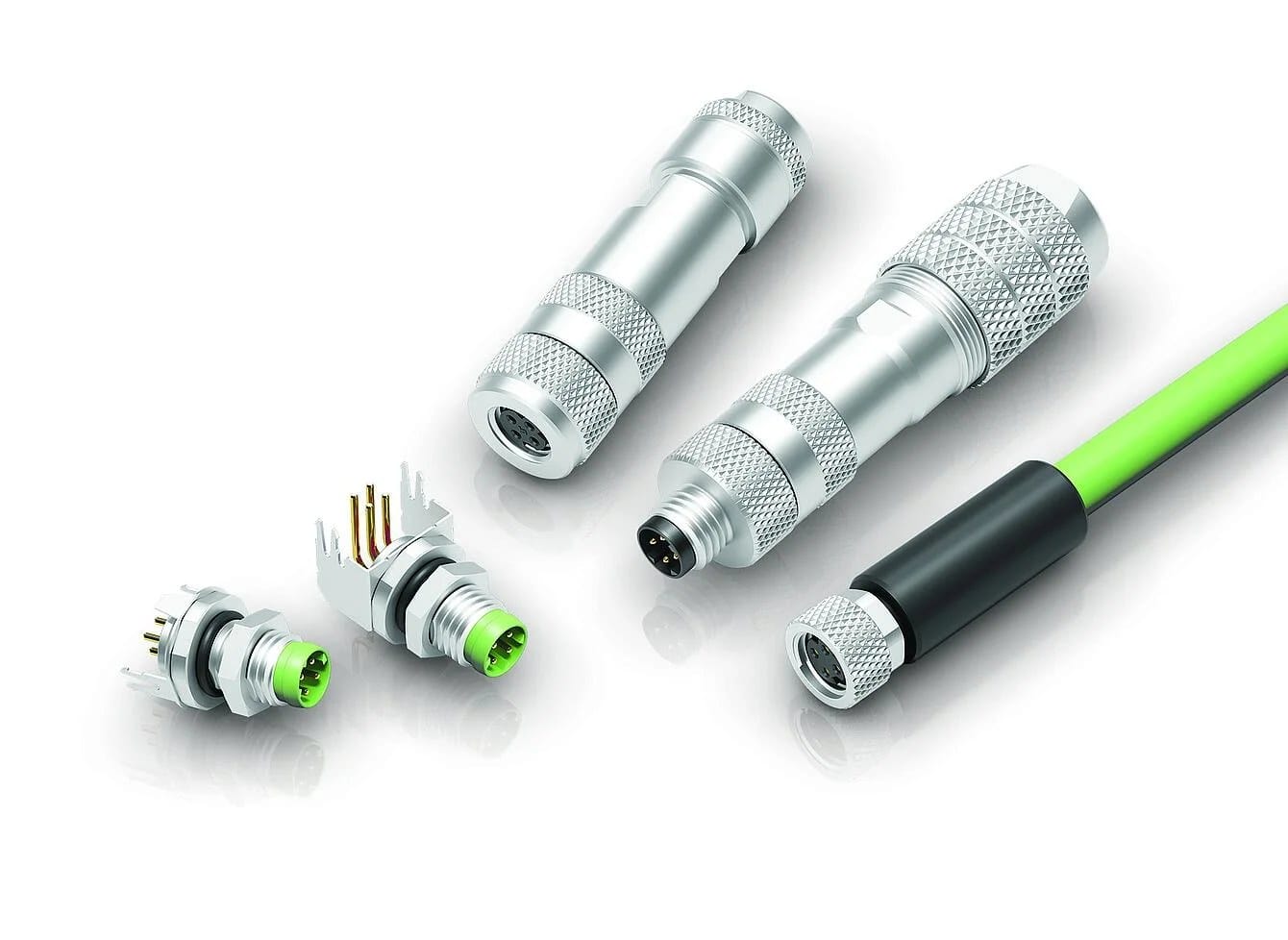
M8 D-Coded Ethernet Cable, 4-Pin 100 Mbit Cordset for Tight Spaces
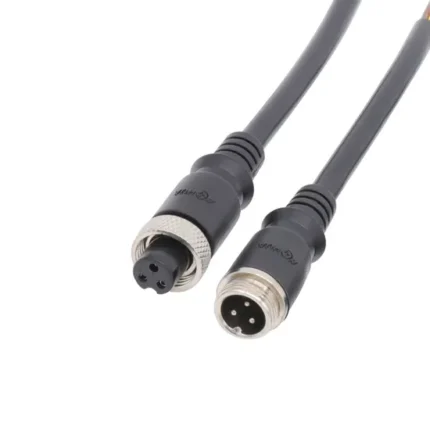
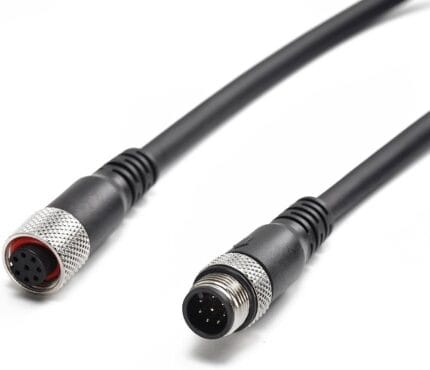
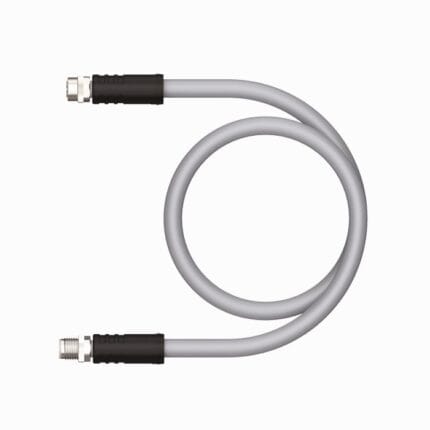
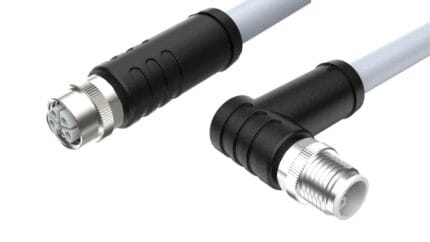
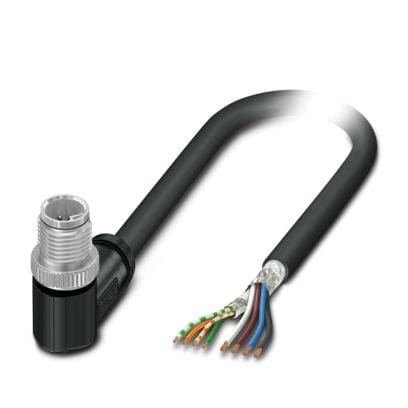
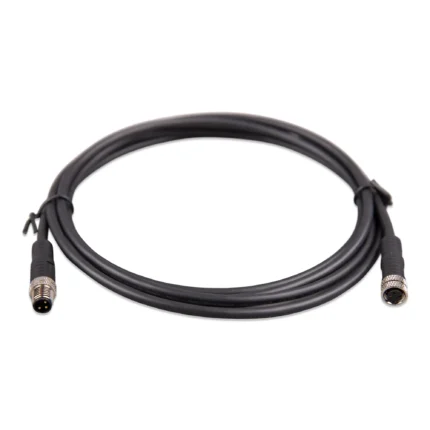
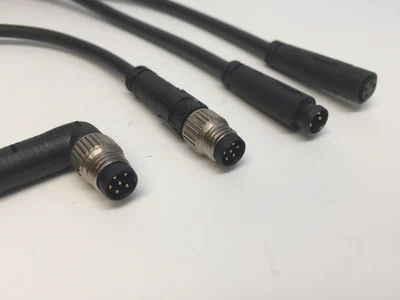
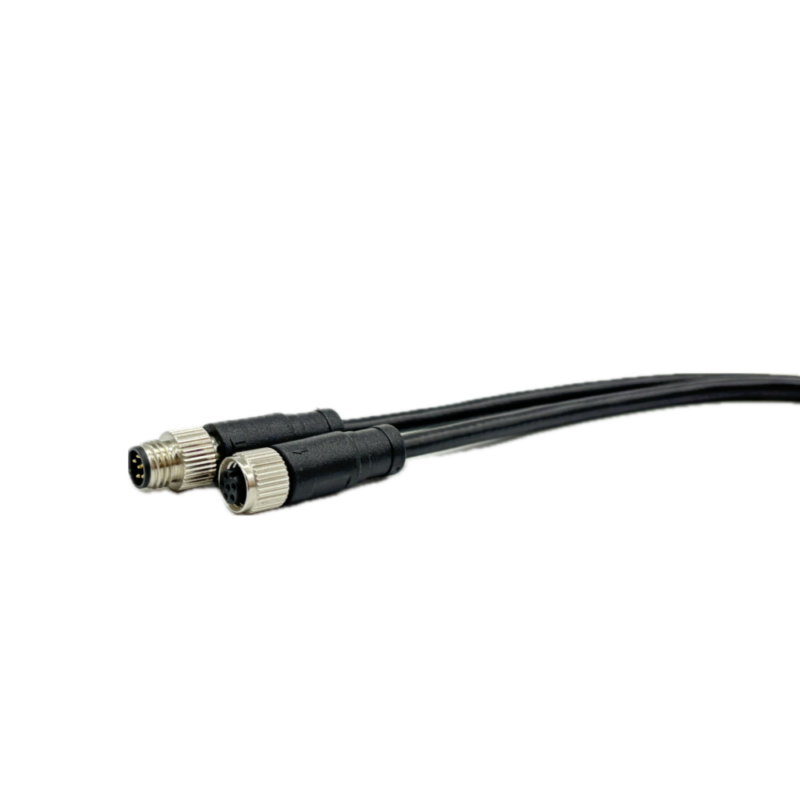
An M8 D-coded Ethernet cable puts two shielded Ethernet pairs into a shell roughly a third the size of an M12, for vision sensors and robot joints where a 12 mm thread will not fit. Built to your pinout, jacket and length, screen bonded to the nut.
Last updated: 13 September 2026
Overview
An M8 D-coded Ethernet cable exists because a 12 mm thread will not fit everywhere. Inside a robot wrist, behind a compact vision sensor, or on a small flow meter there is often no room for an M12 shell plus the bend radius its jacket needs. This 4-position cordset keeps the two-pair Ethernet layout of its bigger sibling, shrinks everything around it, and is built to the pinout, jacket and length on your drawing.
Key Specifications
| Connector A | M8 D-coded 4-pin, straight or right-angle |
|---|---|
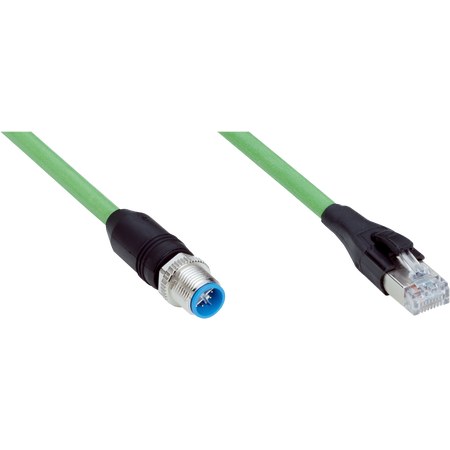
| Connector B | M8 D-coded, RJ45 or open leads |
| Coding | D-code, industrial Ethernet (IEC 61076-2-114 class) |
| Data rate | 100 Mbit/s class – confirm per build |
| Thread | M8 x 1.0 |
| Jacket | PUR or PVC |
| Shielding | Braided shield, bonded to the coupling nut |
| Ingress rating | IP67 when mated – confirm per build |
| Application | Compact vision sensors, robot wrists, tight enclosures |
When M12 will not fit
M8 is roughly a third smaller across the coupling nut than M12, and the saving is not only in the connector. A thinner jacket, a smaller bend radius and a lighter assembly all follow from it, which matters on a moving axis: every gram the wrist has to accelerate is a gram the servo pays for twice, once speeding up and once slowing down. Many cells run M12 through the fixed part of a run and drop to M8 only at the sensor head. We build that transition as one overmolded lead, so there is no second sealing point to leak and no second part number to stock.
M8 D-code pin and pair assignment
Four contacts, two differential pairs, and the screen carried through to the coupling nut. The table below is the assignment most suppliers follow for a D-coded 4-position face, not a promise about the device on the other end.
| Pin | Wire color | Pair | 100 Mbit/s signal |
|---|---|---|---|
| 1 | Yellow | Pair 1 | TD+ (transmit positive) |
| 2 | White | Pair 2 | RD+ (receive positive) |
| 3 | Orange | Pair 1 | TD- (transmit negative) |
| 4 | Blue | Pair 2 | RD- (receive negative) |
We terminate to the pinout you send, not to a color chart. If your camera or your switch reverses the pairs, or if the device uses a different wire set, say so on the order and it will be built that way.
What D-code buys you
D-code arranges four contacts as two shielded pairs matched to the Ethernet physical layer, which is why it is the interface of choice for PROFINET, EtherNet/IP and EtherCAT device drops at the 100 Mbit/s class. A-code can physically carry the same signal, but its contact geometry is not laid out for differential pairs, so crosstalk and impedance behavior get worse as the run gets longer. If the port says D-code, use D-code: the keyway is there to stop a slower or a power-coded plug going in, and it works in both directions.
Choosing a coding when you drop from M12 to M8
Most of the family was standardized around the 12 mm shell. When you reduce the shell size, the same logic still applies, so it is worth reading the whole family once before you commit to a panel layout.
| Code | Contacts | Carries | Where you meet it |
|---|---|---|---|
| A | 3 / 4 / 5 / 8 / 12 | DC power and sensor signals | Proximity switches, valve connectors, IO-Link ports |
| D | 4 | 100 Mbit/s Ethernet | PROFINET, EtherNet/IP and EtherCAT device drops |
| X | 8 | Up to 10 Gbit/s Ethernet | Machine vision, Cat6A backbone runs |
| B | 4 / 5 | PROFIBUS-DP fieldbus | Legacy PLC and drive networks |
| C | 3-6 | AC power | AC sensors and actuators |
| K | 4 + PE | Three-phase AC power | Small motors, distributed drives |
| S | 2+PE / 3+PE | Single-phase AC power | Mains distribution blocks |
| L | 4 + FE | DC power | IO-Link power, AGV and AMR supplies |
| T | 2-4 | DC power | Drives and distributed DC loads |
| M | 5-6 | Three-phase servo power | Servo motors with brake conductors |
| P | 4 | EtherCAT P data plus power | One-cable power and data drops |
| Y | 8 (4+4) | Power plus Fast Ethernet | Cobot joints, AMR sensor clusters |
Planning for the bend radius
The most common field failure on M8 Ethernet is not electrical, it is mechanical: the cable is routed tighter than the jacket and the pairs allow, and the link degrades over weeks of vibration. Ask us for the minimum bend radius for the jacket you are using and route to it. If the run moves, say so up front and we will build with high-flex stranding rather than a fixed-installation core. Where the lead sits in a cable carrier, send us the stroke length and the cycle rate as well.
Typical applications for this M8 D-coded Ethernet cable
- Compact vision sensors and smart cameras with a D-coded port and no room for M12
- Robot wrist and tool-changer drops, where weight and bend radius decide the build
- Flow meters, pressure transmitters and small analyzers with an integrated Ethernet port
- Tight enclosures and junction boxes where a 12 mm thread will not clear the neighbor
- M8-to-M8 patching inside a machine, with an M8 to RJ45 breakout at the cabinet wall
How to specify your build
- End A and end B – M8 D-code male or female, straight or right-angle, M8, RJ45 or open leads.
- Length, and whether the run is fixed or moving.
- Jacket – PUR for coolant and oil, PVC for dry enclosures.
- Shielding, and whether the screen should be bonded to the coupling nut.
- Pinout, if it differs from the standard colors above.
- Quantity, and whether this is a prototype or a production order.
A drawing, a photo of the existing cable, or just the device part number is enough to start.
Workmanship and testing
IPC/WHMA-A-620 Class 3 is the workmanship standard and ISO 9001 is the quality system behind it. We work from 32 to 12 AWG. Nothing ships without a continuity and pinout check, and seal checking can be added where an ingress rating is part of the specification.
Custom builds and ordering
Smallest quoted lot is 5 pcs, out in 3 working days. Production orders start at 500 pcs and ship 14 working days after sample approval; a new overmold body adds about 10 working days. OEM and ODM builds ship under your part number, and we can provide material certificates and first-article reports.
Related M8 and M12 assemblies
- M8 6-Pin A-Coded Right-Angle Sensor Cable
- M8 3-Pin A-Coded Circular Connector Sensor / Actuator Cable
- M8 / M12 5-Pin Right-Angle PUR Sensor Cable (Grey)
- M12 D-Code 4-Pin PROFINET Industrial Ethernet Cable
- M12 4-Pin A-Coded Right-Angle Shielded Sensor Cable
- M12 Drag Chain Cable, Continuous Flex Cordset for Cable Carriers
Full range: circular M8 and M12 cable assemblies.
Frequently Asked Questions
Is M8 D-code the same pinout as M12 D-code?
The pair layout is the same two-pair arrangement, and most suppliers use the same wire colors. The shells are not interchangeable, and pin numbering should be confirmed against the device documentation before you order.
Can I have M8 on one end and RJ45 on the other?
Yes. M8 D-code to RJ45 is a common breakout where the device end is space limited and the cabinet end is a standard switch port.
How short a length can you build?
Down to a few hundred millimeters for sensor heads. Give us the routed length rather than the straight-line distance if the cable has to turn a corner.
What is the minimum order?
Evaluation units can be as few as 5 pcs, turned around in 3 working days. Volume starts at 500 pcs and ships 14 working days after approval.
Do you build the panel receptacle as well?
Yes. Bulkhead and panel-mount receptacles are a standard part of the build, with flying leads or a second connector on the back.
| Connector A | M8 D-coded 4-pin, straight or right-angle |
|---|---|
| Connector B | M8 D-coded, RJ45 or open leads |
| Coding | D-code, industrial Ethernet (IEC 61076-2-114 class) |
| Data rate | 100 Mbit/s class – confirm per build |
| Thread | M8 x 1.0 |
| Jacket | PUR or PVC |
| Shielding | Braided shield, bonded to the coupling nut |
| Ingress rating | IP67 when mated – confirm per build |
| Application | Compact vision sensors, robot wrists, tight enclosures |