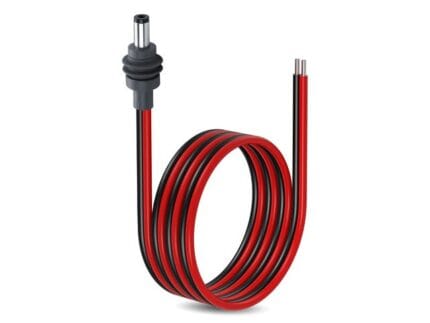
Fused 12V Distribution Harness, Anderson Powerpole to 4x DC 5.5×2.1mm Outputs
A fused 12v distribution harness on one Anderson Powerpole input, feeding four individually protected 5.5×2.1mm barrel outputs. 12 AWG input, 16 AWG branches, fuse values sized to your loads. The main fuse sits within 300 mm of the battery feed; branch fuses are sized to the cable first.
Last updated: 13 September 2026
Overview
A fused 12v distribution harness is the tidier answer to the pile of ring terminals that accumulates on a battery post. A van, a boat cabin, a radio desk or an off-grid box all end up with the same collection of 12 V loads – a terminal, a fridge, strip lighting, a camera, a router – and wiring each one straight back to the battery makes fault-finding a guessing game. One Anderson Powerpole input feeds a bus, and four 5.5×2.1mm barrel outputs come off it, each on its own fuse.
Key Specifications
| Input connector | Anderson Powerpole, red / black standard orientation |
|---|---|
| Output connectors | 4 x DC barrel plug 5.5×2.1mm, center positive |
| Input conductor | 12 AWG |
| Branch conductor | 16 AWG |
| Input protection | 30 A MIDI or blade fuse, within 300 mm of the battery feed |
| Branch protection | 5 A blade fuse on each output |
| Optional outputs | 2 x USB-C Power Delivery ports fed from the same bus |
| Applications | Vans, boats, radio desks, off-grid 12 V distribution |
| Build | Made to order: branch count, fuse values, barrel size and lengths |
| Polarity | Center positive on every branch, marked at each plug |
| Termination | Crimped Powerpole contacts, pull-tested before packing |
Two levels of protection, and why both
The two fuses in this harness are protecting different things, and confusing them is how harnesses get specified wrongly.
| Fuse | Protects | Sits | Sized by |
|---|---|---|---|
| Input / main | The feed cable and the battery | Within 300 mm of the battery feed | The ampacity of the input conductor |
| Branch | Each branch cable and the device on it | At the bus, on each output | The ampacity of the branch conductor, checked against the load |
The main fuse sits close to the source because the unfused length between battery and fuse is the part that can burn – standard vehicle and marine practice. Without branch fuses, one short trips the main fuse and takes down the whole harness.
Choosing the branch fuse value
A fuse opens a circuit before the cable in it overheats, and every value below is chosen on that basis: protect the wire first, the device second, and do not nuisance-trip in normal use.
- Identify the branch conductor and its ampacity – 16 AWG as standard on this build.
- Pick a fuse at or below that ampacity. A fuse above the conductor rating is protecting nothing.
- Check it against the steady draw of the load and leave margin above it.
- Then check the surge. A compressor fridge or a larger terminal pulls more on startup, and a fuse that trips on every compressor cycle is worse than no fuse at all.
The 5 A branch figure quoted by comparable harnesses suits lighting, cameras and small network gear. Where a load has a motor in it, tell us the steady and surge current and we will size the branch to the cable and the load rather than to a default. Where four outputs are not enough, the 8-way fused DC splitter cable takes the same approach further.
The total current budget
Before you pick fuse values, add up what the bus actually has to carry. The main fuse is sized to the input conductor, but the harness only works if the sum of the branches sits inside it.
| Step | Record | Note |
|---|---|---|
| 1 | Steady current of every load | Off the rating plate on each device |
| 2 | The worst single startup surge | Add it to the rest running, not to their surges |
| 3 | Sum, plus margin | A bus at its limit sags and the sensitive devices reset first |
| 4 | Compare to the input conductor ampacity | 12 AWG as standard; go heavier if the sum says so |
We do not publish assumed draws for your equipment. The values your harness is built to are the ones stated per your specification.
Powerpole orientation and crimping
Powerpole shells are genderless and can be assembled in either orientation, which is convenient and also a genuine hazard when two separately purchased leads do not agree. The harness is built to the red-black orientation that has become the de facto standard in amateur radio practice, so it mates with the bulk of commercially available Powerpole equipment. If your existing kit uses the other orientation, say so and we build to match – otherwise you have a lead that physically cannot be plugged in.
The contacts are crimped, not soldered. A soldered Powerpole joint wicks up the stranding and creates a stress point right where the terminal flexes, and the housing will not close properly on a bulged barrel. Every contact on this build is crimped on a calibrated tool, checked for crimp height at setup, and pull-tested before packing.
Branch conductor and routing
Branch conductors are lighter than the trunk for a reason: each one only ever carries the current of a single load, and four 16 AWG branches are easier to route than four 12 AWG ones. Where a branch has to run a long way to reach its device, go up a size on that branch alone – voltage drop cares about length, not about the harness. Keep the branches clear of sharp edges and moving parts, and support the bundle rather than letting it hang off the bus.
Options
Two USB-C Power Delivery outputs can be added, fed from the same bus, for phones and tablets that no longer ship with a barrel input. Reaching more than 60 W on those outputs depends on an E-marked cable and a charger or converter that offers the higher operating point, and both are listed for confirmation rather than assumed. Branch count, fuse values, output barrel size and overall lengths are all built to order.
Typical applications for this fused 12v distribution harness
- Camper van and overland 12 V systems off one battery feed
- Boat cabins where every load needs its own protection
- Amateur radio desks running several rigs and accessories
- Off-grid boxes and solar sheds with a mixed load set
- Mobile service vehicles feeding a cigarette lighter power cable and other barrel devices
How to specify your build
- Input connector – Powerpole, and the orientation your kit uses.
- Branch count and barrel size on each output.
- Steady and surge current of every load.
- Fuse values, or let us size them from the above.
- Conductor on the trunk and on each branch.
- Lengths from the bus to each output.
- Options – USB-C outputs, switches, labeling.
Workmanship and testing
Assembly and inspection follow IPC/WHMA-A-620 Class 3 workmanship criteria under our ISO 9001 quality management system, and every unit passes 100% continuity and pinout testing before it is packed. Conductor range is 32 to 12 AWG. Where an ingress rating is specified we can quote seal checking on the production batch.
Custom builds and ordering
Smallest quoted lot is 5 pcs, out in 3 working days. Production orders start at 500 pcs and ship 14 working days after sample approval; a new overmold body adds about 10 working days. OEM and ODM builds ship under your part number, and we can provide material certificates and first-article reports.
Related DC assemblies
- 8-Way Fused DC Splitter Cable 5.5×2.1mm with Per-Channel Switches
- DC 5521 Power Splitter, 1 Female to 6 Way
- IP67 Waterproof DC Extension Cable 5.5×2.1mm
- 12V/24V Cigarette Lighter Power Cable with Waterproof 5.5×2.1mm DC Plug
- IP67 DC to USB-C Cable, 5.5×2.1mm Barrel Power Lead
- Solar MC4 Adapter Cable to XT60, Anderson and DC7909
Full range: DC plug power cable assemblies and custom wire harnesses.
Frequently Asked Questions
Why a fuse on every output as well as on the input?
So one faulty device cable does not take down the whole harness. Without branch fuses, a short anywhere trips the main fuse and everything goes dark.
What value branch fuse should I use?
At or below the ampacity of the branch conductor, above the steady draw of the load, and high enough to ride out the startup surge. Tell us the loads and we will size them.
How close to the battery does the main fuse go?
Within 300 mm of the battery feed as standard. The unfused length between battery and fuse is the part that can burn.
Which Powerpole orientation do you build?
Red-black, the de facto amateur radio standard. If your kit uses the other orientation, say so and we will build to match.
| Input connector | Anderson Powerpole, red / black standard orientation |
|---|---|
| Output connectors | 4 x DC barrel plug 5.5×2.1mm, center positive |
| Input conductor | 12 AWG |
| Branch conductor | 16 AWG |
| Input protection | 30 A MIDI or blade fuse, within 300 mm of the battery feed |
| Branch protection | 5 A blade fuse on each output |
| Optional outputs | 2 x USB-C Power Delivery ports fed from the same bus |
| Applications | Vans, boats, radio desks, off-grid 12 V distribution |
| Build | Made to order: branch count, fuse values, barrel size and lengths |
| Polarity | Center positive on every branch, marked at each plug |
| Termination | Crimped Powerpole contacts, pull-tested before packing |