8-Way Fused DC Splitter Cable 5.5×2.1mm with Per-Channel Switches
A fused dc splitter cable that feeds eight 5.5×2.1mm loads from one supply, with a rocker switch and a fuse on every channel, so one shorted branch drops alone. Blade or self-resetting fusing, 18 AWG trunk, 5.5×2.5mm outputs and a panel mount bracket on request.
Last updated: 13 September 2026
Overview
A CCTV rack, an LED video wall, a kiosk and a vending machine all share the same problem: many 12 V
loads, one power supply, and no tolerance for a single failure taking the whole bank down. A daisy chain
of cheap Y-leads makes that outcome likely. This fused DC splitter cable feeds up to
eight loads from one 5.5×2.1mm input, with a switch and a fuse on every channel, so a fault on one
branch drops that branch and nothing else.
Key Specifications
| Input connector | DC barrel plug or socket 5.5×2.1mm |
|---|---|
| Output connectors | 8 or 10 x DC barrel socket 5.5×2.1mm |
| Trunk conductor | 18 AWG |
| Branch conductor | 20 to 22 AWG |
| Per-channel protection | 2 A self-resetting fuse, or 3 A blade fuse |
| Per-channel control | Rocker switch on every output |
| Total current | Up to 10 A across all channels |
| Options | 5.5×2.5mm output version, panel mount bracket |
Choosing the fuse for each channel
Two protection types cover this build, and the right one depends on who services the rack and how
often it trips.
| Type | Behavior | Pick it when | Trade-off |
|---|---|---|---|
| Self-resetting (polymeric) | Trips on overcurrent, resets once it cools and the fault is cleared | Unattended sites, kiosks, remote cabinets with no technician nearby | Slower to trip, and it holds a reduced current rather than opening cleanly |
| Blade fuse | Opens and stays open until replaced | Racks with a technician on site, and anywhere a hard fault must stay isolated | Needs a spare fuse in the cabinet, but the trip is definite and visible |
Sizing rule that holds for both: the fuse protects the branch conductor and the load, so it is chosen
from the branch gauge and the load’s steady draw, with headroom for the startup surge. A camera that
pulls 0.4 A steady and 1.2 A when the IR LEDs and the heater come on needs a fuse above the surge, not
above the idle figure. The rating your assembly is built and verified to is the one stated on your
drawing — send us the load list and we will size each channel with you.
The total current budget
Fusing protects the channels; it does not create capacity. The sum of everything running at once has
to sit inside what the supply and the trunk conductor can carry, regardless of how the individual
channels are fused. The table below is arithmetic, not a rating — put your own nameplate figures in the
last column.
| Example bank | Channels | Draw per channel | Total draw |
|---|---|---|---|
| Eight fixed cameras, IR off | 8 | 0.3 A | 2.4 A |
| Eight fixed cameras, IR and heater on | 8 | 1.0 A | 8.0 A |
| Four LED panels at full brightness | 4 | 1.5 A | 6.0 A |
| Ten small sensors and controllers | 10 | 0.2 A | 2.0 A |
Three habits keep this honest. Add up nameplate current for every load rather than trusting a
typical figure. Apply a margin for startup surge, because eight cameras coming up together after an
outage draw far more than eight cameras running. And check the total against the supply rating before
wiring the rack, not after.
Why per-channel switching earns its place
The fuse is the safety part; the switch is the part technicians thank you for. With a rocker on every
output, one display panel can be powered down for service without killing the rest of the wall, a faulty
branch can be isolated without pulling the supply, and a bank can be brought up in stages so the whole
rack does not hit the supply with its combined startup surge at once. On a video wall or a CCTV rack
that is the difference between a five-minute fix and a site visit.
Wiring checklist
- Add up the load — nameplate current for every branch, plus surge.
- Check it against the supply — the total, not the per-channel figure.
- Size each fuse from the branch conductor and the load, not from the supply.
- Mount the splitter to a panel or a DIN rail adapter plate so the switches stay reachable.
- Strain relieve every branch — a splitter floating in the bottom of a cabinet puts all the weight on eight sockets.
- Label each channel at both ends before the cabinet is closed.
- Bring it up in stages the first time, watching the supply, rather than switching all eight at once.
Typical applications for this fused DC splitter cable
- CCTV racks, where a shorted camera cable must not take the other seven off the recorder
- LED video walls and light boxes, with per-panel isolation for service
- Kiosks, vending machines and self-service terminals with several 12 V sub-assemblies
- Test benches and burn-in racks that need individual branches switched independently
- Distribution from a single sealed supply, using our fused 12V distribution harness where Anderson connectors are preferred
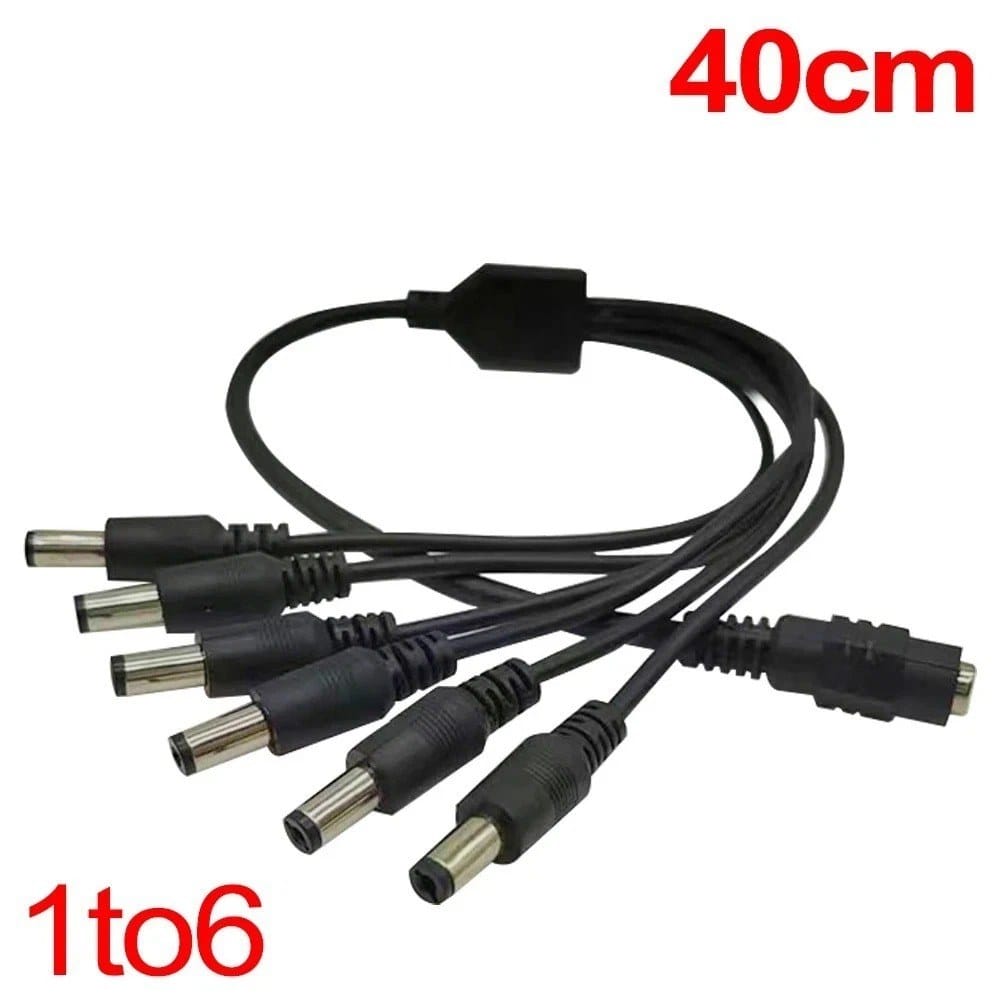
- Smaller banks, where a DC 5521 1-to-6 power splitter is a simpler answer
How to specify your build
- Channel count — 8 or 10 outputs.
- Fuse type and rating — self-resetting or blade, and the value per channel from your drawing.
- Input style — barrel plug or socket, and which you need.
- Output barrel size — 5.5×2.1mm standard, 5.5×2.5mm on request.
- Mounting — panel bracket, DIN adapter plate, or loose.
- Labeling — channel numbers printed, or blank for field marking.
Workmanship and testing
Assembly and inspection follow IPC/WHMA-A-620 Class 3 workmanship criteria under our ISO 9001 quality management system, and every unit passes 100% continuity and pinout testing before it is packed. Conductor range is 32 to 12 AWG. Where an ingress rating is specified we can quote seal checking on the production batch.
Related splitters and distribution
- Fused 12V Distribution Harness, Anderson Powerpole to 4x DC 5.5×2.1mm
- DC 5521 Power Splitter 1 Female 2 Way
- DC 5521 Power Splitter 1 Female 6 Way
- DC 5521 Daisy Chain Cable 1 Female 5 Way
- Mini UPS Splitter Cable DC 5.5×2.1mm
- IP67 Waterproof DC Extension Cable 5.5×2.1mm
Full range: DC Plug Power Cable.
Frequently Asked Questions
Self-resetting or blade fuse?
Self-resetting for unattended sites where nobody can change a fuse. Blade for racks with a technician on site, or anywhere a hard fault must stay isolated until someone looks at it.
Can I run all eight channels at their per-channel limit?
No. The total draw has to sit inside what the supply and the trunk conductor can carry. Add up the loads, allow for startup surge, and check the total against the supply.
Does the splitter protect the supply?
It isolates faults between branches. The supply still needs its own protection on the input side.
Can I get 5.5×2.5mm outputs?
Yes, the output barrel size is specified per order.
What is the minimum order?
Prototypes start from 5 pcs and ship in 3 working days. Production runs start at 500 pcs and ship 14 working days after approval.
| Input connector | DC barrel plug or socket 5.5×2.1mm |
|---|---|
| Output connectors | 8 or 10 x DC barrel socket 5.5×2.1mm |
| Trunk conductor | 18 AWG |
| Branch conductor | 20 to 22 AWG |
| Per-channel protection | 2 A self-resetting fuse, or 3 A blade fuse |
| Per-channel control | Rocker switch on every output |
| Total current | Up to 10 A across all channels |
| Options | 5.5×2.5mm output version, panel mount bracket |