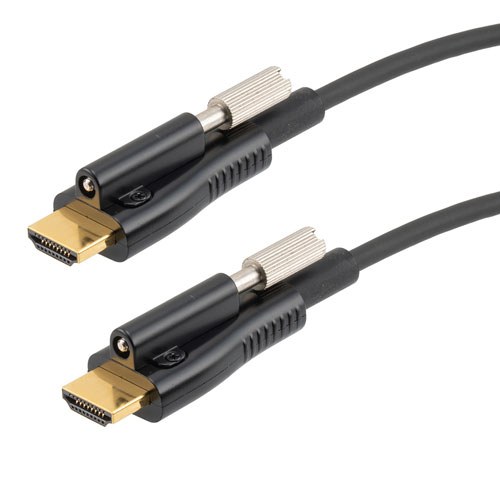
Active Optical HDMI Cable for Boardrooms and Ceiling Projectors
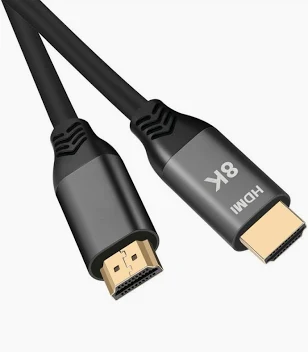
An active optical HDMI cable puts the high speed signal path onto fiber so a long boardroom or ceiling projector run stays slim enough to pull through conduit. Marked source and display ends, aramid strength member, hybrid copper for power and control. Tell us the route and we quote the length with a service loop.
Overview
A boardroom run fails in a particular way. The projector is on the ceiling, the source is in a
floor box or a rack at the back of the room, and everything works during commissioning until the room heats
up, at which point the picture drops out or the link negotiates down to something the client did not pay
for. An active optical HDMI cable exists for that run: the high speed signal path moves
onto optical fiber, so the assembly stays thin enough to pull through conduit and long enough to reach
without a repeater in the ceiling void.
Key Specifications
| Interface | HDMI type A male to HDMI type A male |
|---|---|
| Construction | Hybrid optical fiber plus copper |
| Directionality | Marked source and display ends, one way |
| Strength member | Aramid yarn |
| Nominal lengths | 10 m / 15 m / 20 m (pending confirmation) |
| Outer diameter | Slim profile, exact figure pending production sample |
| Jacket options | Standard PVC; jacket for plenum spaces on request |
| Compliance files | Pending supplier confirmation |
| Pulling | Pull on the strength member, never on the connectors |
| Build length | Custom lengths with a service loop on request |
| Labeling | End markers and printed length on request |
The copper length wall
Passive copper
HDMI assemblies reach a
point where the physics stops cooperating. To carry a high bandwidth signal further, the conductors get
thicker and the shielding gets heavier, and the result is a stiff cable with a wide bend radius that fights
you inside a ceiling void, a lectern or a conduit run. The failure modes are the ones installers recognize:
the picture drops when the projector warms up, the link falls back to a lower format, or the source refuses
to see the display at all.
An equalizer or a repeater buys some of that back, but both need power at a point in the ceiling that
usually does not have any. That is the gap fiber fills: the distance stops being a copper attenuation
problem.
What an active optical assembly actually is
The construction is hybrid. The high speed video lanes run over optical fiber, with an optical engine in
each connector shell converting between electrical and optical. The copper that remains carries power, the
display data channel and the control signals both ends need. That is why the finished lead stays slim where a
copper assembly of the same reach would be the thickness of a thumb.
| What governs the run | Passive copper | Hybrid optical assembly |
|---|---|---|
| High speed path | Copper pairs, attenuated over distance | Optical fiber, conversion in the plug shells |
| Weight and diameter | Grows with length and shielding | Stays slim across the length range |
| Bend and pull | Stiff, wide minimum bend radius | Lighter, with a strength member taking the pull |
| Power | None needed | Draws a small rail from the source port |
| Direction | Either way round | One way; ends are marked |
| Pulling through conduit | Hard; unforgiving of tight bends | Easier, if the connectors are protected |
Directionality and where the power comes from
The two ends are not interchangeable. Each shell contains active electronics, and the end marked for the
source takes its operating rail from the source port. Pull the assembly in backwards and it will not work at
all, which is the most common installation fault with this class of cable and the first thing to check when a
new run is dead.
- Read the end markers before the pull, not after it
- Where a source port is marginal in the current it supplies, tell us — some docks and split outputs are tight
- The run cannot be reversed later by swapping ends at the wall plate; plan the route once
Pulling, bend radius and the ceiling void
Fiber cores tolerate pulling and routing well but not tight folding. The assembly uses aramid yarn as the
strength member, so the pull force is taken by the yarn rather than by the fibers, but a hard kink at the
connector boot will still damage it. Coil the cable in large loops for transport, avoid stapling through the
jacket, and keep bends gentle where the lead turns into a wall plate or a projector mount.
- Pull the assembly into place before terminating; never use the connectors to drag it through conduit
- Leave a service loop at the projector end so the plug can be re-seated without re-pulling the run
- Keep the lead away from mains and lighting cable where the two must run parallel
- Where the run crosses a plenum space, nominate a jacket intended for that use, since the standard jacket
is not intended for it and the rating is stated per your drawing
Installation notes for boardrooms and ceiling projectors
Measure the route rather than the room. The cable goes up a wall, across a ceiling void and down into a
mount, and that route is always longer than the diagonal off the plan. We would rather quote a slightly
longer assembly with a service loop than one that has to be stretched to reach. On a mount that swings or
lifts, leave slack for the travel, and support the cable so its weight does not hang off the plug.
Typical applications for this active optical HDMI cable
- Boardrooms with the source at the table or in a rack and the display on the ceiling
- Lecture halls with a lectern feed and a long run to the projector
- Ceiling projector installs where conduit is already routed and the bend count is known
- Signage runs from a rack to a remote display, with an Ultra High Speed HDMI cable for the short copper drops
- Room builds that also need a long USB-C run, where a USB-C active optical cable covers the same distance
What we need from you to quote
- Route length, measured along the route the cable will actually take.
- Source and display — makes and models, and the format you need to reach.
- The route itself — conduit, ceiling void, wall cavity, and how many bends.
- Whether the run crosses a plenum space, and the jacket rating to meet.
- Service loop — how much slack you want at the display end.
- Quantity, and whether this is one room, a rollout, or a private label order.
Workmanship and testing
IPC/WHMA-A-620 Class 3 is the workmanship bar for Active Optical HDMI builds, and ISO 9001 is the system behind the line, from 32 to 12 AWG. Each Active unit passes a continuity and pinout check before it ships, and seal checking is quoted whenever an ingress rating is on the drawing.
Every production run can ship with RoHS and REACH declarations and the electrical report agreed at quotation; see certifications and material declarations. UL styles and other named approvals are built to drawing: we source to the style you specify and document it, rather than asserting a listing we do not hold. This assembly is built on the four lines covered under the assembly lines behind this build, with nothing in the build handed to an undisclosed subcontractor. Related reading: what stage and studio work demands. Tooling is quoted separately, cut in-house rather than brokered out, and owned by you.
Custom builds and ordering
Five pieces is the prototype minimum for Active Optical HDMI builds, shipping in 3 working days. The production minimum is 500 pcs, delivered 14 working days after sample sign-off. Tooling not already held adds around 10 working days. Active orders ship as OEM or ODM under your part number and labeling material certificates and first-article reports come with them on request.
Related video assemblies
- Ultra High Speed HDMI Cable for 8K Video Walls
- Micro HDMI to HDMI Cable
- Mini HDMI to HDMI Cable
- 8K HDMI Screw Lock Cable Assembly with M3 Panel Screws
- USB-C to DisplayPort Cable for High Refresh Monitors
- USB-C Active Optical Cable for Long-Reach USB4 Class Links
Full range: audio and video cable assemblies.
Frequently Asked Questions
Why will it not work when I pull it the other way round?
The assembly is directional. Each shell has active electronics and the source end takes its power from the
source port. Check the end markers first.
Can I pull it through conduit by the connectors?
No. The strength member is aramid yarn inside the jacket and it is there to take the load, but a hard kink
at the boot will still damage the fiber.
How much service loop should I leave?
Enough to re-seat the plug at the display without re-pulling, and enough for the travel if the mount lifts
or swings. Tell us the mount and we will quote the length with it built in.
Can it run through a plenum ceiling void?
Only with a jacket intended for that use, nominated on your drawing. The standard jacket is not intended
for plenum spaces.
| Interface | HDMI type A male to HDMI type A male |
|---|---|
| Construction | Hybrid optical fiber plus copper |
| Directionality | Marked source and display ends, one way |
| Strength member | Aramid yarn |
| Nominal lengths | 10 m / 15 m / 20 m class |
| Outer diameter | Slim profile |
| Jacket options | Standard PVC; jacket for plenum spaces on request |
| Compliance files | Stated per your drawing |
| Pulling | Pull on the strength member, never on the connectors |
| Build length | Custom lengths with a service loop on request |
| Labeling | End markers and printed length on request |
Related products