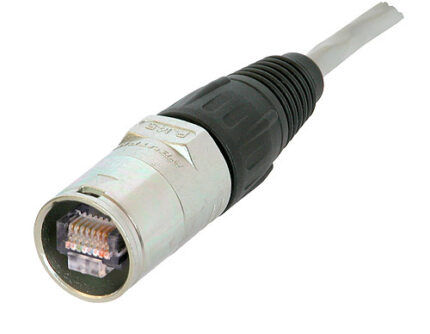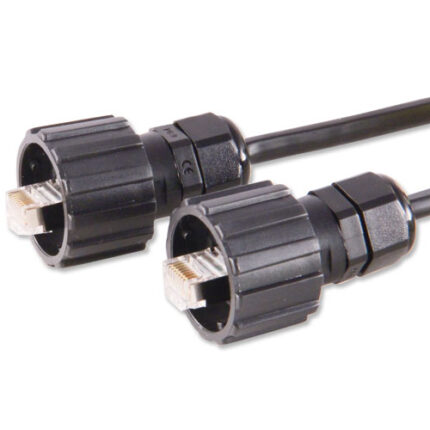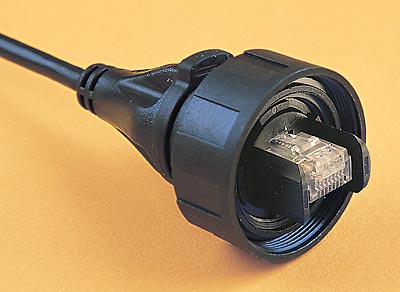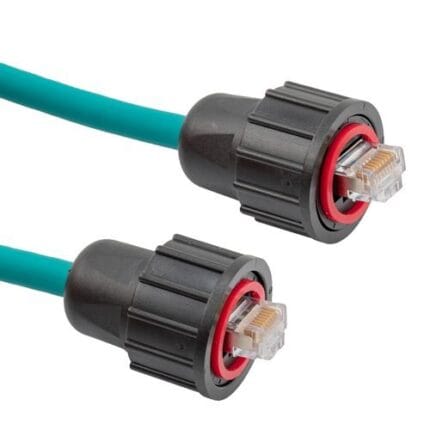
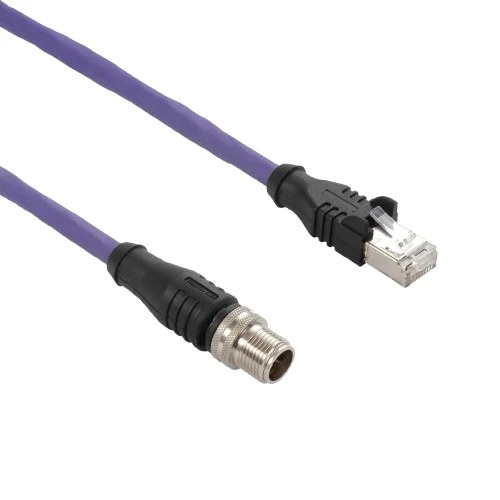
Cat6A IP69K Washdown Patch Cord, M12 X-Code to RJ45, PUR
A Cat6A IP69K washdown patch cord for food, dairy, brewery and pharma lines: M12 X-code on the wet end, RJ45 in the cabinet, PUR jacket, built for caustic foam and high-pressure hot rinse. Lengths 3 to 10 m.
Overview
A Cat6A IP69K washdown patch has to survive the part of the shift that
destroys ordinary cords: the rinse at the end of it. Food and beverage packaging lines, dairies,
breweries and pharmaceutical clean rooms are foamed with caustic detergent and then rinsed with
water at high pressure and high temperature. The cord carries 10 gigabit Ethernet to a vision
camera or an operator panel that cannot be moved out of the wash zone, so it takes the jet on the
outside and keeps the link up on the inside.
Key Specifications
| Category / class | Category 6A, Class EA per ISO/IEC 11801 |
|---|---|
| Wet end connector | M12 X-coded, 8 positions, per IEC 61076-2-109 (confirm applicable edition) |
| Dry end connector | RJ45 plug, shielded |
| Ingress target | IP69K per ISO 20653 (pending test report and edition confirmation) |
| Jacket material | PUR, halogen-free (pending supplier datasheet) |
| Armour option | Stainless steel braid, 316L class (pending supplier confirmation) |
| Chemical resistance | Caustic foam and Ecolab-type detergents claimed in competitor data (pending test report) |
| Temperature range | -25 to +85 C (pending supplier datasheet) |
| Standard lengths | 3 m / 5 m / 10 m (pending supplier confirmation) |
| Typical loads | Washdown vision cameras, panel PCs, remote I/O on food, dairy, brewery and pharma lines |
| Coupling torque | Hand-tighten then torque to the figure on the connector drawing; value stated per order |
| Cleaning agents | Agents in use stated per order; material compatibility confirmed per datasheet |
What the IP69K test actually does to your cord
IP69K is the high-pressure, high-temperature water jet code in the ISO 20653 ingress series,
written for road vehicles and widely adopted as the benchmark on processing equipment. It is worth
reading the parameters once, because they explain why washdown failures are almost always joint
failures rather than jacket failures.
| Parameter | Value per ISO 20653 | What it does to the assembly |
|---|---|---|
| Water temperature | 80 C | Softens and expands materials; a marginal gasket gives up here |
| Pressure | 80 to 100 bar (8 to 10 MPa) | Drives water into any gap at the coupling |
| Flow rate | 14 to 16 L per minute | Volume, not just pressure, finds the weak seal |
| Nozzle distance | 100 to 150 mm | Close range means no chance to deflect the jet |
| Spray angles | 0, 30, 60 and 90 degrees | Every seam and every face gets hit |
| Duration | 30 s per angle | Sustained, not a splash |
| Turntable | 5 rpm | No protected side |
Whether an assembly passes depends on the overmold geometry, the gasket compression at the
coupling and the torque it is tightened to, not on the cable alone. An under-torqued M12 coupling
is the single most common cause of a washdown failure we hear about.
The spray angles and duration above are what the class is tested against, and none of them describe the joint on its own. Where a specification has to name a class, the test conditions and limits for IP65 to IP69K are worth reading alongside it.
IP69K against IP67: different problems, not better or worse
Buyers often read the numbers as a ladder, and they are not one. IP67 is immersion in cold
water; IP69K is a hot jet at close range. A cord can pass one and fail the other, which is why
the two ratings appear on different products in this range. If the run is outdoors and gets rained
on, IP67 is the right question. If it gets foamed and rinsed at shift change, IP69K is.
The first digit is the same in both cases and appears in the IP code as a 6, meaning dust-tight. The difference is entirely
in the second character and the test behind it.
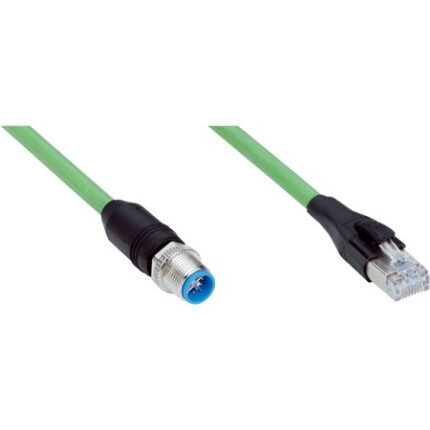
M12 X-code on the wet end, RJ45 on the dry end
X-coding is the eight-position M12 keying laid down for 10 gigabit Ethernet, described in IEC
61076-2-109; check which edition your plant standard references. On the machine side the cord
terminates in an M12 X-coded plug that mates with a sealed receptacle on the camera or the panel.
On the cabinet side it ends in an ordinary RJ45, so nothing special is needed at the switch. That
asymmetry is the point: one sealed joint out in the wash zone, one commodity port in the dry
cabinet.
The washdown failure list
- Under-torqued coupling — hand-tight is not enough; torque to the drawing
figure. - Water pooling at the connector — route the cord so it drains.
- Weight hanging off the coupling — a wet cable is heavy; support it.
- Jacket attack from the chemistry — caustic and chlorine agents attack
different compounds, so tell us what is in use. - Direct nozzle impingement — keep the run out of the aim path.
Jacket and armor options
PUR is the working jacket because it resists the cleaning chemistry, the hot water and the
abuse of a wet floor better than PVC, and it stays flexible at the low end of the quoted
temperature range. A stainless steel braid over the jacket, quoted as 316L, is offered for cells
where the cord is abraded against frames or hit by the nozzle. Treat both as options to be
specified, not defaults.
Installation reality
Route the cord so that water drains off it rather than pooling at the connector, and support it
so the weight of a wet cable is not hanging off the coupling. Keep the bend radius at the strain
relief generous. Where the panel side needs a sealed feedthrough, our IP67
RJ45 panel coupler is the usual partner part.
What we are confirming
Ingress rating, temperature range, jacket chemistry, cleaning agent resistance and the stainless
braid option are taken from public competitor data. Give us the cleaning agents in use, the rinse
temperature and pressure, and the length, and we will come back with the datasheet that covers the
construction you are buying. We will state the applicable edition of ISO 20653 only once it is
confirmed against the test certificate.
How to specify your build
- Ends — M12 X-code to RJ45 as standard; other combinations on request.
- Cleaning chemistry — the agents, their concentration and the rinse
temperature. - Rinse pressure, if it exceeds the standard test envelope.
- Length and how the cord will be supported.
- Armor — plain jacket or stainless braid over it.
- Quantity, and whether this is a trial install or a line rollout.
Typical applications for this Cat6A IP69K washdown patch
- Vision cameras inspecting product on a wet line
- Operator panel PCs mounted at the machine on food and dairy lines
- Remote I/O blocks and weigh stations inside the wash zone
- Brewery and bottling cells, alongside our M12
IP69K washdown cable with stainless steel coupling nut - Clean-in-place skids where the cord is exposed to both chemistry and the rinse
Workmanship and testing
Terminations on Cat6A IP69K Washdown builds run from 32 to 12 AWG, and the work is held to IPC/WHMA-A-620 Class 3 inside an ISO 9001 system. 100% continuity and pinout are checked on every Cat6A unit before packing, and seal checking is quoted whenever an ingress rating is on the drawing.
Material declarations against RoHS and REACH are issued per project, alongside the dimensional and electrical reports agreed at quotation; see certifications, compliance and material declarations. Where your drawing names a UL style or another approval, the build follows your drawing and ships with the supporting document rather than a claim of our own. The ingress rating is built into the joint, following the sealing structures set out in IP67 and IP68 sealing structures and validated against IEC 60529 before release. The wider context is covered under cable assemblies for industrial automation and robotics. Tooling for this build is cut in our own tool room and belongs to your program, so a repeat run years later starts from the same tool.
Custom builds and ordering
Cat6A IP69K Washdown prototypes start from 1 to 50 pcs and ship in 3 working days; series supply starts at 500 pcs and takes 14 working days after approval. Cat6A builds ship under your part number and labeling for OEM and ODM orders, and.
Related washdown and M12 assemblies
- M12 IP69K Washdown Cable
with Stainless Steel Coupling Nut - M12 IP68 / IP69K
Food-Grade Stainless Steel Washdown Cable - M12 X-Code Cat6A to
RJ45 Shielded Industrial Ethernet Cable - IP69K Screw Lock Cable for
RJ45 and M12 Gigabit Vision Links - IP67 RJ45 Panel Coupler,
Cat6A Shielded Bulkhead Feedthrough
Full range: Ethernet
cable and patch cords.
Frequently Asked Questions
Is IP69K better than IP67?
Not better, different. IP67 is cold immersion; IP69K is a hot high-pressure jet at close range.
Specify the one that matches how the line is cleaned.
Why does the coupling have to be torqued?
Gasket compression is what makes the seal. Hand-tight leaves it short, and the jet finds the
gap. Torque to the figure on the connector drawing.
Will the jacket survive our cleaning agent?
Tell us the agent, the concentration and the rinse temperature and we will check it against the
material datasheet rather than guessing. PUR is the default for this duty.
Do I need the stainless braid?
Only where the cord is abraded against frames or sits directly in the nozzle path. It is an
option, not a default.
Which end goes in the wash zone?
The M12 X-coded end mates with a sealed receptacle on the camera or panel. The RJ45 end lives in
the dry cabinet, so nothing special is needed at the switch.
| Category / class | Category 6A, Class EA per ISO/IEC 11801 |
|---|---|
| Wet end connector | M12 X-coded, 8 positions, per IEC 61076-2-109 (confirm applicable edition) |
| Dry end connector | RJ45 plug, shielded |
| Ingress target | IP69K per ISO 20653 |
| Jacket material | PUR, halogen-free |
| Armour option | Stainless steel braid, 316L class |
| Chemical resistance | Caustic foam and Ecolab-type detergents |
| Temperature range | -25 to +85 C class |
| Standard lengths | 3 m / 5 m / 10 m class |
| Typical loads | Washdown vision cameras, panel PCs, remote I/O on food, dairy, brewery and pharma lines |
| Coupling torque | Hand-tighten then torque to the figure on the connector drawing; value stated per order |
| Cleaning agents | Agents in use stated per order; material compatibility confirmed per datasheet |