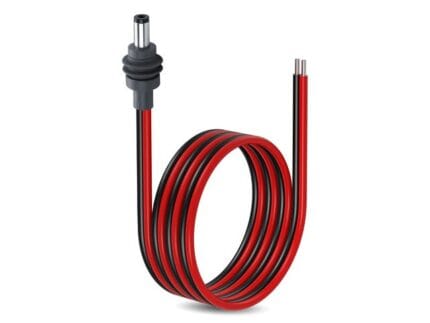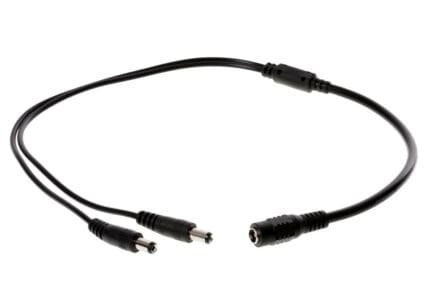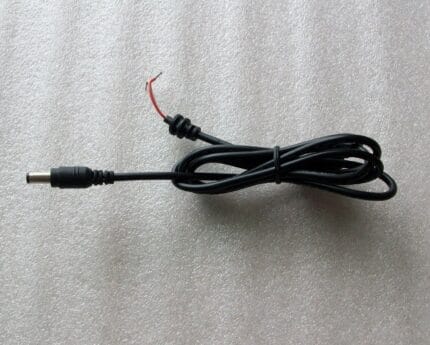
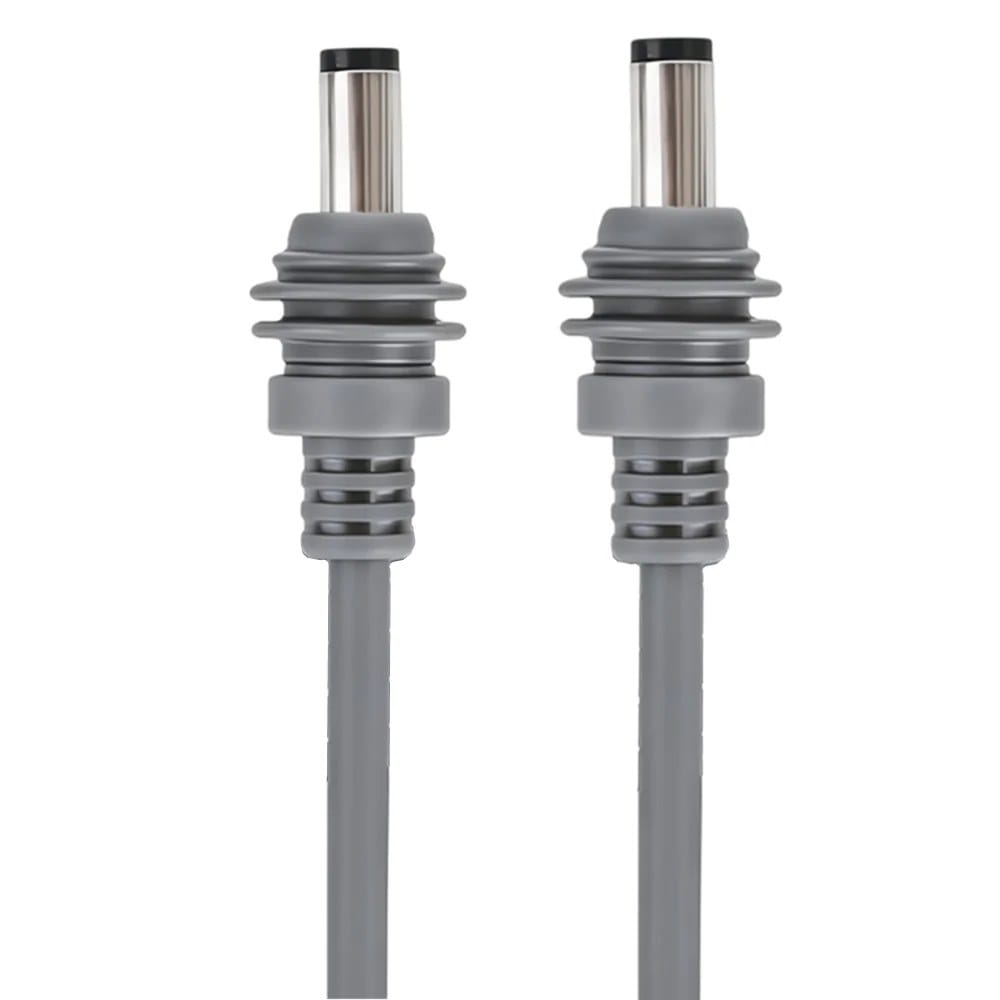
IP67 Waterproof DC Extension Cable 5.5×2.1mm Male to Female, 2 / 3 / 5 m
A waterproof dc extension cable with a sealed threaded 5.5×2.1mm coupler and compression gasket, built for outdoor CCTV, LED signage and solar boxes. 18 AWG on 2 m and 3 m builds, 16 AWG on the 5 m build, with a UV resistant jacket.
Last updated: 13 September 2026
Overview
An unsealed barrel joint is the first thing to fail on an outdoor installation: condensation forms
inside the coupler, the contacts green over, and the camera or the sign starts rebooting at random. This
waterproof DC extension cable uses a sealed threaded coupler with a compression gasket
on the mating faces, so the joint holds up on a pole, under a soffit or inside a solar battery box.
It runs 5.5×2.1mm male to female in 2 m, 3 m and 5 m, with the conductor stepped up on the longest
build.
Key Specifications
| Connector A | DC barrel plug 5.5×2.1mm, center positive |
|---|---|
| Connector B | DC barrel socket 5.5×2.1mm, sealed threaded coupler |
| Ingress rating | IP67 when fully mated (test report pending) |
| Conductor | 18 AWG on 2 m / 3 m; 16 AWG on 5 m |
| Lengths | 2 m / 3 m / 5 m |
| Jacket | UV resistant PVC, -20 to +80 ℃ |
| Polarity | Center positive, straight through |
| Applications | Outdoor CCTV, LED signage, solar enclosures, landscape lighting |
Which gear this fits
This is a continuation lead for anything with a 5.5×2.1mm center-positive barrel — the default across
low-voltage DC equipment. Typical loads:
| Load | Why it ends up on an extension | Length that usually suits |
|---|---|---|
| Outdoor CCTV and PTZ cameras | Supply sits in an enclosure, camera sits on a pole or a soffit | 2 m to 3 m |
| LED signage and light boxes | Driver mounted indoors, sign mounted outside | 3 m |
| Solar generator and battery boxes | The outlet is on the box, the load is not next to it | 2 m to 5 m |
| Landscape and garden lighting | Run has to cross a bed or a path | 5 m |
| Compact satellite terminals and radios | Supply indoors, antenna outside | 3 m to 5 m |
If your gear takes 5.5×2.5mm or 4.0×1.7mm instead, say so — the same sealed build is quoted with a
different barrel at either end, and a IP65
waterproof DC 5521 extension cable covers a slightly lighter duty version of the same job.
Identifying the run you have now
Before you order a replacement, four checks tell you what you need and whether the cable is actually
the problem.
- Measure the barrel. A caliper across the plug gives the outside diameter; the pin
inside gives the second number. A plug that rattles in the socket is the wrong size. - Check the polarity symbol on the supply. Center positive is the convention here and
this cable is straight through, so it passes through whatever it is given. - Look at the joint itself. Green or white crust on the contacts means water has been
in; a clean, dry coupler points at the supply or the load instead. - Measure the voltage at the load end under load. If it is well below the supply
output, the run is too long or too light for the current.
Why the original joint fails
Outdoor DC failures follow a short list, and none of them are mysterious. Condensation is the big
one: a coupler that breathes as the temperature swings draws moist air in at night and holds it, and the
contacts corrode from the inside. Water tracking along the jacket into an unsealed joint is the second,
and it is why a drip loop matters. Ultraviolet light embrittles a general-purpose jacket in two summers,
then the first frost cracks it. And vibration — on a pole or a mast — works a plain friction-fit barrel
loose over a season. A threaded coupler with a compression gasket addresses the first two, a UV resistant
jacket addresses the third, and a screwed rather than a pushed connection addresses the fourth.
What the ingress rating covers
Ingress ratings are defined in IEC 60529 as an industry-wide classification: the first digit covers solid ingress,
with 6 meaning dust-tight, and the second covers liquid, with 7 covering temporary immersion under
stated conditions. Two points matter more than the number. A rating applies to a mated
pair — an unmated socket on a spare port is an open port. And it applies to the assembly as tested,
connector and overmold together, so ask for the report rather than for the figure on a listing. We will
publish the report for this build when supplier testing is complete; until then the IP67 figure is a
design target, and the rating your assembly is built and verified to is the one stated on your drawing.
Conductor choice by length
Short runs are wire-gauge tolerant; long runs are not. The 2 m and 3 m builds use 18 AWG, and the 5 m
build steps up to 16 AWG so that a 12 V load at the far end still sees a usable voltage. If your run is
longer than 5 m, move the supply closer or go up another gauge rather than joining two extensions — every
added coupler is another joint to seal and another place to lose voltage.
Installation notes
- Tighten the coupler by hand, then a quarter turn more. An under-tightened gasket does not seal; an over-tightened one is cut.
- Leave a drip loop below the joint so water does not track along the jacket into the coupler.
- Use a grommet wherever the run passes through a wall or a soffit, and seal the penetration as well as the cable.
- Cut the cable to length only if the run is fixed and the ends will be re-terminated — a cut end loses the sealed overmold.
- Support the run so the coupler does not carry the weight of a hanging loop.
Typical applications for this waterproof DC extension cable
- Outdoor CCTV and PTZ cameras fed from a nearby enclosure
- LED signage and light boxes with the driver mounted indoors
- Solar generator and battery boxes with a 5.5×2.1mm outlet
- Garden and landscape low-voltage lighting runs
- Mast and pole mounts, paired with a Starlink Mini DC extension cable on the same post
- Outdoor LED cabs fed through a COB LED power injection cable at the far end
How to specify your build
- Length — 2 m, 3 m or 5 m, or a custom length.
- Conductor — 18 AWG standard, 16 AWG on the long build, heavier on request.
- Barrel ends — plug to socket as standard; other combinations quoted.
- Jacket — UV resistant PVC stock, or a different compound for oil or burial.
- Testing — whether you need seal checking on the production batch.
- Quantity, and whether samples are needed first.
Workmanship and testing
ISO 9001 governs the line and IPC/WHMA-A-620 Class 3 governs the workmanship. Terminations cover 32 to 12 AWG. No unit is packed before continuity and pinout have been verified, and where an ingress rating is specified we can quote seal checking on the production batch.
Related outdoor DC leads
- IP67 DC to USB-C Cable, 5.5×2.1mm Barrel Power Lead
- 14 AWG DC Barrel Pigtail Cable 5.5×2.1mm to Bare Wire
- Starlink Mini DC Extension Cable
- IP65 Waterproof DC 5521 Extension Cable
- DC7909 Solar Extension Cable 14 AWG
Full range: DC Plug Power Cable.
Frequently Asked Questions
Is the IP67 rating confirmed by test?
Not yet — it is a design target and the supplier test report is pending. We publish the report when it is in hand, and the rating your build is verified to is the one on your drawing.
Can I join two extensions together?
You can, but each joint is another thing to seal. One longer cable in a heavier gauge is the better answer for a run over 5 m.
Do I need to seal the coupler myself?
No. The threaded coupler has a compression gasket; tighten it by hand plus a quarter turn and keep the mating faces clean.
Will the jacket survive permanent sun exposure?
The stock jacket is a UV resistant PVC chosen for permanent outdoor runs. Tell us if the run also sees oil, salt or burial and we will quote a different compound.
What is the minimum order?
Sample quantity starts at 5 pcs with 3 working days to ship. Once the sample is approved, production from 500 pcs takes 14 working days.
| Connector A | DC barrel plug 5.5×2.1mm, center positive |
|---|---|
| Connector B | DC barrel socket 5.5×2.1mm, sealed threaded coupler |
| Ingress rating | IP67 when fully mated |
| Conductor | 18 AWG on 2 m / 3 m; 16 AWG on 5 m |
| Lengths | 2 m / 3 m / 5 m |
| Jacket | UV resistant PVC, -20 to +80 C |
| Polarity | Center positive, straight through |
| Applications | Outdoor CCTV, LED signage, solar enclosures, landscape lighting |