
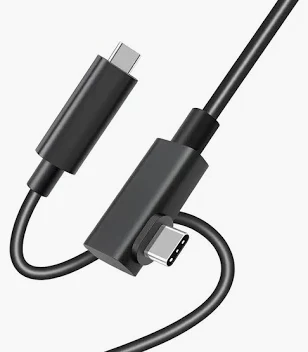
VR Link Cable, 5 m Hybrid Fiber with 90 Degree Headset End
A vr link cable built as a hybrid runs the data path over optical fiber and the power over copper, so a five meter lead stays thin and light enough to forget about. 90 degree molded headset end, angled USB-C, strap supplied.
Overview
A tethered headset is the one place where cable weight and drag are felt directly by the user, because the lead moves with the head. A vr link cable built as a hybrid solves that: the data path runs over optical fiber while power and control travel over copper, which is how a five meter lead stays thin and light enough that you stop noticing it. The angled molding at the headset end routes the cable back along the strap instead of sticking out sideways where it catches on a shoulder and levers against the port.
Key Specifications
| Interface | USB-C to USB-C |
|---|---|
| Headset end | 90 degree angled molding |
| Construction | Hybrid fiber and copper |
| Nominal length | 5 m (further lengths on request) |
| Cable management | Hook and loop strap supplied |
| Outer diameter | Slim profile, exact figure pending production sample |
| Fitment | PC-tethered headsets with a USB-C link |
| Options | Straight or angled on either end, extra strain relief for long sessions |
Why fiber for a five meter run
| Copper at 5 m | Hybrid fiber at 5 m | |
|---|---|---|
| Weight | Noticeable pull on the head strap | Light enough to forget |
| Stiffness | Kinks and fights back when coiled | Drapes and coils easily |
| Bulk | Thick jacket and heavy shielding | Slim outer diameter |
| Drag across a play area | Pulls the headset sideways | Follows without tugging |
A copper assembly long enough to carry a high speed data signal at five meters ends up thick, stiff and heavy, and all of that weight hangs off the head strap. Moving the data path to fiber removes most of that bulk.
What the copper still has to do
Fiber carries the data, but the headset also has to be powered and it has to talk to the PC before the link comes up. That is the copper part of a hybrid build, and it is why the assembly is not simply a thin optical lead.
- Power delivery from the PC port to the headset, so the cable has to carry current as well as light.
- Control and enumeration, which is what makes the headset appear as a device when it is plugged in.
- Enough conductor size that the voltage at the headset end is still usable after five meters — this is the dimension that separates a hybrid that works from one that browns out under load.
Sustained charging behavior under load and the exact outer diameter both sit on our confirmation list. We publish them against a production sample and a bench test rather than against a competitor listing.
Bend radius: the one handling rule that matters
Optical fiber is robust in tension and much less forgiving in a tight bend. A copper cable can be folded; a fiber section that gets folded around a chair arm or a desk edge is how these leads die.
| Handling | Why | What to do instead |
|---|---|---|
| Tight kinks and folds | Exceeds the bend radius of the fiber section | Coil in loose loops of a hand span or more |
| Tangling at the headset end | Sideways leverage on a small port | Use the angled molding and the supplied strap |
| Stepping on the cable | Crushes the fiber under a point load | Route across the back of the play area |
| Pulling the lead to disconnect | Loads the connector instead of the body | Grip the connector, not the cable |
Fitment and the angled end
The angled connector is the detail that makes this usable in practice. A straight plug sticking out sideways catches on the strap and on your shoulder, and the leverage eventually damages the port. The 90 degree molding routes the cable back along the head strap instead. This assembly is intended for PC-tethered headsets that accept a USB-C link. Confirm the port position on your headset before ordering, since the angled molding needs clearance on one side, and tell us which side that is.
Typical applications for this vr link cable
- PC-tethered gaming and simulation rigs where five meters of freedom is the point
- Training and simulation bays running sessions for hours at a time, alongside our USB-C active optical cable for longer fixed runs
- Arcade and location-based entertainment installations
- Product demonstration and showroom setups where the cable has to look tidy
- Motion capture and volumetric stages, paired with our Cat6A fiber hybrid cable on the capture side
Ordering
Standard build is five meters with an angled headset end and a straight connector at the PC. Other lengths, straight-to-straight and angled-to-angled variants are available for volume orders. Where the cable will be used in a training or simulation setting that runs for hours at a time, tell us and we will quote a build with additional strain relief at the headset end.
Points to confirm
- Data rate and charging power figures are taken from competitor listings, not our own tests.
- Outer diameter needs confirmation against production samples.
- Bend radius limits for the fiber section need supplier data.
- Sustained charging behavior under load needs bench testing.
Workmanship and testing
Terminations on VR Link builds run from 32 to 12 AWG, and the work is held to IPC/WHMA-A-620 Class 3 inside an ISO 9001 system. No VR unit is packed until 100% continuity and pinout check out, and seal checking is quoted whenever an ingress rating is on the drawing.
Material declarations against RoHS and REACH are issued per project, alongside the dimensional and electrical reports agreed at quotation; see certifications, compliance and material declarations. Where your drawing names a UL style or another approval, the build follows your drawing and ships with the supporting document rather than a claim of our own. Exit direction is a tooling decision, not a field bend see right-angle exit tooling options for the forms we mold and when each one makes sense. Related reading: what stage and studio work demands. Tooling for this build is cut in our own tool room and belongs to your program, so a repeat run years later starts from the same tool.
Custom builds and ordering
VR Link prototypes start from 1 to 50 pcs and ship in 3 working days; series supply starts at 500 pcs and takes 14 working days after approval. Tooling not already held adds around 10 working days. VR builds ship under your part number and labeling for OEM and ODM orders, and material certificates and first-article reports are on offer.
Related USB-C and optical links
- USB-C active optical cable for long-reach USB4 class links
- USB4 80 Gbps cable for docks, 8K displays and eGPU enclosures
- Car USB-C data cable with right angle plug for dashboard use
- Right angle USB-C cable, 80 cm, for tight desk and wall setups
- USB-C Gen2 data cable, 10 Gbps, with 100 W power delivery
Full range: audio and video cable assemblies.
Frequently Asked Questions
Why is it a hybrid rather than all fiber?
The headset has to be powered and has to be recognized by the PC before the data link comes up. That needs copper alongside the fiber.
Can I coil it tightly?
No. Coil in loose loops. A tight fold exceeds the bend radius of the fiber section and is the usual way these leads fail.
Which side does the angled connector exit?
Whichever you need. Confirm the port position on your headset and tell us the side before ordering.
Do you publish the charging figures?
Not yet. Sustained charging behavior under load needs bench testing, and we would rather quote a measured result than repeat a competitor listing.
| Interface | USB-C to USB-C |
|---|---|
| Headset end | 90 degree angled molding |
| Construction | Hybrid fiber and copper |
| Nominal length | 5 m (further lengths on request) |
| Cable management | Hook and loop strap supplied |
| Outer diameter | Slim profile |
| Fitment | PC-tethered headsets with a USB-C link |
| Options | Straight or angled on either end, extra strain relief for long sessions |
Related products
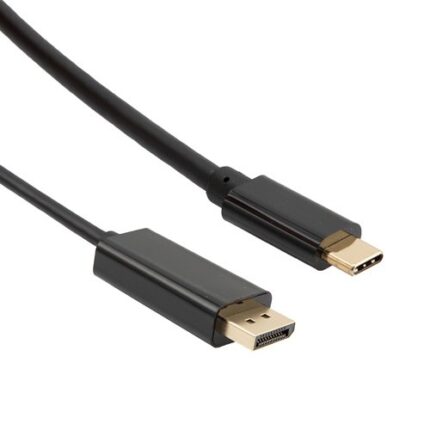
USB-C to DisplayPort Cable for High Refresh Monitors
A USB-C to DisplayPort cable carries native DisplayPort signaling out of a USB-C port, bi-directional and without a converter in the path. Latching shell, gold plated contacts, reinforced molding at the USB-C end. Tell us your source, monitor and target refresh format and we will build the length to it.