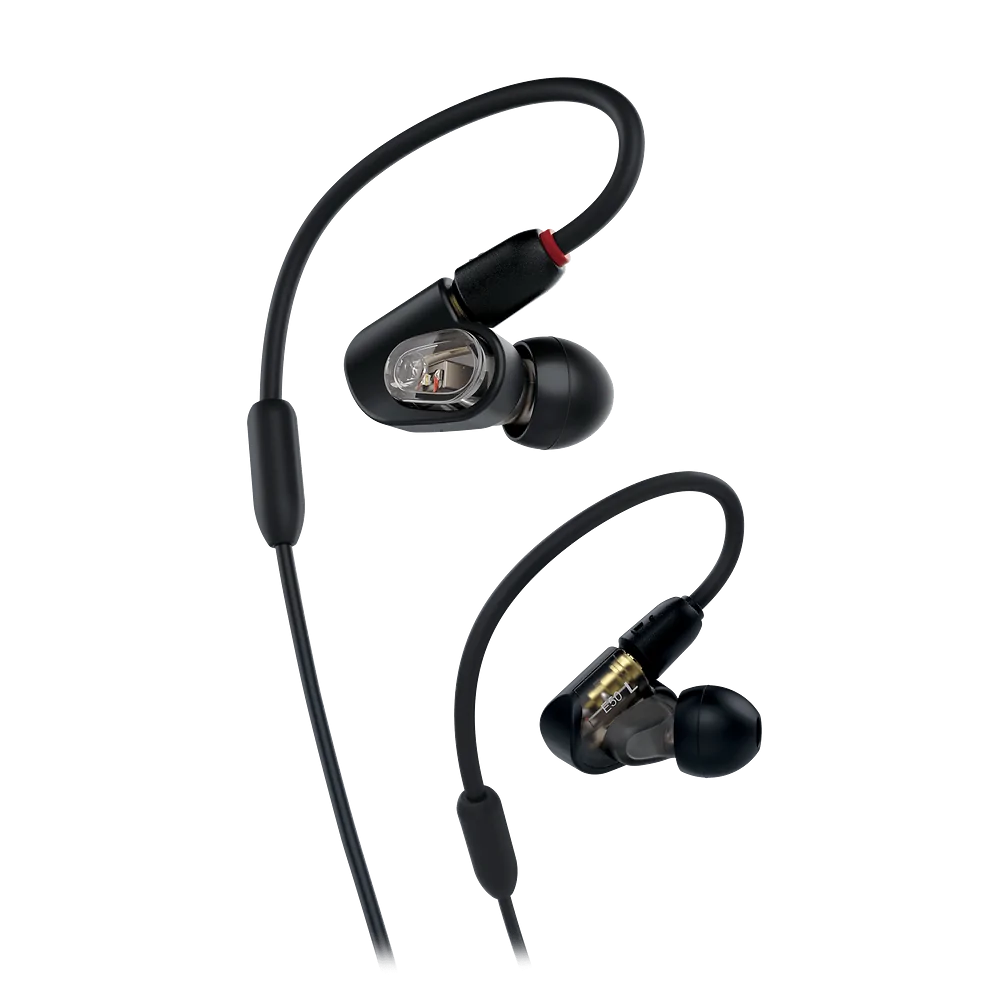
Earphone Memory Wire Cable with Formable Ear Hook
An earphone memory wire cable carries audio and mic signals while a stainless shaping core holds the over-ear bend you set. Conductor count, jacket and terminations are built to your drawing, not pulled off a shelf.
What an earphone memory wire cable has to survive
An earphone memory wire cable has to do two jobs that pull against each other. It has to hold the bend set at the factory, survive the wearer re-shaping it every time the earpiece goes in, and keep that shape through pocket heat and bag crush. At the same time it is still a cable: audio conductors, often a microphone pair, sometimes control lines, all packed into the section that gets bent more often than anything else on the product.
The build we run most often puts enameled copper and a stainless shaping wire in one cable. The copper carries the signal. The steel core does no electrical work at all; it simply holds the shape. That division is what lets an ear hook stay where you put it without a clip, a molded stiffener or an external stay. Winding the conductor around the core rather than laying the two side by side keeps the section round and keeps it to one cable instead of two that would need taping or sleeving later.
Formable is the word that matters here. Read the next section before you send us a drawing.
Formable is not shape memory, and mixing them up costs a sample round
Two very different materials get sold under the name memory wire, and confusing them is the fastest way to waste a round of samples.
| Formable stainless (what we build) | Shape memory alloy (what we do not) | |
|---|---|---|
| What it does | Stays where you bend it | Springs back to a trained shape when heated |
| Mechanism | Plastic deformation of the metal | Solid-state phase transformation |
| Typical material | Stainless steel shaping wire | Nickel-titanium alloy |
| Fits | Ear hooks, headset positioning, routing that has to stay put | Actuators, latches, thermal triggers |
| Relative cost | Low | High |
| Termination | Crimp, weld or captured in the overmold | Crimp or resistance weld; will not take solder |
We build the left column. If your headset needs a wire that actively pulls itself back to a trained curve when current or heat is applied, that is a shape memory actuator, it belongs to a different supply chain, and it is not what this page covers. Tell us early and neither of us spends money finding out.
Which core does the ear hook need?
The core decides how the hook feels in the hand and how long it lasts, and it is the first thing to settle.
| Core type | How it behaves | Where it fits |
|---|---|---|
| Single solid wire | Crisp bend, firmest hold, lowest cost | Over-ear hooks on light headsets |
| Stranded or bunched core | Softer hand, gentler curve, survives more re-bending | Sports and call-center headsets re-shaped daily |
| Served bundle (textile or film wrap over the core) | Shields the enamel from the steel, longest bend life | High-cycle products, thin enamels, tight hook radii |
| Twin or flat core | Resists twist, keeps the bend in one plane | Hooks that must not roll off the ear |
The fastest way to settle it is to tell us the curve the hook has to hold and roughly how many times it will be re-bent in service. Those two answers narrow the field faster than any datasheet.
Why the ear hook is the first thing to fail
On this construction the enameled conductor sits directly against a steel core, so every re-bend rubs the coating against metal that is harder than the coating. Enough cycles and the enamel goes through: the copper touches the core and you get a fault that only appears when the hook is held at one particular angle. In the field that shows up as crackle, dropouts or one channel cutting out when the wearer turns their head.
Three things set how long that takes. Bend radius is the biggest: a tight hook loads the winding far harder than a gentle curve. The second is whether anything sits between the copper and the steel, which is what the served core in the table above is for. The third is the enamel grade, and that one carries a real trade-off.
Solderable or scrape-resistant enamel: pick one for the hook
The coating on the conductor has two jobs that pull in opposite directions. It has to survive being rubbed against steel, and it has to come off cleanly at the ends so the conductor can be terminated.
| Enamel family | Comes off in a solder pot | Abrasion resistance | Choose it when |
|---|---|---|---|
| Solderable polyurethane | Yes, at the temperature your wire supplier specifies | Moderate | Termination yield and speed matter most |
| Solderable polyester or polyesterimide | Yes, at a higher bath temperature | Good | You need a higher thermal class and solder stripping |
| Standard polyesterimide, polyamideimide, polyimide | No, needs chemical, mechanical or laser removal | Very good | Bend life dominates and you can accept slower stripping |
Solderable coatings come off with controlled immersion, stripping and tinning the strands in a single pass. We will not pretend that works for every enamel, and if the grade on your drawing calls for chemical, mechanical or laser removal we will say so before quoting. On fine headset conductors the stripping method drives yield, so it is worth settling early.
For background on the equipment this construction serves, see the general reference on headphones.
Where the cable ends: earphone housing, plug and microphone
Solder will not wet stainless the way it wets copper. Ordinary rosin flux leaves a cold joint, and anything aggressive enough to bite into the steel leaves residue we would not want on a headset. In most builds the core is not part of the electrical path at all: it is crimped, spot welded, or captured inside the overmold at the strain relief so it cannot migrate.
Adding a microphone or an inline control changes more than the conductor count. More conductors mean a bigger bundle, a larger jacket, and a hook section that behaves differently; usually the core diameter has to come down to keep the same hand feel. We settle conductor count and core diameter together for exactly that reason, and it is cheaper to do on paper than on a second sample round. Where the headset end has to be a serviceable plug rather than a fixed cable, our Plantronics headset bottom terminal cable and Plantronics headset QD cable are built under the same discipline; for tight housings that need the plug to exit at an angle, see the 3.5mm TRRS 4-pole right angle cable.
Jacket, hand feel and what the wearer notices
The hook is the part the customer actually touches, so jacket choice is a product decision and not only an electrical one. Soft-touch compounds feel better against skin and stay flexible in the cold. PVC costs less and takes color well. Silicone is the softest and the most resistant to sweat, but it picks up lint. Each one creeps differently over time, which matters because the jacket itself contributes to how well the bend holds.
We do not certify a jacket to any particular skin-contact or safety standard. You specify the material and the documentation you need, and we build to that.
What we need from you to quote
| Item | Why it moves the quote |
|---|---|
| Hook curve and bend radius | Sets core type, stiffness and bend life |
| Re-bend cycles expected | Drives core and serving choice, and qualification testing |
| Conductor count and size | Sets what the cable carries and its overall diameter |
| Enamel grade | Decides the stripping process and the tool set |
| Jacket material and color | Hand feel, cleaning and lead time |
| Terminations at both ends | Drives tooling; we cut our own molds |
| Length, tolerance and quantity | Standard quoting input |
How we build and inspect them
Assembly runs in Shenzhen on four lines with around forty operators, and tooling is cut on site, so a custom overmold does not push the schedule out by weeks. Minimum order is typically 500 pieces, samples go out in roughly three days, and a production run takes about two weeks, process dependent. Each cable is built and inspected to IPC-WHMA-A-620 Class 3 and gets a 100% continuity and pinout check before it ships. Straight audio leads for the same program run through the same bench, as with our 3.5mm stereo Y splitter cable. Where a design is better served by a cable that retracts than one that holds a shape, start from a coiled retractable cable, and for this construction in its most general form see the memory wire composite harness.
Frequently asked questions
Does the steel core take solder?
Not with any process we would ship. Expect a crimp, a spot weld, or the core trapped inside the overmold.
How many times can the hook be re-bent?
We do not quote a cycle figure, because core type, hook radius and the serving layer all move it. Give us your duty cycle and we will test to it.
Will your line strip the enamel we use?
Only the solderable families. Those come off in a controlled bath; the high-temperature coatings need chemical, mechanical or laser removal instead.
Do you stock these?
No. Every earphone memory wire cable is built to your drawing.
Everything on this page is general guidance. Each cable is built and inspected to your drawing.
| Construction | Enameled copper wound on a stainless shaping core |
|---|---|
| Core Material | Stainless steel shaping wire, formable / dead-set |
| Core Diameter | Stated per your drawing |
| Conductor | Enameled copper, wound on the steel core |
| Conductor Count | Stated per your drawing |
| Conductor Size | Stated per your drawing |
| Enamel Grade | Stated per your drawing (solderable or scrape-resistant) |
| Jacket Material | Stated per your drawing |
| Overall Diameter | Stated per your drawing |
| Bend Cycles | Stated per your drawing |
| Termination | Stated per your drawing |
| Build and Inspection | IPC-WHMA-A-620 Class 3, 100% continuity and pinout, ISO 9001 |