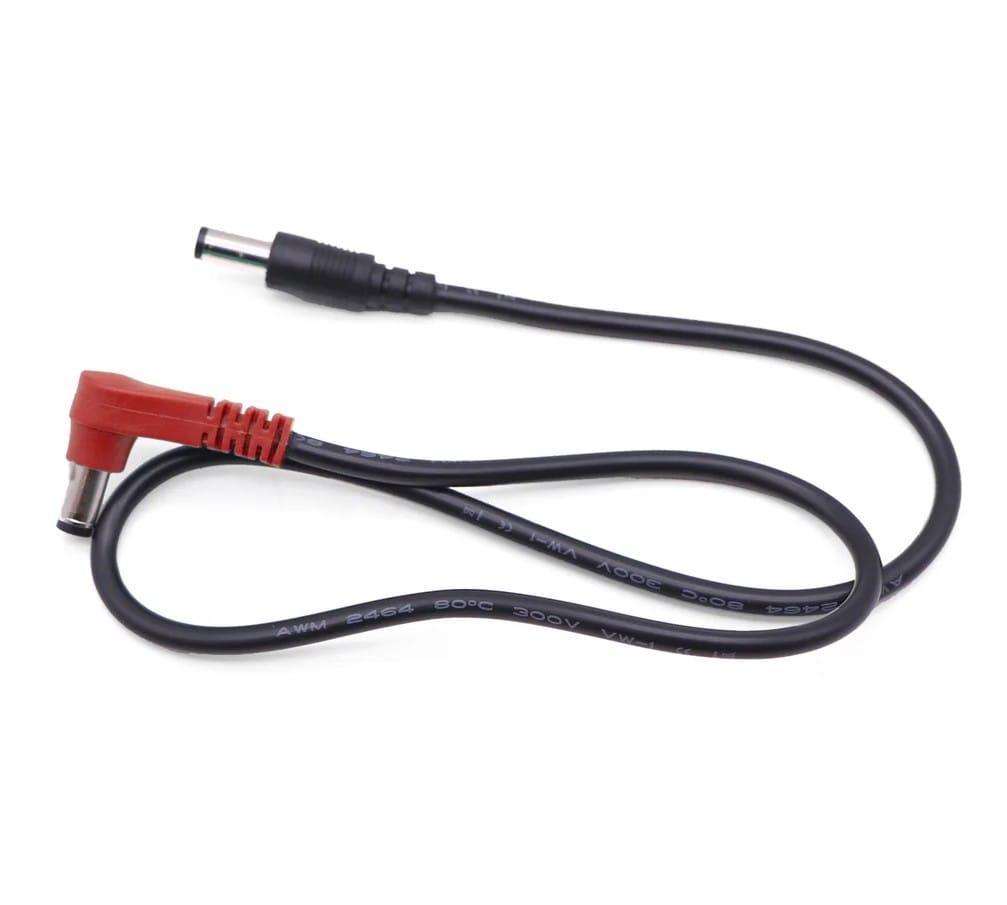
Reverse Polarity DC 5521 Power Cable
This reverse polarity 5521 cable is a DC 5.5 x 2.1 mm lead wired center negative, the opposite of the usual center-positive convention, for older or specialized equipment.
Red and black molded housings make the inverted pinout obvious.
Overview
A reverse polarity 5521 cable is a DC 5.5 x 2.1 mm lead wired center negative – the opposite of the convention almost everything else uses. It exists because a minority of equipment, much of it older or built to a vendor-specific standard, expects the inverted pinout, and because the cost of getting it wrong is a destroyed input stage. Both ends of this assembly are center negative, and the plug housings are molded red and black so the difference is visible on the bench and in the bag.
Key Specifications
| Connector A | DC 5.5 x 2.1 mm male, center negative |
|---|---|
| Connector B | DC 5.5 x 2.1 mm female, center negative |
| Polarity | Center negative (reverse polarity) |
| Cable marking | AWM 2464 80 C 300 V VW-1 jacket print |
| Jacket | Black PVC |
| Housing colors | Red on the center conductor, black on the shield return |
| Conductor | Stranded copper; gage stated per your drawing |
| Length | Stated per your drawing |
| Application | Legacy / specialty DC gear with inverted polarity |
Reading the polarity symbol on the device
Almost every DC device prints a small diagram near its jack: a circle with a dot in the middle, and plus and minus signs arranged around it. The dot is the center contact and the ring is the sleeve.
| Symbol | Meaning | Which cable you need |
|---|---|---|
| Plus at the center dot, minus at the ring | Center positive | The standard 5521 lead |
| Minus at the center dot, plus at the ring | Center negative | This reverse polarity lead |
| No symbol at all | Unknown – do not guess | Check with a meter first |
Where the symbol is missing or illegible, check with a meter before you connect. With the supply energized and nothing attached to it, put the multimeter black lead on the outside sleeve of the plug and the red lead on the inside contact. A positive reading means center positive; a negative reading means center negative. That takes twenty seconds and it is the only reliable way to be sure.
Why the wrong polarity destroys equipment
Most DC inputs are protected by a diode or a bridge at best, and by nothing at all at worst. Reverse the supply across an input with no protection and current flows through paths that were never meant to carry it – the bypass capacitors, the regulator substrate, the protection diode itself. The failure is usually immediate and usually visible only as heat. Two rules follow from that: never assume the convention, and never use an unmarked supply on a device you cannot replace.
- Legacy networking gear and some point-of-sale peripherals are the usual suspects.
- If you have a mixed estate, store reverse-polarity leads separately and mark them.
- Where a device is valuable, fit a polarized connector that cannot be reversed rather than relying on a barrel.
- If you are unsure, ask us to build both and label them – it is cheaper than one returned unit.
Why both ends are molded in color
Red on the housing carrying the center conductor and black on the shield return is a deliberate choice on this part. A reverse-polarity lead that looks identical to a standard one will eventually be plugged into standard gear, and the housings are the last line of defense. The jacket print is retained as well, so the cable can be identified from anywhere along its length rather than only at the plug.
Typical applications for this reverse polarity 5521 cable
- Legacy networking equipment documented as center negative
- Certain LED controllers and lighting interfaces with inverted input
- Point-of-sale peripherals and specialty vendor gear
- Any DC device whose label or schematic calls for center-negative 5.5 x 2.1 mm input
- Service stock for a mixed estate where both conventions are in use
How to specify your build
- Polarity – confirm center negative against the device symbol or a meter reading.
- Whether both ends need to be center negative, or only the device end.
- Length and conductor gage, sized to your load and run.
- Load current, steady and peak.
- Housing and jacket color – red and black is the default here.
- Any print or labeling you want on the cable.
- Quantity.
Workmanship and testing
Build standard for Reverse Polarity DC 5521 builds is IPC/WHMA-A-620 Class 3 under ISO 9001, with terminations from 32 to 12 AWG. continuity and pinout are checked on every Reverse unit before packing, and seal checking is quoted whenever an ingress rating is on the drawing.
RoHS and REACH declarations are provided per project together with the agreed test reports; the documentation scope is listed under certifications and compliance. If your drawing specifies a UL style, we build to that drawing and supply the UL reference with the shipment instead of substituting an equivalent. The molded body is shot on our own presses; material choice and bond behavior follow the process described under overmolding and injection molding. The wider context is covered under our marine and outdoor work. Any tooling we cut for this part stays yours, maintained in our own tool room under your part reference.
Custom builds and ordering
On Reverse Polarity DC 5521 builds, prototype lots run from 1 to 50 pcs and leave in 3 working days; production runs of 500 pcs and up ship 14 working days after approval. Tooling not already held adds around 10 working days. Reverse OEM and ODM shipments carry your part number and labeling, and material certificates and first-article reports are available on request.
Related DC plug power cables
- DC 5525 Male to Bare Wire Power Cable
- 14 AWG DC Barrel Pigtail Cable to Bare Wire
- DC 5525 Female to Male Adapter Cable
- DC Barrel Adapter Kit, 5521 / 5525 / 4017 / 3513
- USB A to DC 5521 Male Power Cable
- IP67 Waterproof DC Extension Cable 5.5×2.1mm
Full range: DC plug power cable assemblies.
Frequently Asked Questions
How do I know if my device is center negative?
Read the symbol printed next to the jack: if the minus sign sits at the center dot, it is center negative. If there is no symbol, check the supply plug with a meter before connecting.
Can I use this on standard center-positive gear?
No. It is built for equipment that explicitly calls for center negative. Connecting it to standard gear can damage the input.
Can you make only one end center negative?
Yes. Polarity is a build note on each end – tell us which end has to be reversed and we will wire it that way.
Is the red and black housing just cosmetic?
No, it is the point. It makes a reverse-polarity lead impossible to confuse with a standard one on a bench or in a service bag.
| Connector A | DC 5.5 x 2.1 mm male, center negative (reverse polarity) |
|---|---|
| Connector B | DC 5.5 x 2.1 mm female, center negative (reverse polarity) |
| Polarity | Center negative (reverse polarity) |
| Cable Marking | AWM 2464 80 C 300 V VW-1 |
| Jacket | Black PVC |
| Application | Legacy / specialty DC gear with inverted polarity |
| Housing Colors | Red on center conductor, black on shield return |
| Length | Stated per your drawing |