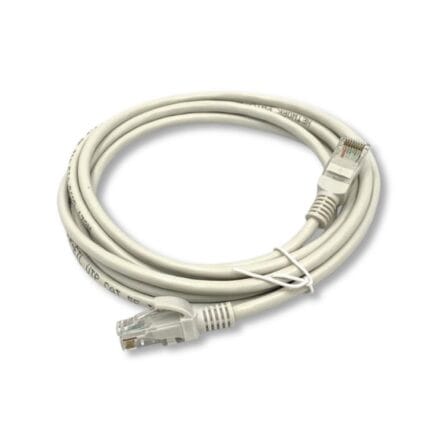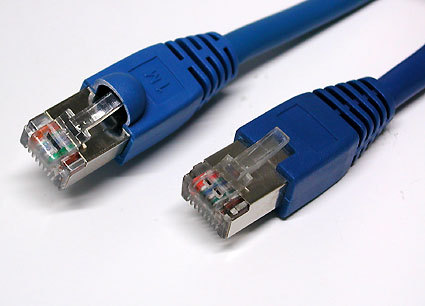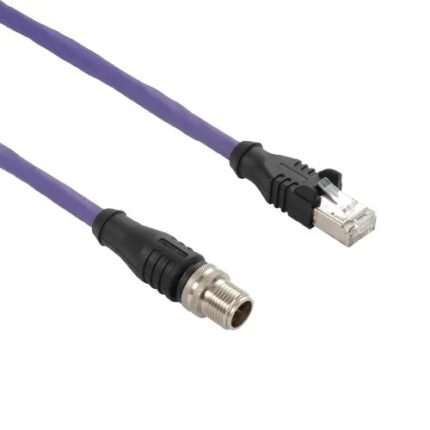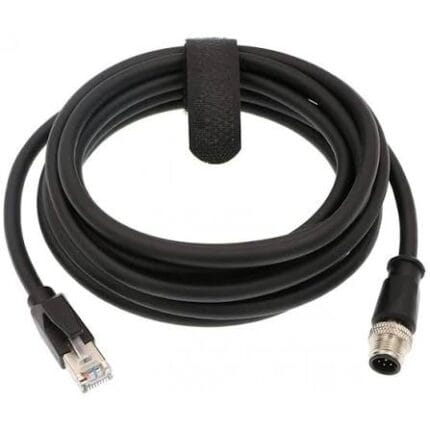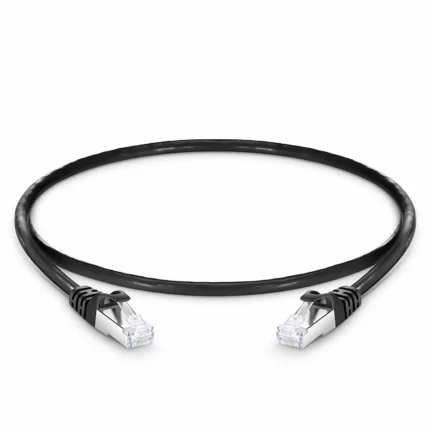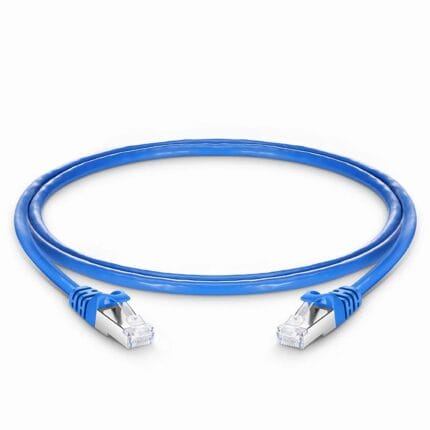
Cat7 S/FTP Patch Cord (600 MHz, TERA / GG45, PIMF, LSOH)
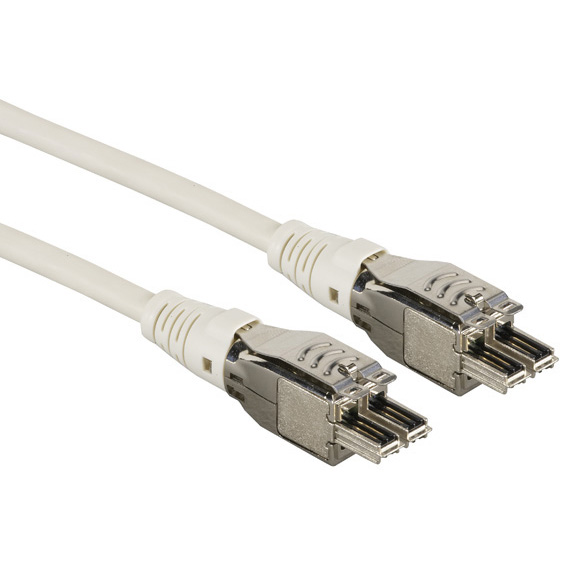
A cat7 patch cord in S/FTP PIMF construction to 600 MHz Class F, terminated TERA, GG45 or RJ45, on a low-smoke LSOH jacket.
Overview
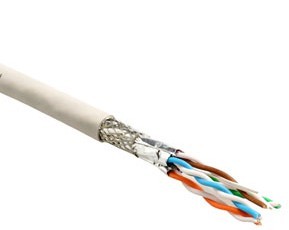
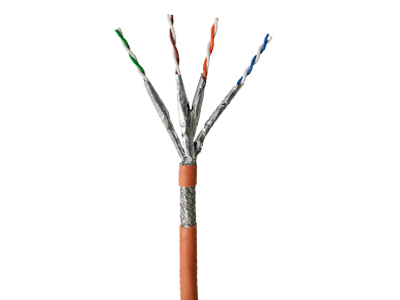
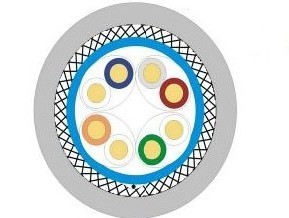
A cat7 patch cord is a Class F build: defined in ISO/IEC 11801 at 600 MHz, with every pair wrapped in its own foil before the overall braid goes on. That per-pair screening is what people mean by PIMF, and it is the reason a Cat7 cord is noticeably stiffer than a Cat6A one. The thing worth knowing before you order: Cat7 is an ISO/IEC classification, not a TIA category, and the connector on the end matters more here than for any other Ethernet cord.
Key Specifications
| Cable type | Cat7 S/FTP, 4-pair PIMF |
|---|---|
| Class | Class F, 600 MHz, ISO/IEC 11801 industry-general definition |
| Individual screen | Aluminum/polyester foil per pair |
| Overall screen | Tinned copper braid |
| Connector | TERA, GG45 or RJ45 — to order |
| Impedance | 100 ohm class |
| Sheath | LSOH low-smoke compound |
| Bend radius | Expressed as a multiple of outside diameter; stated per order |
| Length | OEM build, stated per order |
What Class F covers
The ISO/IEC 11801 series defines channel classes by frequency, and the TIA category system is a parallel but separate set of component specifications. They line up most of the way and then diverge, which is where the confusion about Cat7 comes from.
| Class / category | Frequency | Construction | Defined by |
|---|---|---|---|
| Class D / Cat5e | 100 MHz | UTP or FTP | Both systems |
| Class E / Cat6 | 250 MHz | UTP or F/UTP | Both systems |
| Class EA / Cat6A | 500 MHz | UTP, F/UTP or S/FTP | Both systems |
| Class F / Cat7 | 600 MHz | S/FTP, pairs individually screened | ISO/IEC 11801; no TIA category |
| Class FA / Cat7A | 1000 MHz | S/FTP | ISO/IEC 11801; no TIA category |
| Class I and II / Cat8 | 2000 MHz | S/FTP, 22 AWG | Both systems, to 30 m |
That gap in the fourth row is the important one. There is no TIA Category 7, so a North American project written against ANSI/TIA-568 usually jumps from Category 6A to Category 8. Cat7 is specified on projects written against ISO/IEC 11801, which is why you see it across Europe and Asia and rarely in a US specification. These are industry-general definitions; what your cord is built and verified to is stated per order.
TERA, GG45 and RJ45: the connector question
This is where Cat7 builds go wrong in the field. Class F was written around a higher-frequency connector, and the plug you terminate decides whether you actually get Class F or just an expensive Cat6A.
| Connector | Standard | Accepts an RJ45 plug | What it means |
|---|---|---|---|
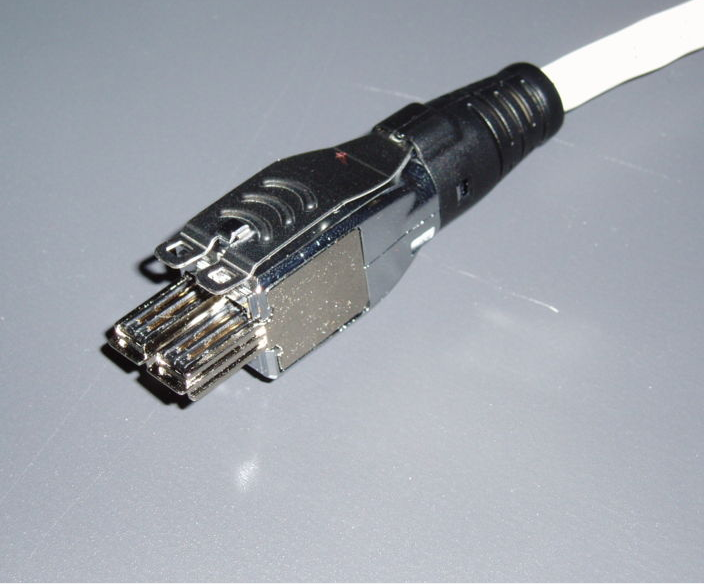
| TERA | IEC 61076-3-104 | No | Full Class F performance; needs a TERA jack throughout |
| GG45 | IEC 61076-3-110 | Yes | Class F on the outer contacts; takes a standard RJ45 as well |
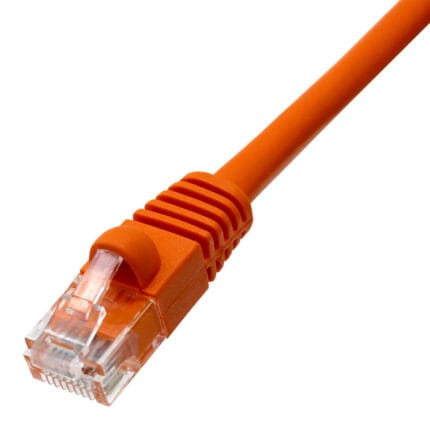
| RJ45 | IEC 60603-7 | Yes | Simplest build; performance limited by the plug, not the cable |
Plain advice: if your jacks and patch panels are RJ45, an RJ45-terminated Cat7 cord behaves like a very good Cat6A cord. If you want Class F end to end, every component in the channel has to be Class F, including the jacks. Ordering a TERA cord into an RJ45 panel accomplishes nothing.
Choosing between Cat6A, Cat7 and Cat8
| Cat6A | Cat7 | Cat8 | |
|---|---|---|---|
| Channel frequency | 500 MHz | 600 MHz | 2000 MHz |
| Typical application | 10GBASE-T to 100 m | 10GBASE-T, shielded environments | 25/40GBASE-T to 30 m |
| Connector | RJ45 | TERA, GG45 or RJ45 | RJ45 |
| Stiffness | Moderate | High | High |
| Choose it when | You need 10G and a standard RJ45 plant | The project is written to ISO/IEC Class F | You need 25 or 40G over copper in a rack |
Bend radius and installation
Per-pair foil plus overall braid makes this the stiffest patch cord in the range, and stiffness is what causes installation damage. Keep the bend radius generous — it is normally expressed as a multiple of the cable outside diameter, and the value your build is made and tested to is stated per order. Do not tie it down hard, and do not dress it into a manager designed for slim Cat5e. The second common mistake is the shield: with this much screening, a cord that is not drained into a shielded jack gives up most of what you paid for.
Typical applications for this cat7 patch cord
- Data center and server room links written to ISO/IEC Class F
- Broadcast and studio plants with heavy RF in the rack
- Industrial and medical environments with Class F panels already installed
- Machine vision and high-speed camera links — see our Cat8 Ethernet Patch Cord for 25 and 40G over copper
- Any shielded plant where the panels and jacks are already Class F
How to specify your build
- Connector — TERA, GG45 or RJ45, and what the panel actually is.
- Length, and the bend radius available on the route.
- Jacket — LSOH as standard; other compounds on request.
- Shield termination — confirm the jacks and panels are shielded and grounded.
- Category — confirm whether the project is written to ISO/IEC or TIA.
- Quantity and labeling.
Workmanship and testing
Assembly and inspection follow IPC/WHMA-A-620 Class 3 workmanship criteria under our ISO 9001 quality management system, and every unit is 100% continuity and pinout tested before it is packed. Conductor range is 32 to 12 AWG. Screen coverage and plug termination are checked against the connector standard on the first article. Where a standard sets a limit for the category, the connector interface or the jacket, that is the industry-general definition of the rating. The values your assembly is built and verified to are the ones stated on your drawing, per order.
RoHS and REACH declarations are provided per project together with the agreed test reports; the documentation scope is listed under certifications and compliance. If your drawing specifies a UL style, we build to that drawing and supply the UL reference with the shipment instead of substituting an equivalent. Overmold tooling for this part is designed and cut in our own tool room under the overmold tooling we build in-house, so the tool belongs to your program and a revision is a machining job rather than a new negotiation. Related reading: what automation programs ask for.
Custom builds and ordering
Cat7 S/FTP prototype builds start from 1 to 50 pcs and are out in 3 working days; production is quoted from 500 pcs at 14 working days after approval. Your part number and labeling go on OEM and ODM Cat7 shipments, and material certificates plus first-article reports are available. New tooling adds about 10 working days, and we hold 100 sets of mold tooling in house.
Related high-frequency shielded assemblies
- Cat8 Ethernet Patch Cord, S/FTP 22 AWG
- Cat7 SSTP Patch Cord
- Cat6A Shielded Patch Cord, S/FTP 26 AWG
- Cat6 S/FTP Shielded RJ45 Patch Cord
- ix Industrial Cat6A Patch Cord
- Cat6A UTP Patch Cord, 28 AWG
Full range: Ethernet patch cord range.
Frequently Asked Questions
Is Cat7 better than Cat6A?
It is defined to a higher frequency, 600 MHz against 500 MHz. Whether you gain anything depends on the connector: with RJ45 plugs on both ends, the plug is the limit.
Will a TERA plug fit an RJ45 jack?
No. TERA is a different interface. GG45 accepts a standard RJ45 plug, which is why it is the common compromise.
Why is there no TIA Category 7?
The TIA category system goes 6A to 8. Cat7 exists in ISO/IEC 11801 as Class F. Projects written to ANSI/TIA-568 usually skip it.
Is Cat7 worth it for a 10G link?
Usually Cat6A is the better value — it is defined for 10GBASE-T over the full 100 m channel on RJ45 and costs less.
| Individual screen | Aluminum/polyester foil per pair |
|---|---|
| Overall screen | Tinned copper braid |
| Connector | TERA, GG45 or RJ45 — to order |
| Bend radius | Expressed as a multiple of outside diameter; stated per order |
| Cable type | Cat7 S/FTP, 4-pair PIMF |
| Class | Class F, 600 MHz, ISO/IEC 11801 industry-general definition |
| Sheath | LSOH low-smoke compound |
| Impedance | 100 ohm class |
| Length | OEM build, stated per order |