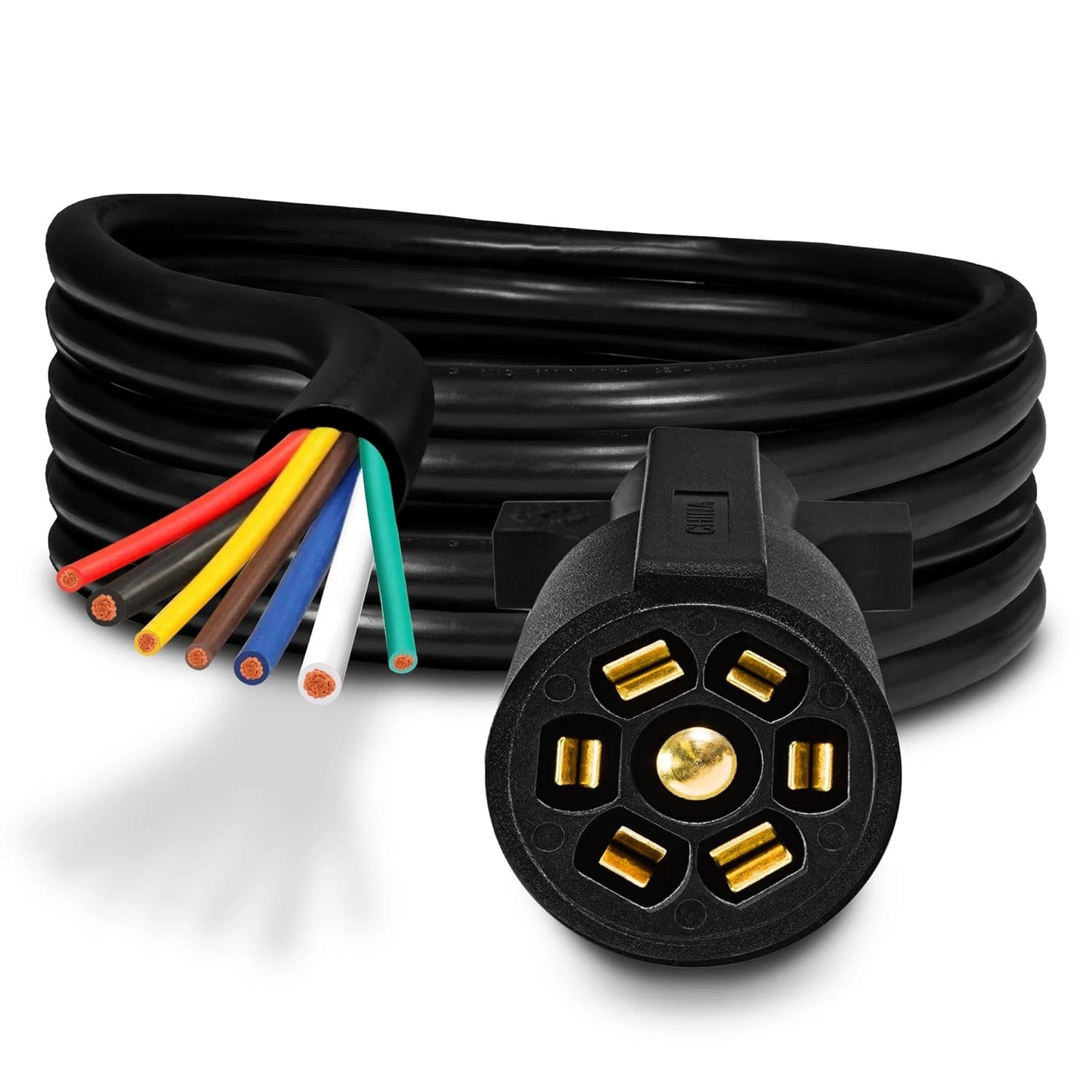
7-Way RV Trailer Wiring Harness, Overmolded Blade Plug
A 7 way trailer wiring harness with an overmolded RV blade plug, seven color-coded circuits and a sealed strain relief, built to the length and wiring schedule you send.
Overview
This 7 way trailer wiring harness carries every circuit a light-duty trailer needs — tail and running lights, both stop and turn circuits, electric brake feed and an auxiliary supply — through one molded blade plug, so the connection between tow vehicle and trailer is made and broken as a single sealed assembly.
The heavy-duty trucking side uses a different, larger connector family, which is why towing electrics are specified in two separate worlds. This build addresses the light-duty side: camper trailers, caravans, boat trailers, utility and horse trailers, where the requirement is a single-handed connect that survives weather, road salt and repeated mating rather than a screw-together industrial connector.
Key Specifications
The table below lists the configuration shown in the product photo.
What Actually Goes Wrong With Towing Electrics
Ask anyone who has towed for a season and the answer is rarely “the cable broke”. The failures are corrosion at the contacts, a blade that has been bent one too many times, water tracking along the inside of the cable instead of stopping at the plug, and a strained joint where the harness flexes against the trailer frame every time the coupling articulates.
All four are water and movement problems, and all four are solved or not solved at the plug. A harness whose conductors enter a molded body that genuinely seals around them removes the tracking path. A plug whose blades are supported by molding rather than held by a clip survives being dropped onto a hard shoulder. Those are the two things worth paying for here.
Single-Sealed Versus Screw-Together
Blade plugs of this style connect in one motion and rely on a friction fit plus the weight of the cable to stay seated. That is sufficient for light duty and far more convenient than threaded alternatives, provided two details are right: the contact spring tension in the socket has to be intact, and the cable has to be supported so its weight does not lever the plug out of the socket on rough road.
Screw-together connectors exist for applications where vibration is severe or the connection must never separate unintentionally. For a camper that gets hitched a dozen times a season, the blade style remains the standard answer.
Construction and Materials
The plug body is molded directly over the terminated conductors so the sealing path runs continuously around the cable entry rather than relying on a separate grommet that has to be compressed correctly by whoever assembles it. Because the strain relief is part of the same molding, a pull on the harness is taken by the body rather than transmitted to individual crimps.
Conductors are stranded rather than solid, since this harness lives in an environment that flexes every time the vehicle articulates. Solid conductor has no business being installed across a moving hitch.
The jacket is chosen for outdoor service: ultraviolet exposure, road salt, diesel splash and the temperature swing of a trailer parked outside all year.
Color Codes on a 7 Way Trailer Wiring Harness
The mapping between wire color and circuit function follows whatever convention the tow vehicle and trailer are wired to, and conventions differ between regions and between vehicle manufacturers. That is not a detail to assume. Tell us which convention your build follows, or send the vehicle pinout, and we will terminate to it.
Getting this wrong is expensive in a specific way: nothing is visibly damaged, the lights sort of work, and the brake circuit behaves incorrectly in a way that is discovered during an emergency stop rather than in the yard.
Typical Applications for a 7 Way Trailer Wiring Harness
Caravan and camper builds are the main use — one harness covering road lighting plus the supply and brake circuits that make a modern RV trailer legal to tow.
Boat trailers add a harder requirement, because the plug gets immersed rather than merely rained on, and salt water is unforgiving of any gap in the sealing.
Utility, horse and plant trailers round out the list, along with the replacement market: harnesses damaged by a snagged cable or a corroded plug are one of the most commonly replaced items on light trailers.
Routing and Installation Notes
Support the harness close to the plug. The most common mechanical failure is not the cable itself but the joint fatiguing where unsupported length lets it oscillate against the frame.
Leave enough slack for the hitch to articulate through its full range plus the turn radius the trailer actually uses, and then secure the excess so it cannot droop into the coupling or the road.
Keep the harness away from exhaust runs and brake components. Routing that looks tidy on the bench can put the jacket against something hot or moving.
Check the socket as well as the plug. A worn vehicle-side socket with relaxed contact tension will cause intermittent lighting regardless of how good the harness is.
Compatibility and Fitment
This harness is built for the light-duty seven-way blade interface and its standard seven-circuit layout. It is not interchangeable with heavy-duty commercial connectors, which use a different shell, thread and contact arrangement for a different electrical job.
Confirm the circuit convention on the tow vehicle before ordering, and tell us whether the trailer end terminates to a junction box, a molded plug of the same style, or to flying leads for on-board wiring.
Custom Builds and Ordering
Lengths, circuit assignment, whether a coiled section is wanted, junction box provision and end treatment are all built to order. Send the pinout for the vehicle side and we will quote the matching 7 way trailer wiring harness to your length, circuit assignment and end treatment. Prototype and sample lots run from 1 to 50 pieces and ship in 3 working days; production orders start at 500 pieces per part number and ship 14 working days after approval, with new overmold tooling adding about 10 working days.
Packaging and Shipping
Each harness ships coiled, bagged and labeled by part code. Bulk packaging to your labels is available for trailer builders.
Quality and Compliance
Every harness is continuity tested across all circuits before packing and inspected for full molded encapsulation at the plug and cable entry. See the SAE vehicle and trailer interface standards for the governing application area.
Every production run can ship with RoHS and REACH declarations and the electrical report agreed at quotation; see certifications and material declarations. UL styles and other named approvals are built to drawing: we source to the style you specify and document it, rather than asserting a listing we do not hold. Production runs on the same lines described under cable assembly and wire harness production, where cutting, termination, molding and 100 percent electrical verification sit under one roof. More background: cable assemblies for automotive and EV. Tooling is quoted separately, cut in-house rather than brokered out, and owned by you.
Frequently Asked Questions
Will it fit any seven-way socket? It fits the standard light-duty blade socket. Heavy-duty trucking connectors are a different interface.
Can you wire it to our own color convention? Yes. Send the assignment and we will terminate your 7 way trailer wiring harness to it rather than assume one.
Is a coiled section available? Yes, specify the relaxed and extended lengths you need.
Can the trailer end be left open for on-board wiring? Yes. Flying leads, junction box or a second molded plug are all standard options.
Related Cable Ranges
Browse the related ranges: Automotive Wire Harnesses Screw-Lock Molded Cable Custom Wire Harnesses.
For heavy-duty commercial towing electrics see the J560 trailer ABS harness, and for sealed diagnostic connections the Deutsch DT heavy-duty cable.
| Product type | 7-way RV blade trailer wiring harness, molded plug to open leads or your connector |
|---|---|
| Connector A | 7-way RV blade plug, six blades plus center contact, molded body |
| Connector B | Open tinned leads, ring terminals, or your connector – stated per build |
| Circuits | Ground, tail and running, left turn and brake, right turn and brake, electric brake, 12 V auxiliary, reverse |
| Color code | Built to your schedule – SAE J2863 or traditional RV convention; white ground and blue electric brake are common to both |
| System voltage | 12 V / 24 V nominal |
| Conductor | 16 AWG lighting circuits, 12 AWG brake and auxiliary – confirm per build |
| Junction | Molded strain-relief body at the plug |
| Cable length | Stated per build; straight or coiled section available |
| Jacket | PVC standard; PUR for abrasion and oil – confirm per build |
| Options | Coiled section, dust cap, junction box, labels per circuit |
| Typical applications | Light-duty towing, camper and travel trailer builds, utility and boat trailers, horse boxes, tow-bar wiring repair |
| Order quantity | Prototype 1 to 50 pieces; production from 500 pieces |
Related products
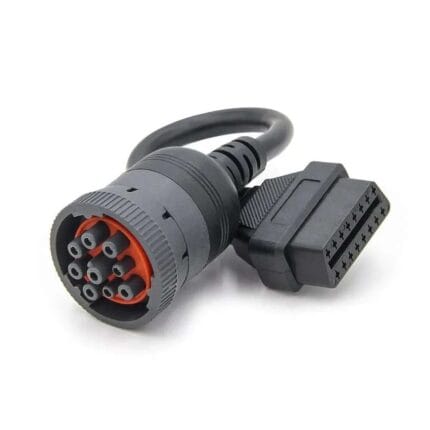
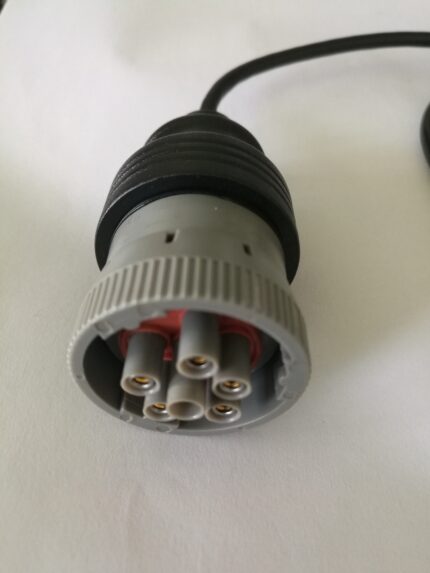
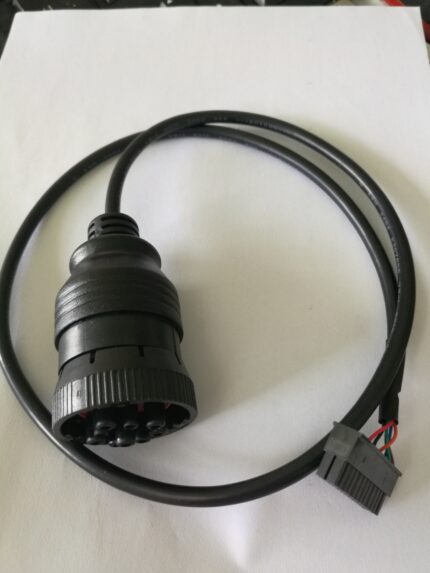
Heavy-Duty 9-Pin Industrial Diagnostic Cable Assembly
A heavy duty 9 pin cable with a 9-pin round industrial plug and a 14-pin 2x7 DIP bare end, for engine management diagnostics on trucks, marine diesel and heavy equipment benches. Verify the pinout against your service manual, since 9-pin assignments follow the engine maker rather than one specification.