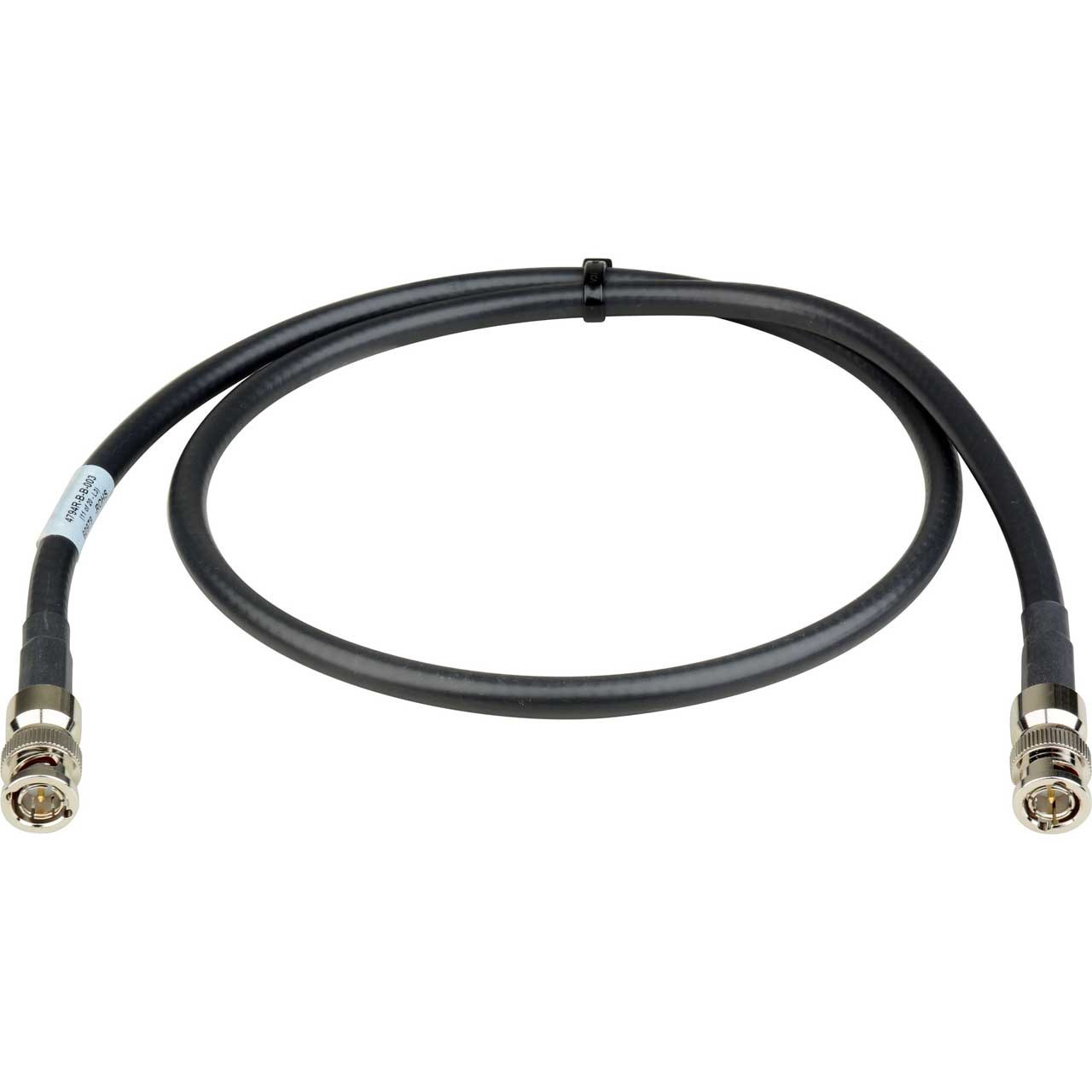
SDI BNC Cable Assembly for Studios and OB Vans
An SDI BNC cable assembly built around a 75 ohm path end to end, for SD, HD, 3G, 6G and 12G runs in studios, OB vehicles and stadium infrastructure. Straight, right angle and micro-BNC ends, color coded boots, or bulk coax with a crimp set. Reach quoted from your coax datasheet.
Overview
Broadcast runs are unforgiving because a fault shows up on air. An
SDI BNC cable assembly is the physical layer under all of it: racks and patch panels in a
studio, the drum of cable on an outside broadcast vehicle, a stadium bowl where the run is installed once
and expected to last for years. The specification that matters is not the length printed on the label. It is
whether the coax, the connectors and the crimps hold a 75 ohm path at the bit rate the facility actually
runs, because a link that is fine at one rate can fall apart at the next.
Key Specifications
| Interface | 75 ohm BNC male to 75 ohm BNC male |
|---|---|
| Coax options | Full size 75 ohm coax or mini-RG59 style (pending confirmation) |
| Connector variants | Straight, right angle, BNC to micro-BNC |
| Nominal lengths | 0.5 m to 100 m, built to order |
| Identification | Color coded boots, printed labels available |
| Field option | Bulk coax, connectors and crimp set for on-site termination |
| Compliance files | Pending supplier confirmation |
| Center conductor | 16 AWG on full size, 21 AWG on mini build (pending datasheet) |
| Impedance | 75 ohm path end to end, stated per your drawing |
| Rate grades | SD, HD, 3G, 6G or 12G, per the coax you specify |
| Return loss | Stated per your drawing and the coax datasheet |
The SDI rate grades
Serial digital interface rates are set by SMPTE, and each step up the ladder roughly doubles the bit rate
and shortens the reach. The serial digital interface family covers all five grades over the same 75 ohm coax, which
is why the rate the facility runs has to be stated before the cable is specified. Knowing which grade that
is decides the coax, the connector quality and how forgiving the run can be.
| Grade | Nominal bit rate | Defining standard | Planning note |
|---|---|---|---|
| SD-SDI | 270 Mbit/s | SMPTE ST 259 | The longest reach of the five; common on legacy and monitoring runs |
| HD-SDI | 1.485 Gbit/s | SMPTE ST 292 | The workhorse rate for HD infrastructure |
| 3G-SDI | 2.97 Gbit/s | SMPTE ST 424 | Still the default for most studio and OB builds |
| 6G-SDI | 5.94 Gbit/s | SMPTE ST 2081 | Where UHD moves onto a single link; reach has to be planned, not assumed |
| 12G-SDI | 11.88 Gbit/s | SMPTE ST 2082 | The tightest budget; favors short, clean runs with good connectors |
Those rates are the published definitions for the standards. The distance a given grade will travel is a
function of the coax, the connectors and the equipment at both ends, so we quote reach from the coax
datasheet and your measured run — stated per your drawing rather than as a generic claim.
Planning distance without guessing
A rule of thumb in the trade is that usable reach drops as the bit rate climbs, which is why 12G
infrastructure is planned on materially shorter runs than 3G. Three things decide where the limit falls.
- The coax — a thicker low loss construction carries a signal further, every time
- The terminations — a stepped-on connector will pass continuity and still fail at rate
- The equipment — a receiver with margin buys more reach than any change to the cable
For permanent runs we supply cable on the reel with connectors and a crimp set, so a technician can pull
first and terminate on site to the measured length, with no wasted slack to coil.
Return loss and why 75 ohm means 75 ohm
Return loss measures how much signal is reflected back toward the source instead of reaching the
receiver, and reflections are what turn a clean eye pattern into an intermittent fault on the longest run in
the building. Two causes dominate: an impedance discontinuity at a connector, and mixing 50 ohm parts into a
75 ohm path.
A 50 ohm plug may mate with a 75 ohm jack, and it will work at low rate while destroying return loss at
3G and above. Every part in this assembly — coax, plugs, adapters, patch panel — is 75 ohm, and the return
loss figure your build is verified to is the one stated on your drawing.
Cable and connector choices
Two coax constructions cover most of the work. Full size 75 ohm coax with a heavier center conductor
suits permanent runs inside a building, where the cable is dressed into tray or conduit and never coiled
again. A thinner mini-RG59 style construction suits patching inside a rack, on a camera, or anywhere the
cable has to bend tightly and stay light. Tell us which job the assembly has to do and we will build to it
rather than shipping whatever is on the reel.
Right angle and mixed connector builds
- Straight BNC to straight BNC for rack and patch work
- Right angle BNC where a rack door or a camera body leaves no clearance
- BNC to micro-BNC for compact camera and monitor bodies
- Color coded boots and printed labels for identifying channels in a dense patch field
Care in service
Do not coil the assembly by wrapping it around an elbow, and keep it out of the path of vehicle wheels on
an OB site. Inspect the connector shoulders after a tour; a plug that has been stepped on usually still
passes a continuity check but will not hold impedance. On permanent installs, label both ends with the same
identifier so a fault can be traced without tone testing the whole rack.
Typical applications for this SDI BNC cable assembly
- Studio racks, patch panels and machine room infrastructure
- Outside broadcast vehicles and flyaway kits, where a 12G-SDI coax cable assembly covers the UHD lanes
- Stadium and arena bowls with a single install expected to last for years
- Camera to monitor and camera to CCU patching on location
- Facilities that also run a long HDMI path, using an active optical HDMI cable at the display end
How to specify your build
- Rate grade — SD, HD, 3G, 6G or 12G, and whether the facility is mixed.
- Cable construction — full size or mini, and what the run has to bend around.
- Ends — straight, right angle, or BNC to micro-BNC.
- Length — measured on site, or on the reel for field termination.
- Identification — boot colors and printed labels for the patch field.
- Return loss — the figure you need, per your drawing and the coax datasheet.
- Quantity, and whether you want assemblies or bulk coax with a crimp set.
Workmanship and testing
ISO 9001 covers the system and IPC/WHMA-A-620 Class 3 covers the work on SDI BNC builds, across 32 to 12 AWG. No SDI unit is packed until continuity and pinout check out, and seal checking is quoted whenever an ingress rating is on the drawing.
Material declarations against RoHS and REACH are issued per project, alongside the dimensional and electrical reports agreed at quotation; see certifications, compliance and material declarations. Where your drawing names a UL style or another approval, the build follows your drawing and ships with the supporting document rather than a claim of our own. Where this build needs an overmold, the tool is designed, cut and maintained in our own shop under the overmold tooling we build in-house, and it is never used for another customer’s program. Related reading: what stage and studio work demands.
Custom builds and ordering
SDI BNC lots run from 1 to 50 pcs, out in 3 working days. Volume starts at MOQ 500 pcs shipping 14 working days after approval. Tooling not already held adds around 10 working days. SDI orders go out under your part number and labeling, OEM or ODM, and material certificates with first-article reports are available.
Related video assemblies
- 12G-SDI Coax Cable Assembly, BNC to BNC
- Active Optical HDMI Cable for Boardrooms and Ceiling Projectors
- Ultra High Speed HDMI Cable for 8K Video Walls
- SMA to BNC RF Coax Patch Cable, 50 Ohm RG-58 — for 50 ohm RF work, not for SDI runs
- 3G-SDI BNC Video Cable, 75 Ohm, Dual Copper Braid
Full range: audio and video cable assemblies.
Frequently Asked Questions
Can I use a 50 ohm BNC plug on a 75 ohm run?
It may mate, but it creates an impedance discontinuity that destroys return loss. At 3G and above that
shows up as an intermittent fault on the longest run. Keep the whole path at 75 ohm.
How far will 12G go?
Materially less far than 3G on the same coax. We quote reach from the datasheet and your measured run
rather than a single number.
Do you supply cable on the reel for on-site termination?
Yes. Bulk coax with connectors and a crimp set is a standard option, so the run is pulled first and
terminated to the measured length.
Will a stepped-on connector still test good?
Usually yes on continuity, which is why continuity alone is not the test. Inspect the shoulders and the
crimp after a tour, and retire anything crushed.
| Interface | 75 ohm BNC male to 75 ohm BNC male |
|---|---|
| Coax options | Full size 75 ohm coax or mini-RG59 style class |
| Connector variants | Straight, right angle, BNC to micro-BNC |
| Nominal lengths | 0.5 m to 100 m, built to order |
| Identification | Color coded boots, printed labels available |
| Field option | Bulk coax, connectors and crimp set for on-site termination |
| Compliance files | Stated per your drawing |
| Center conductor | 16 AWG on full size, 21 AWG on mini build class |
| Impedance | 75 ohm path end to end, stated per your drawing |
| Rate grades | SD, HD, 3G, 6G or 12G, per the coax you specify |
| Return loss | Stated per your drawing and the coax datasheet |