3G-SDI BNC Video Cable, 75 Ohm, Dual Copper Braid
A 3g sdi bnc cable built on true 75 ohm precision coax with dual copper braid, terminated BNC to BNC for broadcast cameras, routers and video racks to the reach you state.
Overview
This 3g sdi bnc cable carries a serial digital video signal between equipment that expects a coaxial path: cameras, routers, monitors and distribution frames in broadcast, production and fixed video installations. One coax, one channel, and a connector interface that has stayed recognizable for decades.
SDI is specified in rate steps rather than as a single standard, and 3G occupies the band most working facilities still live in. Higher rates exist for 4K contribution and UHD plant, lower ones remain everywhere in legacy plant, but the bulk of day-to-day HD infrastructure was built around this rate. Stocking a cable purpose-built for it, rather than an unspecified video coax, is usually the cheaper decision over a facility’s life.
Key Specifications
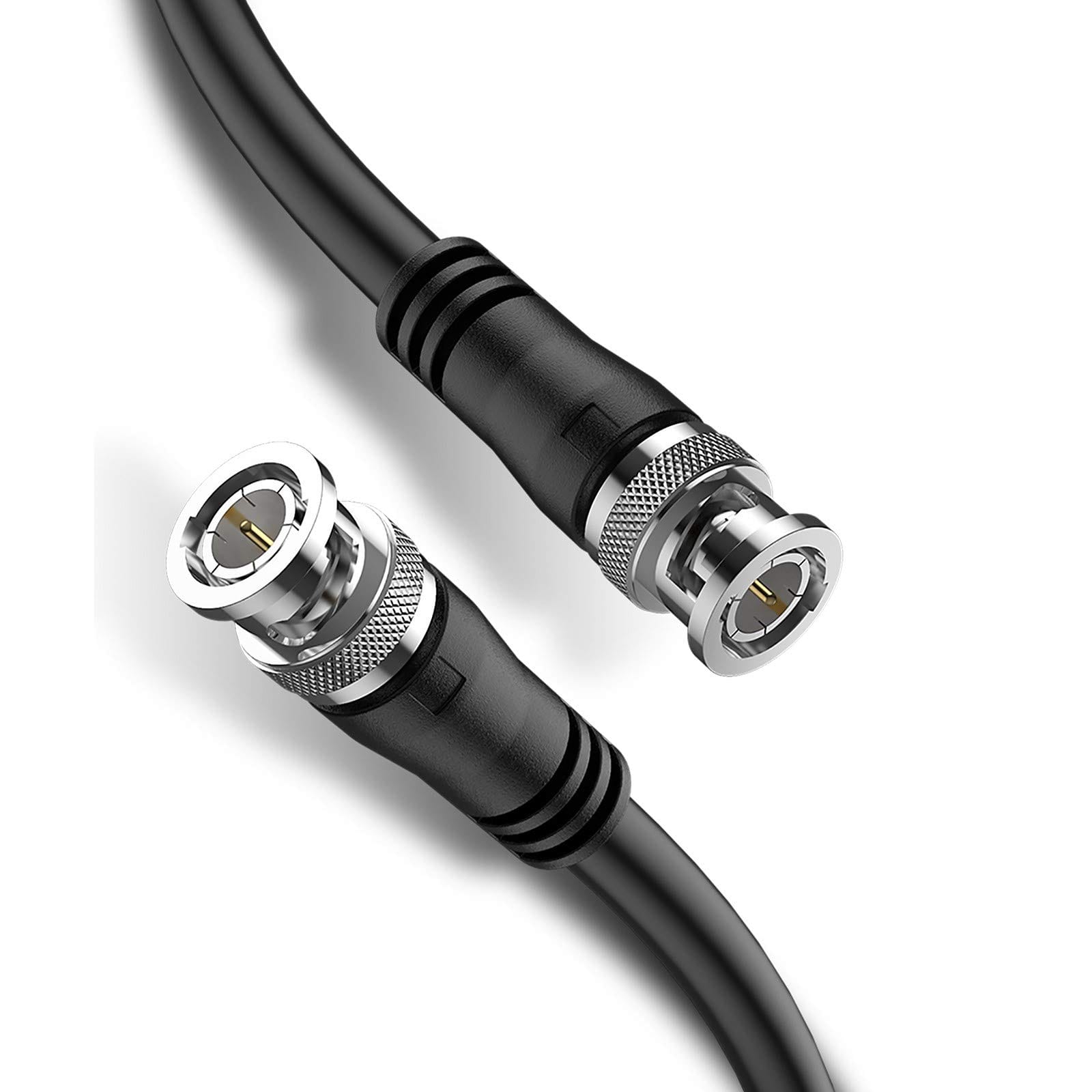
The table below lists the configuration shown in the product photo.
Why the 75 Ohm Figure Governs Everything
Coaxial video does not tolerate imprecision in the one parameter that matters. Every element of the chain — cable, connector, jackfield, patch panel, equipment input — is designed around a single characteristic impedance, and SDI infrastructure uses 75 ohm throughout. Any part of the run that departs from it reflects signal energy back toward the source.
Reflections are the mechanism behind the classic symptoms of a bad video cable: a picture that works fine for twenty metres and fails at thirty-five, or works on one camera and not another, or breaks and recovers when somebody touches the connector. The picture does not fade politely; it tends to fall apart abruptly once the accumulated reflection passes what the receiver can recover.
Speed Grades: Reading the Rate Steps
SDI is documented as a family of rates, each covering a set of formats, and equipment is built to a particular step. A facility running HD at standard frame rates has different headroom requirements than one carrying UHD, and specifying cable to the rate actually in use avoids both overspending and mystery faults.
The practical consequence for ordering is that a higher-rated cable generally substitutes downward without trouble, while assuming that any video coax will serve any rate is how intermittent faults get installed into racks. Match the cable to the highest rate the run will ever need to carry, including future equipment.
Construction and Materials
The dielectric, conductor and shield geometry are what set the characteristic impedance, so this is not a place where a generic coax is close enough. Shielding is a dual copper braid rather than a single braid over foil: two coverage layers with copper rather than a plated substitute, because shield effectiveness at video frequencies depends on coverage and conductivity together, and poor coverage is what lets external interference reach a signal that has very little amplitude left by the time it arrives. Braid count and coverage are confirmed against each build, since portable and permanent runs do not ask the same thing of a shield.
The BNC terminations are crimped to suit the cable exactly. An ill-matched crimp is one of the most common causes of impedance discontinuity in otherwise good installations, and it is introduced at the bench rather than designed in.
The jacket is chosen for the environment the cable will actually see: permanent install, portable snake use, or outside broadcast where the same run gets coiled and uncoiled daily.
Typical Applications for a 3G SDI BNC Cable
Broadcast and production facilities use these as the everyday interconnect between cameras, routing switchers, multiviewers and monitors — the runs nobody thinks about until they fail during a live shot.
House of worship and venue installations use them for camera positions feeding a production desk, often over lengths where cable choice genuinely matters.
Broadcast monitoring and quality control areas rely on predictable behavior, because a cable that marginally passes makes picture assessment unreliable.
Portable production and outside broadcast kits round out the list: shorter assemblies built to survive being coiled, stacked and driven to site, then expected to work first time.
How Far a 3G SDI BNC Cable Carries the Signal
Distance is the single most important variable after impedance. Every coax attenuates more at higher frequency, and the amount that arrives at the receiver is what decides whether a link is robust or marginal. A run comfortably inside its distance budget behaves predictably; one at the edge fails when the connector ages slightly or the temperature changes.
Plan for that margin rather than for today’s measurement. Leave headroom, keep runs as short as the layout allows, and treat any link operating near its limit as a fault waiting for the right afternoon.
Compatibility and Fitment
The BNC interface is standard across the Industry and mates with conventional 75 ohm jacks, patch panels and equipment ports. Confirm the impedance of everything else in the path: a single 50 ohm element anywhere in the chain causes exactly the reflection problems described above.
Tell us the connector gender combination at each end, whether right-angle bodies are needed to clear a rack rail or equipment handle, and the longest run the assemblies have to serve.
Installation Notes
Respect the bend radius. Crushing a coax changes its impedance locally and creates a reflection point that no amount of equipment adjustment will fix.
Do not mix impedance families on one run, including adapters and barrels. The weakest element decides the behavior of the whole path.
Support long vertical runs so the connector is not carrying the cable’s weight, and strain-relieve portable assemblies where they get pulled out of a rack.
Custom Builds and Ordering
Lengths, jacket construction, connector combinations and labeling are built to order. Send the longest run and the highest rate the assembly has to carry and we will quote the 3g sdi bnc cable build to suit. Prototype and sample lots run from 1 to 50 pieces and ship in 3 working days; production orders start at 500 pieces per part number and ship 14 working days after approval, with new overmold tooling adding about 10 working days.
Packaging and Shipping
Assemblies ship coiled, never folded, with dust caps on the connectors, individually bagged and labeled. Bulk packs available for installers.
Quality and Compliance
Each assembly is continuity tested, checked for correct center contact and shield termination, and inspected before packing. See the SMPTE standards organization for the governing application area.
RoHS and REACH declarations are provided per project together with the agreed test reports; the documentation scope is listed under certifications and compliance. If your drawing specifies a UL style, we build to that drawing and supply the UL reference with the shipment instead of substituting an equivalent. The molded body is shot on our own presses; material choice and bond behavior follow the process described under overmolding and injection molding. More background: cable assemblies for broadcast and pro AV. Any tooling we cut for this part stays yours, maintained in our own tool room under your part reference.
Frequently Asked Questions
Can this be used for higher-rate signals? Match cable to the highest rate the run will carry, including future equipment needs.
Why not use ordinary CCTV coax? Impedance accuracy and shield quality differ, and both govern how far a signal travels.
Are right-angle connectors available? Yes. Useful where clearance at equipment ports or rack rails is limited.
Can you build to a specified length? Yes. Every 3g sdi bnc cable is built to the length you state; give us the longest run and we will quote to suit.
Related Cable Ranges
Browse the related ranges: Audio Video Cable Signal and Data Cables Custom Wire Harnesses.
For the highest rate class compare the 12G-SDI coax cable assembly.
| Product type | 3G-SDI coax cable assembly, BNC to BNC |
|---|---|
| Connector A | BNC male, 75 ohm, straight or right angle |
| Connector B | BNC male, 75 ohm, straight or right angle |
| Impedance | 75 ohm precision SDI coax |
| Signal | 3G-SDI to SMPTE ST 424; HD-SDI to SMPTE ST 292 and SD-SDI to SMPTE ST 259 on request |
| Shielding | Dual copper braid – confirm per build |
| Jacket | Flexible PVC or low-friction PUR, build to order |
| Return loss | Stated for the build, measured per order |
| Length | OEM build to the reach you state |
| Marking | Labels with your part number or rack position |
| Typical applications | Broadcast cameras and monitors, routing switchers, OB trucks, video monitoring racks, live event and house-of-worship video |
| Order quantity | Prototype 1 to 50 pieces; production from 500 pieces |
Related products
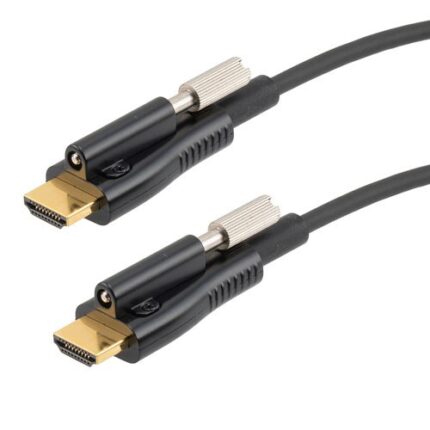
Active Optical HDMI Cable for Boardrooms and Ceiling Projectors
An active optical HDMI cable puts the high speed signal path onto fiber so a long boardroom or ceiling projector run stays slim enough to pull through conduit. Marked source and display ends, aramid strength member, hybrid copper for power and control. Tell us the route and we quote the length with a service loop.