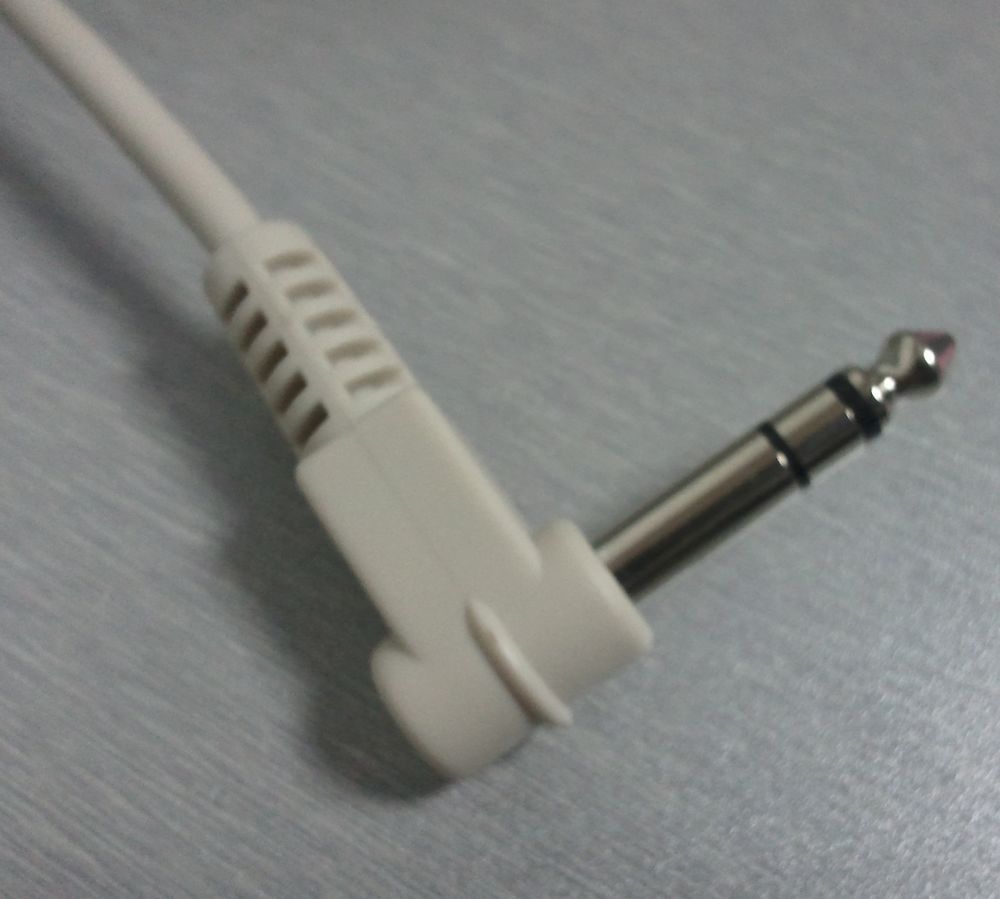
6-35mm TRS 90 Degree Audio Cable
A 6 35mm trs audio cable with a 90 degree right-angle plug for instruments, mixers and rack gear in tight spaces. Balanced mono, unbalanced stereo or insert wiring, far end stripped, TRS, TS or XLR to your drawing.
Overview
This 6.35mm trs audio cable carries a three-conductor 6.35 mm plug
whose head sits at 90 degrees, so the cable leaves the equipment flat against the chassis instead of
standing out where it gets knocked and where it levers against the jack. Three contacts open up three
different jobs: balanced mono, unbalanced stereo, and the send-and-return insert point on a mixer. The
plug looks identical in all three cases, which is where the confusion starts. The far end is built to
your specification – stripped and tinned, a straight 6.35 mm plug, or a different connector such as
XLR.
Key Specifications
| Connector A | 6.35 mm (1/4″) TRS male, 90 degree right-angle, gray PVC housing |
|---|---|
| Connector B | Stripped / tinned, or a 6.35 mm TRS / TS / XLR – by build |
| Cable Length | Custom on request |
| Jacket | Black PVC |
| Application | Guitars, keyboards, mixers and rack gear in tight spaces |
| Contact | Nickel-plated brass tip |
| Conductor | Stranded copper |
| Strain relief | Molded boot at the right-angle plug |
| Wiring | Tip, ring and sleeve, unbalanced stereo or balanced mono |
| Build | Far end, length and pinout per your drawing |
Three jobs for one 6 35mm trs audio cable
Read tip, ring and sleeve as three wires and the confusion disappears. What changes between jobs is
what those three wires connect to at each end, and one of the three is a trap for anyone who assumes a
three-conductor plug means stereo audio. The three-contact
phone
plug has been used for all of them for decades, which is why the plug alone never tells you the
answer.
| Job | Tip | Ring | Sleeve | Watch out for |
|---|---|---|---|---|
| Balanced mono line | Signal hot | Signal cold | Screen | Sending it into an unbalanced input loses 6 dB and the noise rejection |
| Unbalanced stereo | Left | Right | Common | Two channels share one return, so crosstalk rises with the run length |
| Mixer insert point | Send | Return | Common | It is two signals in opposite directions on one plug, not a stereo pair |
| Headphone output | Left | Right | Common | Do not connect a headphone output to a line input without a level pad |
Tell us which of these the plug has to do, and the wiring, the screen bond and the test are set up
for that job rather than for a generic three-wire continuity check.
Balanced or unbalanced, and what happens when you mix them
A balanced connection sends the signal twice, once inverted, and subtracts at the receiving end. Any
noise picked up along the cable arrives identically on both conductors and cancels in the subtraction,
which is why a balanced run survives a long stage cable next to a lighting dimmer. An unbalanced
connection has one signal conductor and a screen that doubles as the return, so whatever the screen
picks up is added to the signal.
- Balanced output to unbalanced input usually works, at half the level, with the
noise rejection lost. - Unbalanced output to balanced input works, with the cold leg sitting at ground;
you keep the grounding benefit and lose the common-mode rejection. - Guitar and instrument outputs are unbalanced by definition, so a TRS lead buys you
nothing there; use a two-conductor TS lead instead. - For a run longer than a few meters, balance it: use
a TRS to XLR lead and balanced
XLR cable for the distance.
Which way should the right-angle plug exit?
The 90 degree head exists for clearance, and it introduces a decision the straight version does not
have: which way the cable leaves the plug. Get it wrong and the lead folds back across the jacks next
to it, or presses against the rack rail. Specify it from the equipment rather than from the
connector.
- Measure the clearance in front of the jack with the lid or the rack door closed.
- Decide the exit direction from the cable route, and mark it on the drawing.
- On a patchbay or a row of jack fields, check the pitch: a right-angle head can be wider than the
spacing between jacks. - Where the panel is opened often, fit a panel-mount socket and keep this lead inside the
enclosure.
How these plugs actually fail
A right-angle plug takes side load that a straight plug never sees, and the usual failure is at the
molded boot rather than at the contacts: the conductors work back and forth until one breaks inside
the insulation where nobody can see it. The symptom is intermittency that changes when you wiggle the
boot. Retire the lead at the first sign of that. Put the strain relief on the chassis rather than on
the plug, using a clamp or a tie where the cable leaves the equipment, and leave a little slack so
nothing pulls on the jack. Wipe the plug tip occasionally as well: a nickel-plated contact with a film
of handling oil on it causes more crackle in a quiet room than most people expect.
Typical applications for this 6 35mm trs audio cable
- Stage keyboards and synthesizers where a straight plug would stand out of the chassis
- Patching between rack effects units and a mixer in a tight rack
- Insert points on a mixing desk, wired send on tip and return on ring
- Guitar and bass rigs, where the right-angle end keeps the lead clear of the strap
- Test equipment and pedalboards built around
low profile patch leads
How to specify your build
- Job – balanced mono, unbalanced stereo, or an insert point.
- Exit direction of the right-angle head, and the clearance available.
- Far end – stripped and tinned, straight TRS, TS, or XLR.
- Length, measured the way the cable will run, not as a straight line.
- Quantity, and whether this is a one-off or a production build.
6-35mm TRS 90 Degree builds are made to IPC/WHMA-A-620 Class 3 workmanship inside an ISO 9001 system, over a 32 to 12 AWG range. continuity and pinout are verified on each 6-35mm assembly before packing, and seal checking is quoted whenever an ingress rating is on the drawing.
Custom builds and ordering
For 6-35mm TRS 90 Degree builds, prototypes run from 1 to 50 pcs with a 3 working day turnaround; volume orders begin at 500 pcs and ship 14 working days after approval. Tooling not already held adds around 10 working days. OEM and ODM 6-35mm work ships under your part number and labeling, and material certificates and first-article reports are on offer.
RoHS and REACH declarations are provided per project together with the agreed test reports; the documentation scope is listed under certifications and compliance. If your drawing specifies a UL style, we build to that drawing and supply the UL reference with the shipment instead of substituting an equivalent. The 90-degree exit is formed in the tool itself; the exit options and their clearances are set out under right-angle exit tooling options. Related reading: cable assemblies for broadcast and pro AV. Any tooling we cut for this part stays yours, maintained in our own tool room under your part reference.
Related audio assemblies
- 1/4 TRS to XLR Cable 6.35 mm Balanced Lead
- XLR Microphone Cable, Balanced Three Pin
- Guitar Pedal Patch Cable with Low Profile Pancake Plugs
- 6.35mm to MIDI 5-Pin DIN Female Cable
- Balanced IEM Cable with Detachable Two-Pin and MMCX
- DMX512 Lighting Cable with 3-Pin or 5-Pin XLR
Full range: audio and video cable assemblies.
Frequently Asked Questions
Can I plug a TRS lead into a TS instrument jack?
Yes, and the ring contact lands on the sleeve, which is harmless for an instrument. It does not make
the signal balanced.
Why is my balanced signal 6 dB down?
Because the cold leg is not being used at the far end. Check that both ends are balanced, and that
the wiring matches.
Is an insert cable the same as a stereo cable?
Wiring, yes; purpose, no. An insert sends on tip and returns on ring – two signals in opposite
directions on one plug.
Can I have a straight plug instead of the right angle?
Yes. Both ends are build options, including the housing color of the plug body.
| Connector A | 6.35 mm (1/4″) TRS male, 90 degree right-angle, gray PVC housing |
|---|---|
| Connector B | Stripped / tinned, or a 6.35 mm TRS / TS / XLR – by build |
| Cable Length | Custom on request |
| Jacket | Black PVC |
| Application | Guitars, keyboards, mixers and rack gear in tight spaces |
| Contact | Nickel-plated brass tip |
| Conductor | Stranded copper |
| Strain relief | Molded boot at the right-angle plug |
| Wiring | Tip, ring and sleeve, unbalanced stereo or balanced mono |
| Build | Far end, length and pinout per your drawing |