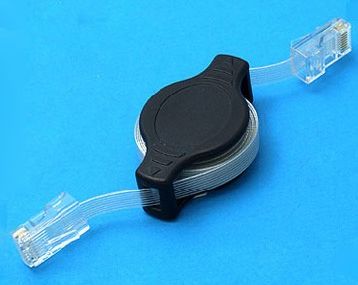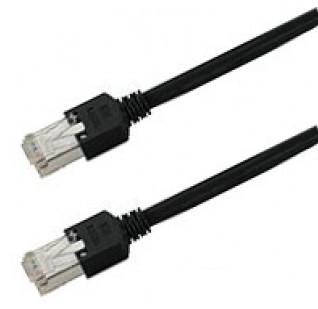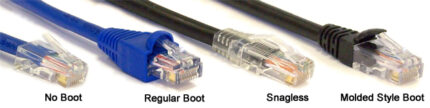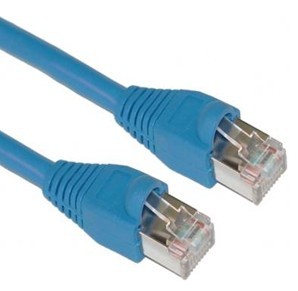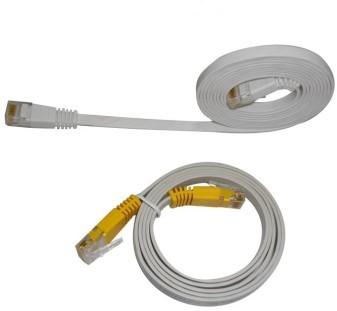
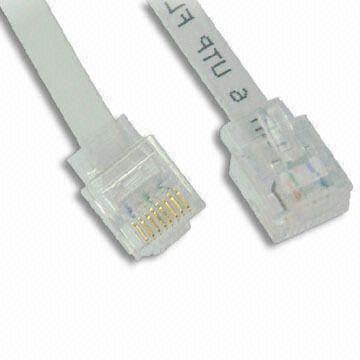
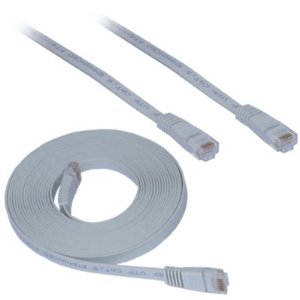
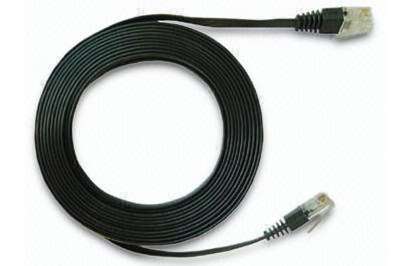
Flat Slim Cat6 / Cat5e UTP Patch Cord (4-Pair, Snagless Boot)
A flat slim cat6 cat5e utp patch cord for the gaps a round cord will not fit: under doors, along baseboards and behind wall-mounted kit. T568B, snagless boot, OEM lengths.
Overview
A flat slim cat6 cat5e utp patch cord exists to solve a physical problem, not an electrical one: there is a gap under a door, a skirting board that will not close over a round cord, or a cabinet that sits 12 mm off the wall. Flattening the cross-section lets the cord lie in that gap instead of holding the door open. The trade-off is conductor size and mechanical protection, so a flat cord is a short-run tool rather than a general-purpose patch.
Key Specifications
| Cable type | Flat slim Cat6 / Cat5e UTP, 4-pair |
|---|---|
| Cross-section | Approx. 1.6 x 6.8 mm, stated per order |
| Conductor | 4-pair 32 AWG (Cat6) / 30 AWG (Cat5e), stranded |
| Wiring | T568B standard, T568A on request |
| Boot | Snagless, low-profile |
| Connector geometry | IEC 60603-7 compliant RJ45 8P8C |
| Jacket | PVC standard; LSZH on request |
| Length | OEM build, short runs recommended |
| Category reference | ANSI/TIA-568 and ISO/IEC 11801, industry-general definition |
Where a flat cord actually earns its place
- Under interior doors and across thresholds where a round cord will not close the gap
- Along baseboards and skirting, where the cord has to sit flush against the wall
- Behind wall-mounted displays, kiosks and furniture with no clearance at the back
- Under carpet tiles and floor mats in temporary or demo installs
- Inside shallow service cavities and display cases
- Anywhere the cord is walked on — flat cords take foot traffic better than round ones
Flat versus round: what you trade away
Both are four-pair twisted-pair construction to the same category reference. What changes is geometry, and geometry drives everything else.
| Flat slim | Round standard | |
|---|---|---|
| Cross-section | Roughly 1.6 x 6.8 mm | 5.5 to 6.5 mm diameter |
| Conductor | 30 to 32 AWG | 23 to 26 AWG |
| Bend direction | Bends easily across the flat axis | Bends in any direction |
| Crush resistance | Low — a chair foot flattens it | High — jacket and fillers protect the pairs |
| Practical length | Short runs | Full channel length |
| Crosstalk margin | Tight; depends on lay and pair spacing | Comfortable |
The category itself is set by the channel limits in ANSI/TIA-568 and the ISO/IEC 11801 series — the Category 5 cable class is defined to 100 MHz and the Category 6 class to 250 MHz as industry-general figures. Your assembly is built and verified to the values stated per order.
Why slim cords stay short
Thinner conductor means higher resistance per meter. That shows up in two places: insertion loss over the run, and heating when the cord carries PoE. Both get worse with length. A flat cord is the right tool at 0.5 to 3 m; at 15 m a round cord is cleaner electrically and mechanically. If the run has to carry PoE to a camera or an access point, say so on the order — we will quote the gauge that carries it, and the rating will be stated per your drawing rather than guessed.
Where not to use one
- Long horizontal runs inside a wall or ceiling void
- Anywhere the cord is stapled, pinched or bundled tight
- Industrial panels with drives nearby — use a shielded round cord instead, such as our Cat5e FTP Shielded Patch Cord
- Outdoor or wet locations, where the flat jacket takes water along its length
- High-density patch bays, where a flat cord does not dress neatly into a manager
Typical applications for this flat slim cat6 cat5e utp patch cord
- Door-gap and threshold links between rooms on the same floor
- Wall-mounted TV, kiosk and signage drops with no rear clearance
- Hotel and classroom furniture runs
- Trade-show and demo booths, where the cord has to disappear under carpet
- Under-desk runs where a round cord snags the chair
How to specify your build
- Length — measure the actual path, including the turn at the door.
- Category — Cat5e class or Cat6 class, and what the far end device needs.
- Wiring — T568B is the default; T568A on request.
- Boot — snagless slim boot, or a low-profile boot if the port is recessed.
- Jacket and color — PVC in standard colors, LSZH for public buildings.
- PoE or not, and the expected current draw.
Workmanship and testing
Assembly and inspection follow IPC/WHMA-A-620 Class 3 workmanship criteria under our ISO 9001 quality management system, and every unit is 100% continuity and pinout tested before it is packed. Conductor range is 32 to 12 AWG. We check the lay length and pair geometry on the first article before the run starts. Where a standard sets a limit for the category, the connector interface or the jacket, that is the industry-general definition of the rating. The values your assembly is built and verified to are the ones stated on your drawing, per order.
RoHS and REACH declarations are provided per project together with the agreed test reports; the documentation scope is listed under certifications and compliance. If your drawing specifies a UL style, we build to that drawing and supply the UL reference with the shipment instead of substituting an equivalent. Termination, molding and verification happen in-house see cable assembly and wire harness production so the process that made your sample is the process that runs the order. The wider context is covered under our industrial automation work. Any tooling we cut for this part stays yours, maintained in our own tool room under your part reference.
Custom builds and ordering
Flat Slim Cat6 / lots run from 1 to 50 pcs, out in 3 working days; volume starts at MOQ 500 pcs shipping 14 working days after approval. Flat orders go out under your part number and labeling, OEM or ODM, and material certificates with first-article reports are available. New tooling adds about 10 working days, and we hold 100 sets of mold tooling in house.
Related slim and low-profile patch cords
- Cat5e UTP Snagless Patch Cord
- Cat5e UTP Short-Body Patch Cord for VoIP
- Cat6A Slim Patch Cord, 28 AWG S/FTP
- Cat6A UTP Patch Cord, 28 AWG
- Cat6 UTP Patch Cord
- Cat5e UTP Patch Cord
Full range: Ethernet patch cord range.
Frequently Asked Questions
Can a flat cord go under a door that closes on it?
That is the main reason to buy one. The flat cross-section takes the compression that would deform a round cord and break the pairs inside it.
Will it run Gigabit?
Over short runs, that is what it is built for. For anything long, or for PoE at real current, use a round cord — tell us the length and the load and we will say which.
Do you make flat cords in Cat6A?
Yes on request, and it is a harder build because the pair isolation has to survive flattening. Ask for the Cat6A slim build if the run needs 500 MHz class performance.
Can I get it in white to match a skirting board?
Yes. Standard jacket colors are stocked and custom colors are quoted with the order.
| Conductor | 4-pair 32 AWG (Cat6) / 30 AWG (Cat5e), stranded |
|---|---|
| Wiring | T568B standard, T568A on request |
| Category reference | ANSI/TIA-568 and ISO/IEC 11801, industry-general definition |
| Boot | Snagless, low-profile |
| Connector geometry | IEC 60603-7 compliant RJ45 8P8C |
| Cable type | Flat slim Cat6 / Cat5e UTP, 4-pair |
| Cross-section | Approx. 1.6 x 6.8 mm, stated per order |
| Jacket | PVC standard; LSZH on request |
| Length | OEM build, short runs recommended |