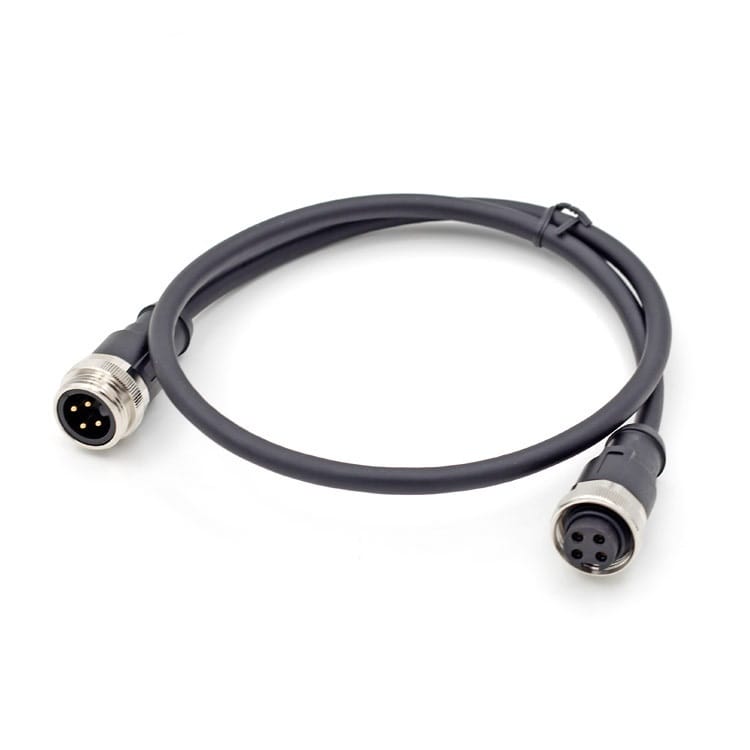
Overmolded Industrial Cable Assembly, Custom Strain Relief, IP67
An overmolded industrial cable assembly with custom strain relief geometry and sealed exits, built from your drawing or sample for machines, sensors and field equipment.
Overview
An overmolded industrial cable assembly replaces the weak point of every industrial cordset — the line where the cable stops and the connector begins — with a single molded body. Instead of a strain relief clamped onto a finished cable, the molding is formed directly over the terminated conductors, so the joint is not assembled on site and cannot be assembled wrongly.
This is the construction we use across our cable ranges, offered here as a defined product so that the capability itself has somewhere to be specified and quoted. Send a drawing or a sample and the geometry — the shape of the strain relief, its length, how it transitions to the jacket — is built to it.
Key Specifications
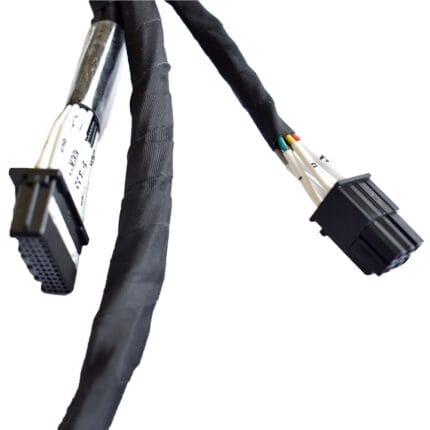
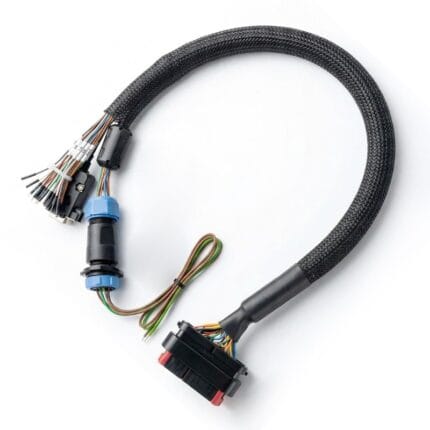
The table below lists the configuration shown in the product photo.
What Overmolding Actually Fixes
Take a conventional cordset apart and the failure points cluster in one place. There is the crimp where conductor meets contact. There is the grommet or clamp meant to stop cable movement reaching that crimp. And there is the small annular gap between jacket and shell where capillary action draws moisture inward, quietly, over months.
A molding formed over the whole assembly addresses all three at once. Encapsulation locks the conductors so flexing cannot fatigue the crimps. The strain relief becomes part of the body rather than a separate part that can be fitted loosely or omitted. And the encapsulation closes the path moisture used to travel, so the sealing line ends up at the connector face, where it belongs and where it can be inspected.
Molded Body Versus Assembled Strain Relief
An assembled strain relief — clamp, boot, heat shrink, whichever — relies on friction against the jacket to transfer load. It works, and it is the right answer for a lot of applications, but it has a defined service life. Under sustained vibration, repeated flexing at one spot, or a jacket that has stiffened with age, the grip relaxes and load begins to reach the crimp.
Molding asks the tooling question instead of the assembly question. It costs tooling up front and nothing per unit thereafter, which is why it suits production runs rather than one-offs, and why the payback is longest exactly where reliability matters most.
Where the Tooling Cost Makes Sense
The honest answer is that molding is a production decision, not a preference. There is tooling to design, prove and maintain, and it pays back over volume. For a prototype run or genuine one-off it may not be worth it, and we will say so.
Where it consistently pays: anything going onto equipment that is vibration-prone, washed down, moved regularly, safety-related, expensive to access for repair, or shipped to customers who will judge your machine on whether its cables fail. In those cases the cost of one field failure dwarfs the tooling.
Construction and Materials
The molding material is chosen to bond with the cable jacket rather than merely sit against it, because a mold that grips by mechanical interference alone will eventually let moisture find the interface. The body is designed with a gradual transition from rigid adapter section to flexible strain relief so the cable does not meet a hard edge where it leaves the mold.
Conductors are terminated before molding and inspected before encapsulation, since nothing inside the body can be repaired afterwards. That sequencing is the reason prototype approval exists: the electrical build is verified, then sealed.
Shielded builds terminate the screen into the molding so the drain has somewhere continuous to go, instead of ending in an unsealed stub.
Typical Applications for an Overmolded Industrial Cable Assembly
Field instruments and mobile equipment are the strongest case — anything that is carried, dragged, or connected by someone who is not thinking about the cable.
Machine builders use these where a machine’s reliability is judged by its customer, because a failed connector on an otherwise sound machine is remembered far more than the million cycles it survived.
Washdown food and beverage plant use sealed versions where hoses are routine, and outdoor installations use them where ultraviolet and water get into every non-molded joint eventually.
Instrumentation and measurement leads benefit in a quieter way: strain relief that does not move keeps contact resistance stable, which matters when what is being measured is a small signal.
Specifying an Overmolded Industrial Cable Assembly
The useful information is not the connector part number. It is what the cable has to survive: how many mating cycles, what it is cleaned with, whether it is flexing continuously or held still, what it gets pulled by, and where the failure would be most expensive.
Second is geometry: space around the port, direction the cable has to leave, and anything the body has to clear. A right-angle body, for instance, is molded in one orientation and cannot be rotated afterwards, so the exit direction has to be decided before tooling.
Compatibility and Fitment
This product is specified by drawing rather than selected from a catalog. Tell us the connectors at each end, the conductor count, the environment, and the geometry constraints, and we will propose both the cable construction and the molding.
Where you already have a sample that works except for one detail — too stiff, wrong exit direction, jacket that cracks in cold — bring that instead. Reverse-engineering an existing part is frequently simpler than specifying a new one from scratch.
Custom Builds and Ordering
Core count, jacket material, shielding, geometry, length, color and labeling are built to order. Send a drawing, a sample, or a description of what is currently failing and we will quote the overmolded industrial cable assembly with tooling plus piece price. Prototype and sample lots run from 1 to 50 pieces and ship in 3 working days; production orders start at 500 pieces per part number and ship 14 working days after approval, with new overmold tooling adding about 10 working days.
Packaging and Shipping
Assemblies ship bagged and labeled by part code, coiled rather than folded. Test reports can accompany production batches on request.
Quality and Compliance
Every assembly is continuity tested and inspected for full encapsulation before packing; sealed builds are leak tested. Prototype approval precedes any production tooling, so nothing is sealed before it is verified. See the IEC cabling and connector standards for the governing application area.
Frequently Asked Questions
Is this a stock part or built to order? Built to order. Every overmolded industrial cable assembly starts from your drawing or sample — that is the point of the product.
Can you match an existing sample? Usually yes, and often faster than specifying from scratch.
Can the exit direction be changed later? No. Orientation is set in the tooling and decided before production.
Is molding worth it for a small run? Sometimes not. We will tell you honestly if a simpler construction fits better.
Related Cable Ranges
Browse the related ranges: Custom Wire Harnesses Circular M-Series Cable Assemblies Automotive Wire Harnesses.
See the same construction applied on moving equipment in the cobot arm drag chain harness and in general machine builds via the custom industrial robot wire harness.
| Product type | Overmolded cable assembly, built to your drawing or sample |
|---|---|
| Core count | 2 to 24 cores, mixed signal and power in one body – confirm per build |
| Conductor range | 32 to 12 AWG, mixed in one bundle |
| Shielding | Overall braid, individual pair foil, or both |
| Jacket | PVC, PUR or TPE – stated per build |
| Ingress rating | IP67 at the molded interface – confirm per build |
| Strain relief | Molded geometry to your bend radius and pull requirement |
| Terminations | Circular, rectangular or terminal blocks per your BOM or sample |
| Tooling | Mold built to your geometry; 3,000 plus tooling sets built since 2012, 100 plus active molds maintained on site |
| Workmanship | IPC/WHMA-A-620 Class 3 under ISO 9001 |
| Typical applications | Machine tools, sensor and actuator leads, outdoor enclosures, pumps and meters, handheld field equipment, medical carts |
| Order quantity | Prototype 1 to 50 pieces; production from 500 pieces |