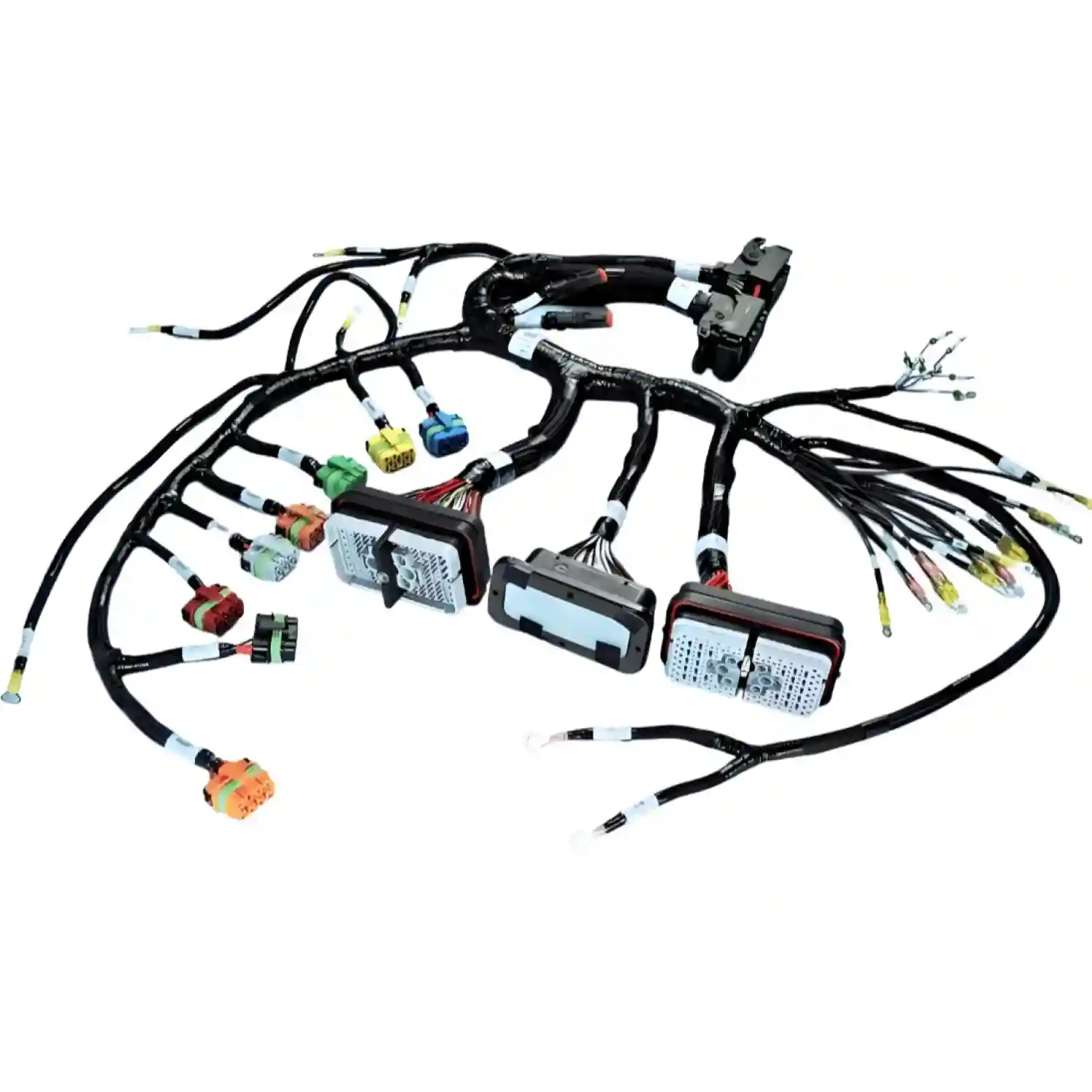
Formable Wire Harness with Position-Holding Core
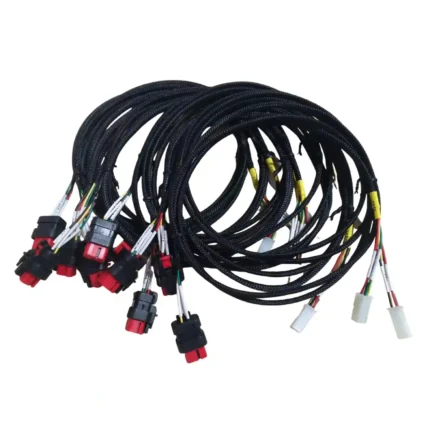
A formable wire harness keeps the routing you set, so branches that have to arch over a board or clear a fan stay put without a bracket. Copper carries the current; the stainless core only holds position.
A formable wire harness is one that keeps the routing you gave it. Usually that means part of it rather than the whole thing – one or two branches. The spur that has to arc over a board instead of resting on it, the lead that must clear a fan, the length a technician keeps shoving aside every time the door swings shut. Add a stainless shaping element to those lengths and the routing problem goes away without a bracket, a clip or a pre-formed part.
Our usual build winds enamelled copper around the steel, so current stays in the copper and the steel only holds a position. The rest of this page follows from that, starting with the clarification carried on every page in the family.
Formable versus heat-recovering alloy: settle it early
Memory wire is a label that gets stuck to two metals with almost nothing in common. Deciding which you mean takes a minute now and saves a month later.
| Stainless shaping core | Heat-recovering alloy | |
|---|---|---|
| Bend it and | It stays bent | Heat brings back the trained form |
| Why | Dislocations move and remain moved | The crystal structure swaps back and forth |
| Metal | Stainless steel | Nickel-titanium |
| Built for | Holding routing inside a machine | Movement, latching, thermal release |
| Cost | Low | High |
| Ends | Crimped, welded, or trapped by the overmold | Crimped or welded; no solder |
Ours is the middle column. If the job actually calls for a wire that springs back to a remembered curve once it is warmed, that is an actuator made from a shape memory alloy, it is sourced somewhere else altogether, and this page is not about it. Raise it in the first exchange and neither side funds a wasted sample round.
Which lengths get an element, and which should not
The commonest thing wrong with an incoming drawing is a request to make the entire harness formable. It comes out stiffer than necessary, dearer than necessary, and harder to feed into a tight enclosure in the first place. Marking two or three lengths and leaving the remainder as ordinary flexible cable is nearly always the better answer.
| Length | Element? | Reasoning |
|---|---|---|
| A spur arcing over a board or a connector | Yes | It stands in for a bracket and the fixing that goes with it |
| A lead aimed once and then left | Yes | Exactly what the construction is for |
| The trunk between two fixed points | No | Already supported; an element only adds cost and stiffness |
| Anything in a carrier or on an axis | No | Repeated flexing work-hardens the steel until it fails |
| A section unplugged and re-dressed weekly | Usually not | Re-posing is precisely what wears the winding |
Current stays in the copper
Stainless resists current around forty times as much as copper, so an element stout enough to hold a shape is neither a supply path nor an earth. Reading it as one is the second correction we most often make. Power conductors in the harness get sized in copper for the current each branch carries, exactly as they would with no element present.
Where a design does want the element bonded to the screen or used as a drain, put it on the drawing and we will build it – then tell you what that does to the resistance of the path, because the answer regularly surprises the person who drew it.
Rubbing against steel is what ends it
Here the enamelled copper rests on steel, and the steel wins. Pose the harness again and the coating is abraded once more. Abrade it enough and the coating perforates, copper touches steel, and the defect only surfaces at one particular angle – the worst sort to hunt on a test bench.
Radius drives it first, then whether a layer keeps the two metals apart, then the coating. That last item is a real fork in the road, since the two properties fight each other.
| Enamel | Off in a solder bath | Against the steel | Pick it if |
|---|---|---|---|
| Polyurethane, solderable | Yes, at the maker-stated temperature | Fair | Fast, repeatable tinning matters most |
| Polyesterimide, solderable | Yes, with a hotter bath | Good | Thermal class and solder stripping are both needed |
| Polyimide and the hard polyesters | No – chemical, mechanical or laser | Excellent | Bend life outranks stripping speed |
Solderable grades strip and tin in one controlled dip, which counts for a great deal on fine wire. The harder grades stand up to the rubbing for longer but need chemical, mechanical or laser removal – and we say which your drawing implies before we price it, not after.
Two ways the element gets joined
Stainless will not take solder the way copper will. A normal rosin flux will not break the oxide, and an aggressive one leaves deposits we do not want sealed up inside a cabinet. That leaves mechanical fixing: crimping, resistance welding, or trapping the element inside the overmold at the strain relief.
Trapping is what decides whether the assembly survives. Left loose, an element creeps back out of the strain relief over months and finishes either through the jacket or pressed into a connector. How much gets trapped depends on how often the length will be re-posed, which is one more reason to put it in writing.
Where a formable wire harness is the wrong call
Moving parts, first and last. A shaping element is pose-and-leave. Cycle it and the steel work-hardens and cracks, so anything riding an axis wants building as a flexing assembly from the outset. For carriages and robot axes, start with the drag-chain harness or the custom industrial robot wire harness.
Vibration is the second. Holding a shape is not damping; a length that buzzes against a panel will fret whatever it is made of. That one is a clamping problem and a clamp is the answer.
For the routing trouble a formable length genuinely fixes, the family runs from the memory wire composite harness and the formable probe cable through to the earphone memory wire cable. Conventional builds in the same category include the kiosk and self-service terminal harness, the energy storage cabinet wiring harness and the leak detection harness.
Seven lines for the drawing
| Write this | Because |
|---|---|
| Which lengths carry an element, marked up | All-formable is stiffer and dearer than it needs to be |
| The radius each length will be posed to | Dominates winding life |
| Conductor count and copper size | The element carries nothing |
| Coating grade, or the bend life wanted | Sets the stripping route and the yield |
| Served or bare element | A wrap keeps the copper off the steel |
| How each end traps it | Stops it creeping out of the strain relief |
| Jacket compound and the environment | Oil, heat, washdown and UV are separate calls |
How we build it
Our Longgang plant in Shenzhen runs four lines with about forty assemblers and ships near a million pieces a year, working to IPC-WHMA-A-620 Class 3 under ISO 9001. Conductors from 32 to 12 AWG, continuity and pinout verified on every unit before packing, and over a hundred tool sets cut in-house. Samples go out in three working days; production opens at 500 pcs and ships fourteen working days after approval. What your harness ends up rated for comes from the parts and the drawing, and we verify against that rather than against a figure printed here.
The discipline generally is described in the reference on the wiring harness. The rest of the range is under custom wire harnesses.
Frequently asked questions
<div class="
For a related configuration, see the Memory Wire Composite Harness, Enameled Copper on Steel Core.
hkw-faq”>
Should the whole harness be formable?
Usually not. Marking two or three lengths and leaving the rest as ordinary flexible cable comes out cheaper, less stiff and easier to feed into a tight enclosure.
Does the shaping element carry current?
No. Stainless resists current around forty times as much as copper, so power conductors are sized in copper for each branch exactly as they would be with no element present.
Can the element be soldered?
Not reliably. Stainless does not take solder the way copper does, so the element is crimped, resistance welded, or trapped inside the overmold at the strain relief.
Is this suitable for a moving axis?
No. Repeated flexing work-hardens a shaping element and it will crack. Anything on a carriage or a robot axis should be built as a flexing assembly from the outset.
What shortens the life of the winding?
Bend radius first, then whether a serving layer keeps the copper off the steel, then the enamel grade. All three are settled on the drawing rather than discovered in service.
Do you stock these?
No. Every harness is built to your drawing, which is also why no rating is printed on this page.
Each assembly is built and inspected against the drawing you send. Nothing here is a published rating.
| Construction | Enameled copper wound on a stainless shaping core |
|---|---|
| Core Material | Stainless steel shaping wire, formable / dead-set |
| Core Function | Holds position; carries no current |
| Formable Segments | Marked on your drawing |
| Conductor | Enameled copper, wound on the steel core |
| Conductor Count | Stated per your drawing |
| Conductor Size | Stated per your drawing |
| Enamel Grade | Stated per your drawing (solderable or scrape-resistant) |
| Jacket Material | Stated per your drawing |
| Overall Diameter | Stated per your drawing |
| Bend Cycles | Stated per your drawing |
| Termination | Stated per your drawing |
| Build and Inspection | IPC-WHMA-A-620 Class 3, 100% continuity and pinout, ISO 9001 |