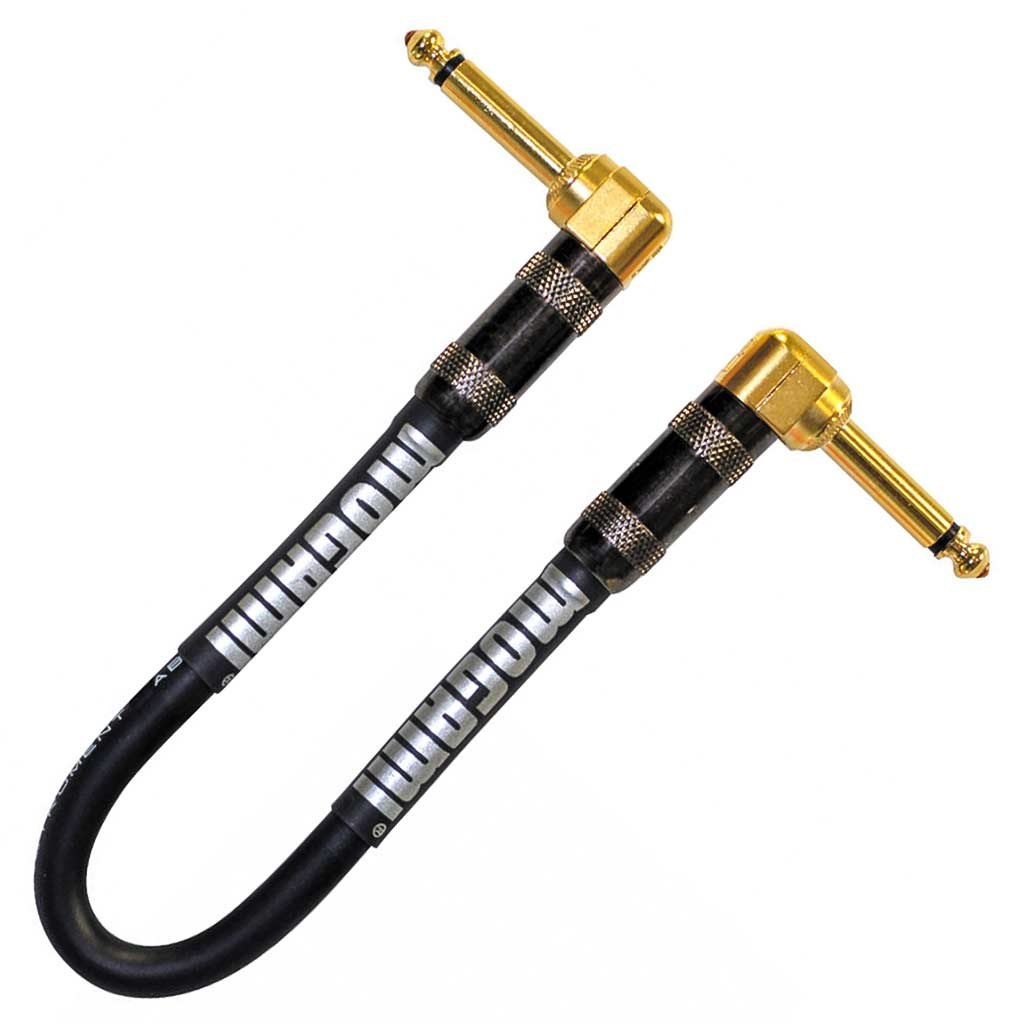
Guitar Pedal Patch Cable with Low Profile Pancake Plugs
A guitar pedal patch cable with a low profile pancake housing that sits almost flush with the jack, so pedals can be butted together on a crowded board. Straight to angled and angled to angled, six to eighteen inches, in singles or multi-packs. Built to the combinations your layout needs.
Overview
Space is the constraint that decides everything on a pedalboard. Every millimeter taken by a
connector is a millimeter that cannot hold another pedal, and a board that has to be rebuilt because a plug
will not fit between two enclosures is an evening lost. A guitar pedal patch cable with a
pancake style housing addresses exactly that: the plug body sits almost flush with the jack, so pedals can
be butted together and the leads routed underneath the row rather than looping out sideways into the lid.
Standard 6.35 mm phone connector jacks accept it without modification, so this is a straight swap on an
existing board.
Key Specifications
| Interface | 6.35 mm TS, straight or right angle pancake housing |
|---|---|
| Combinations | Straight to angled, angled to angled |
| Stock lengths | 6 in / 10 in / 12 in / 18 in |
| Solder | Silver bearing solder, 4 percent silver (pending confirmation) |
| Jacket filler | Cotton filler for shape retention |
| Packing | Singles, three pack, six pack, color sets |
| Capacitance | Not yet verified, pending measurement |
| Compliance files | Pending supplier confirmation |
| Plug body | Low profile pancake, sits flat against the jack |
| Shielding | Screened, drain bonded at the sleeve |
| Order option | Custom lengths and jacket colors on request |
Why the plug profile matters where pedals touch
A conventional barrel plug projects the full length of its body out of the jack, and then the cable needs
bend clearance on top of that. On a board where the jacks sit on the top edge of the enclosure and the next
pedal is 10 mm away, there is no room for either. The pancake housing puts the cable exit at ninety degrees
to the plug axis and flattens the body, so the assembly occupies roughly the thickness of the shell rather
than the length of a barrel.
| Constraint on the board | Conventional barrel plug | Low profile pancake housing | What to do |
|---|---|---|---|
| Jacks on adjacent pedals facing each other | Needs the plug body plus bend clearance between the enclosures | Only the shell thickness plus the cable exit | Measure the gap, then add the lid clearance before ordering a length |
| Pedal sitting hard against the board rail | Body fouls the rail and levers the jack | Sits inside the pedal footprint | Use an angled pancake on the rail side |
| Lid closing onto the board | Plug catches the lid foam and takes the strain | Flat housing takes the pressure across its face | Route the leads under the pedal row, never over it |
| Power supply mounted under the shelf | Long detour around the brick | Short run across the top of the row | Keep one longer lead to cross the board |
| Jacks on the side face of a compact pedal | Sticks out past the enclosure side | Flat against the side face | Angled to angled is usually the combination that fits |
Noise: what an unbalanced patch lead is up against
Everything on a pedalboard between the guitar and the first buffered pedal is unbalanced. The screen of
the lead is the signal return, which means any current induced in it appears directly in the audio. The
usual suspects are the switching supplies under the shelf, the transformers in a wall wart sitting next to
the board, and the lighting dimmer in the room.
- Keep patch leads short; the induced noise scales with the length of the run, not with the price of the cable
- Route leads away from the DC supply cables and cross them at right angles where they have to meet
- A patch lead is not the place to fix a ground loop; that is solved at the power supply and the amp
- A crackle when you wiggle a plug is a mechanical fault at the joint, not a shielding problem
- One bad lead in a chain of eight will be found by swapping, so buy a mixed set and keep a spare
Lengths and combinations
Most boards need a spread rather than one length: very short leads between adjacent pedals, and a couple
of longer ones to cross the board or reach an input on the far side. Stock lengths run from six inches to
eighteen inches, and we build straight to angled and angled to angled as standard combinations. Multi-packs
of three or six cover a rebuild in one order, and color sets make it obvious which lead is which when a
fault has to be traced during a soundcheck.
Solder and strain relief
The plug end is where these leads fail. The joint is soldered with a silver bearing solder for a reliable
connection on both the tip and the sleeve, and the housing clamps the cable so that a pull on the lead is
taken by the molding rather than by the solder tag. A cotton filler inside the jacket helps the assembly
hold its shape where it has to bend tightly around a pedal corner.
Capacitance and what it does to your tone
Long cable runs and high capacitance roll off the top end of an instrument signal, which players hear as
a duller tone once a chain of pedals and leads adds up. Short patch leads contribute very little to that
total, which is one reason to keep them as short as the layout allows and to spend the attention on the
longer instrument cable that runs to the amplifier instead. Published capacitance figures for this class of
lead come from competitor listings; the figure your build is made and measured to is stated per your
drawing.
Typical applications for this guitar pedal patch cable
- Dense boards where pedals have to sit shoulder to shoulder
- Touring rigs rebuilt nightly, where a flat plug survives the lid better than a barrel
- Retail and distributor multi-packs and color sets
- OEM bundles shipped with a board or a pedal, alongside a coiled 1/4 inch guitar cable
- Keyboard and synth rigs where the same low profile plug keeps a rack shelf tidy
Ordering
Buy a mixed set the first time rather than a single length, then standardize on what the layout actually
needed. For shops and distributors we supply multi-packs and color sets with custom lengths, jacket color
and printed branding on request.
Workmanship and testing
Terminations on Guitar Pedal builds run from 32 to 12 AWG, and the work is held to IPC/WHMA-A-620 Class 3 inside an ISO 9001 system. No Guitar unit is packed until continuity and pinout check out, and seal checking is quoted whenever an ingress rating is on the drawing.
RoHS and REACH declarations are provided per project together with the agreed test reports; the documentation scope is listed under certifications and compliance. If your drawing specifies a UL style, we build to that drawing and supply the UL reference with the shipment instead of substituting an equivalent. Overmold material is selected for how it bonds to the jacket, following the method set out under overmold materials and injection parameters. Related reading: what stage and studio work demands. Any tooling we cut for this part stays yours, maintained in our own tool room under your part reference.
Custom builds and ordering
Guitar Pedal prototypes start from 1 to 50 pcs and ship in 3 working days. Series supply starts at 500 pcs and takes 14 working days after approval. Tooling not already held adds around 10 working days. Guitar builds ship under your part number and labeling for OEM and ODM orders, and material certificates and first-article reports can be supplied.
Related audio assemblies
- Coiled 1/4 Inch Guitar Cable
- 6.35 mm TRS 90 Degree Audio Cable
- 1/4 TRS to XLR Cable 6.35 mm Balanced Lead for Monitors
- XLR Microphone Cable, Balanced Three Pin Male to Female
- 3.5 mm TRS to 2x RCA Cable
Full range: audio and video cable assemblies.
Frequently Asked Questions
<div class="
For a related configuration, see the Coiled 1/4 Inch Guitar Cable.
hkw-faq”>
Which combination should I buy: straight to angled, or angled to angled?
Angled to angled for adjacent pedals in a row, because it keeps both ends flat. Straight to angled where
one end has to come up over a pedal or reach an input on the far side of the board.
Will a low profile plug fit every pedal?
It fits any standard 6.35 mm jack. What it does not fix is a jack recessed deep into the enclosure, or a
pedal with the jack set into a well; check the depth before ordering if the pedal is unusual.
Do patch leads really change my tone?
At six to eighteen inches, very little compared with the cable running to the amplifier. Where they matter
is mechanically: a lead that has to be forced into a gap will fail at the plug long before it is audible.
Can I get a mixed set with my own colors and branding?
Yes. Multi-packs of three or six, custom lengths, jacket colors and printed branding are all standard OEM
options, and the packing can carry your part number.
| Interface | 6.35 mm TS, straight or right angle pancake housing |
|---|---|
| Combinations | Straight to angled, angled to angled |
| Stock lengths | 6 in / 10 in / 12 in / 18 in |
| Solder | Silver bearing solder, 4 percent silver class |
| Jacket filler | Cotton filler for shape retention |
| Packing | Singles, three pack, six pack, color sets |
| Capacitance | Stated per your drawing |
| Compliance files | Stated per your drawing |
| Plug body | Low profile pancake, sits flat against the jack |
| Shielding | Screened, drain bonded at the sleeve |
| Order option | Custom lengths and jacket colors on request |
Related products
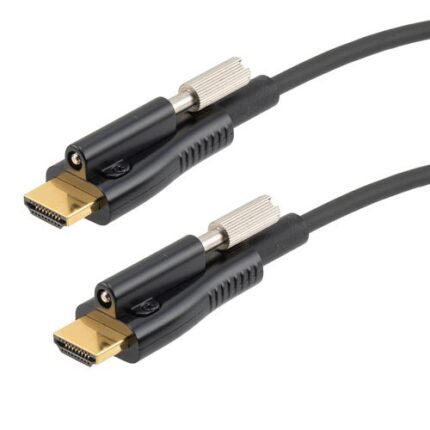
Active Optical HDMI Cable for Boardrooms and Ceiling Projectors
An active optical HDMI cable puts the high speed signal path onto fiber so a long boardroom or ceiling projector run stays slim enough to pull through conduit. Marked source and display ends, aramid strength member, hybrid copper for power and control. Tell us the route and we quote the length with a service loop.